
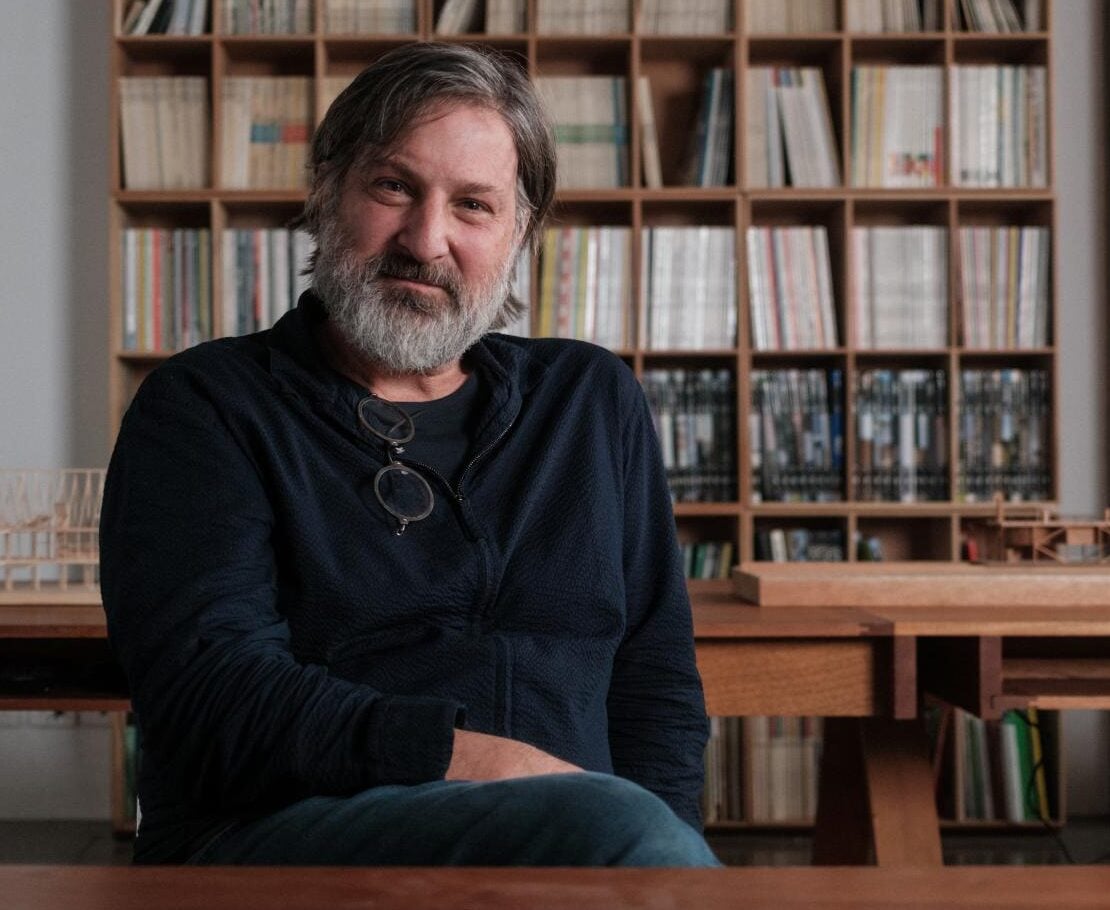

Chilean architect Smiljan Radić Clarke in Santiago, Chile, has received the 2026 Pritzker Architecture Prize for a body of work shaped by material experimentation, spatial perception, and close engagement with landscape and context. The recognition places Radić among recent laureates such as Liu Jiakun, Riken Yamamoto, David Chipperfield, and Diébédo Francis Kéré, while making him the second Chilean architect to receive the prize after Alejandro Aravena in 2016 and the fifth Latin American architect in the award’s history. Founded in Santiago in 1995, his practice has completed more than 60 projects across houses, cultural buildings, civic programs, installations, and temporary structures, while remaining deliberately compact and rooted in Chile. Works such as House for the Poem of the Right Angle, the expansion of the Chilean Museum of Pre-Columbian Art, NAVE, Restaurant Mestizo, Teatro Regional del Bío Bío, Pite House, Vik Millahue Winery, and the 2014 Serpentine Gallery Pavilion show a sustained investigation into fragility, provisional monumentality, and the emotional dimension of space. Radić’s architecture often appears lightly placed on the land, combining industrial systems with raw or local matter to produce buildings that intensify atmosphere without depending on spectacle. The jury framed that position as a distinct architectural contribution shaped by memory, climate, material intelligence, and public experience.
 Serpentine Gallery Pavilion, © Iwan Baan
Chilean architect Smiljan Radić Clarke has been named the laureate of the 2026 Pritzker Architecture Prize, one of architecture’s highest distinctions. The award recognizes a body of work shaped by material experimentation, spatial perception, and careful engagement with landscape and context. Born in Santiago, Chile, where he continues to live and work, Radić leads Smiljan Radić Clarke, the office he established in 1995. The recognition makes him the second Chilean architect to receive the prize after Alejandro Aravena in 2016 and the fifth Latin American architect to be honored in the award’s history.
Radić’s architecture occupies a territory where the phenomenological experience of space comes before explanation. His buildings often appear quiet, elemental, and resistant to immediate verbal interpretation. Rather than relying on formal declaration, they invite visitors to understand them through movement, atmosphere, light, and perception. That position has allowed his work to remain open, precise, and difficult to reduce to a single visual formula.
Material presence stands at the center of his approach. Radić places industrial components beside raw or locally sourced elements to produce buildings that are exacting and tactile. Across many projects, structures appear provisional, fragile, or lightly set on the ground. That condition suggests a deliberate acceptance of uncertainty and impermanence. His architecture privileges embodied experience, material intelligence, and a measured sense of vulnerability.
Radić has kept his practice intentionally compact since founding his studio in Santiago in 1995. Even so, the office has completed more than 60 projects across a wide range of scales and programs, including private houses, cultural institutions, civic buildings, installations, and temporary structures. Many of these works are in Chile, though his international profile expanded through commissions and exhibitions abroad, including the 2014 Serpentine Gallery Pavilion in London. Despite growing recognition, his practice has remained rooted in observation rather than institutional scale.
 Serpentine Gallery Pavilion, © Iwan Baan
Born in Santiago in 1965, Radić grew up in a family shaped by migration and cultural displacement. His paternal grandparents emigrated from Brač, Croatia, while his mother’s family came from the United Kingdom. That background informed an understanding of belonging as something assembled rather than inherited. Radić has described that condition as formative in the development of his architectural thinking.
Radić studied architecture at the Pontificia Universidad Católica de Chile and later continued his studies at the Istituto Universitario di Architettura di Venezia, an experience he regards as central to his intellectual development. During his early professional years, he began an ongoing exchange with sculptor Marcela Correa, whose work influenced his architectural thinking and with whom he has collaborated on several projects. Together, they built Casa Chica in Vilches in 1997. That early work revealed his interest in architecture as both physical construction and conceptual inquiry.
“Through a body of work positioned at the crossroads of an iconoclastic language, material exploration, and cultural memory, Smiljan Radić favours fragility over any unwarranted claim to certainty.” – 2026 Pritzker Architecture Prize Jury
 House for the Poem of the Right Angle, © Smiljan Radić
  House for the Poem of the Right Angle, © Cristobal Palma
Radić’s architecture often unfolds as a spatial experience that resists immediate verbalization. Instead of presenting a fixed formal language, his buildings invite interpretation through atmosphere, movement, and perception. House for the Poem of the Right Angle in Vilches is one of the clearest examples of that approach. Set within a forested landscape, the house is organized around thick walls and carefully placed openings that register shifting light and the passage of time. In that project, dwelling becomes an act of contemplation.
A similar introspective condition appears in the expansion of the Chilean Museum of Pre-Columbian Art in Santiago. There, Radić’s intervention takes place largely beneath the existing colonial courtyard. A subterranean gallery lit from above allows artifacts and historical continuity to remain primary. The architecture withdraws to intensify the visitor’s spatial experience. NAVE, a performing arts center created from a damaged early twentieth-century residence, follows a related logic. The original structure remains in place while rehearsal and performance spaces are inserted within it. The result functions less as a finished object and more as an adaptable setting for artistic production and collective gathering.
 Teatro Regional del Biobío, © Cristobal Palma
  Teatro Regional del Biobío, © Iwan Baan
Material experimentation plays a central role in Radić’s work, where construction often reveals unexpected relationships between industrial fabrication and raw matter. At Teatro Regional del Bío Bío in Concepción, a semi-translucent polycarbonate envelope set over a steel frame filters daylight and produces a luminous presence along the riverfront at night. The project shows how civic architecture can achieve spatial intensity without relying on conventional monumentality.
Restaurant Mestizo in Santiago’s Bicentenario Park develops a different material strategy. A horizontal roof supported by massive quarry stones extends across the landscape and works at once as shelter, horizon, and civic gesture. The juxtaposition of heavy stone and slender structural elements dissolves the boundary between architecture and terrain. Pite House in Papudo, on Chile’s central coast, is embedded in rocky topography and sheltered from prevailing winds. Terraces and retaining walls frame the Pacific horizon while binding the building to the site. In each case, Radić turns exposure into intimacy and produces spaces that feel protective while remaining provisional.
Radić has described his approach to materials as dependent on the context of each site. “Naturally, the same material is understood very differently depending on its use and its historical position in a particular place,” he wrote. “Understanding that tension in the different places where I build is what matters in my work.”
 Serpentine Gallery Pavilion, © Iwan Baan
Radić’s international profile expanded in 2014, when he was invited to design the Serpentine Gallery Pavilion in London. He was among the youngest architects selected for the annual commission in Kensington Gardens. His proposal challenged the expectations often attached to the pavilion. A translucent fiberglass ring, cocoon-like in form, appeared to hover above the lawn on a ring of large load-bearing stones. The project brought geological weight and industrial lightness into direct contact, producing a structure that felt ancient and temporary at the same time. Reflecting on the commission, Radić said, “At the time, it was a big surprise for me to be chosen to build that pavilion,” adding, “Just as receiving this prize now is a surprise.”
Across many projects, architecture appears intentionally unstable or temporary. Fragility is treated as a spatial condition rather than concealed. Guatero, created for the XXII Chilean Architecture Biennial in Santiago, embodies that approach through a pneumatic structure defined by air pressure. Its translucent membrane turns a delicate form into an immersive environment where light, sound, and movement continuously reshape the interior atmosphere. Temporary structures such as the transparent dome created for Alexander McQueen’s Spring Summer 2022 fashion show in London further examine the atmospheric potential of inflatable systems.
 © Smiljan Radić
  © Cristobal Palma
Earlier works had already pointed toward this sensibility. Carbonero House in Melipilla, constructed from timber and blackened mesh, allows wind, shadow, and sound to pass through its porous envelope. The house loosens the boundary between building and landscape. Vik Millahue Winery in the O’Higgins region extends horizontally across the valley and integrates production areas and public spaces within a sequence of concrete retaining walls that stabilize the terrain. These projects show Radić’s sustained interest in architecture as a framework that mediates between landscape, climate, and human occupation.
The diversity of these works reflects a deliberate resistance to stylistic repetition. “Style sometimes means having a continuous line of solutions across a wide range of really different projects, a filter that produces a certain formal signature,” Radić said. “Personally, I find that boring; at least it is something I always try to avoid. I prefer to resolve projects case by case, creating places that can lead people to think about their material reality and their memory in a different way, from another point of view.”
Radić’s practice extends beyond built work into exhibitions and collaborations with artists and cultural institutions. His projects have appeared in international exhibitions including Global Ends at Gallery Ma in Tokyo in 2010, Un Ruido Naranjo at the Museum of Contemporary Art in Hiroshima in 2012, The Wardrobe and the Mattress at Hermès Gallery in Tokyo with Marcela Correa in 2013, Bus Stop for Krumbach at Kunsthaus Bregenz in 2013, and Smiljan Radić: BESTIARY at TOTO Gallery Ma in Tokyo in 2016.
His work has received numerous distinctions, including Best Architect Under 35 from the Colegio de Arquitectos de Chile in 2001, the Oris Award in 2015, the Arnold W. Brunner Memorial Prize from the American Academy of Arts and Letters in 2018, and the Grand Prize at the Pan American Architecture Biennial of Quito in 2022. He has been an Honorary Member of the American Institute of Architects since 2009 and an Honorary Fellow of the Croatian Academy of Sciences and Arts since 2020.
 Teatro Regional del Biobío, © Hisao Suzuki
After the Serpentine Pavilion, Radić completed work in Croatia, Italy, and the United States, including a flagship store for Alexander McQueen in Miami. His office currently has projects underway in the United Kingdom, Spain, Switzerland, and Albania, including a residential tower complex.
The 2026 Pritzker Architecture Prize jury recognized Radić for a practice that expands architecture through experimentation, material exploration, and careful attention to the emotional dimension of space. The jury is chaired by Alejandro Aravena and includes Barry Bergdoll, Deborah Berke, Stephen Breyer, André Corrêa do Lago, Anne Lacaton, Hashim Sarkis, Kazuyo Sejima, and Manuela Lucá Dazio as Executive Director.
The recognition comes ten years after Aravena became the first Chilean architect to receive the prize in 2016. Radić described that earlier moment as having a “major effect” on Chilean architects. “I think it created a kind of shared idea around which many of them felt included in the same conversation from other latitudes,” he said of Aravena’s victory. “Now the same thing might happen again, I hope.”
Aravena, in turn, praised Radić for working in “unforgiving circumstances, from the edge of the world, with a practice of just a few collaborators,” and for “making the unobvious obvious.”
 Smiljan Radić Clarke, photo courtesy of The Pritzker Architecture Prize
Radić will receive a 100,000 USD grant and a bronze medal at a ceremony later this year.
The official jury citation offers the clearest account of why Radić’s work has carried such weight within contemporary architecture. The Pritzker Architecture Prize is awarded in recognition of exceptional talent, vision, and commitment that, over time, have given rise to profound and enduring contributions to humanity and the built environment through the art of architecture. Smiljan Radić’s body of work embodies these values in their most radical and essential form.
The citation argues that Radić’s architecture is difficult to render fully in words because it works with dimensions of experience that are immediately palpable but resistant to verbalization. His buildings are not conceived simply as visual artifacts. They demand embodied presence. The jury notes that a central paradox of his architecture lies in its ability to establish a personal, almost introspective point of entry without ending in withdrawal. What begins as an individual encounter expands into collective resonance. In that reading, Radić’s work reaches toward a shared origin beyond race, gender, or culture while avoiding nostalgia or historical revivalism.
The citation places equal emphasis on his radical experimentation and his refusal of convention. His unorthodox approach may initially seem unusual or rebellious, yet it does not produce estrangement. Instead, it gives the sensation of encountering something genuinely new. Through unexpected connections and patterns of circulation, his buildings create multiple stages for users to act, interact, and alter the narratives that unfold within them. Monumentality, in his work, is not achieved through scale alone. It is reworked through fragility, lightness, atmosphere, material tension, and spatial intensity, allowing ordinary acts such as walking, waiting, and gathering to acquire significance.
The jury further describes Radić’s buildings as temporary, unstable, or deliberately unfinished in appearance, yet capable of offering structured, optimistic, and quietly joyful shelter. They often seem delicately placed upon the ground rather than firmly anchored to it, acknowledging landscape, collective memory, and shared territory over individual authorship. That sense of impermanence extends to his materials, which range from industrial to natural and from refined to marginal, without hierarchy. In projects such as NAVE, Teatro Regional del Bío Bío, and Guatero, the jury sees spaces that are structurally sophisticated, playful, and socially open.
The citation concludes by framing Radić’s architecture as a practice that restores depth and complexity to the discipline. His spaces remain ambiguous, sometimes unsettling, and never fully predefined. They resist complete comprehension from a single viewpoint and invite interpretation rather than consumption. For that reason, and for showing that architecture can embrace imperfection and fragility without losing force, Smiljan Radić Clarke has been named the 2026 Pritzker Prize Laureate.
Gallery
 © Smiljan Radić © Smiljan Radić © Cristobal Palma
  © Cristobal Palma House for the Poem of the Right Angle, © Smiljan Radić © Cristobal Palma
  © Gonzalo Puga
  © Gonzalo Puga
  © Cristobal Palma
  © Cristobal Palma
  © Cristobal Palma
  © Cristobal Palma
  © Iwan Baan
  © Iwan Baan
  © Iwan Baan
  © Iwan Baan © Cristobal Palma © Iwan Baan
  © Hisao Suzuki
  © Iwan Baan
  Smiljan Radić Clarke, photo courtesy of The Pritzker Architecture Prize