

Architects: Tadao Ando Architect & Associates
Area: 113.04 m² (1,217 ft²)
Year: 1989 (Chapel), 1999 (Sunday School Addition)
Photography: Ibaraki Kasugaoka Church, Naoya Fujii, Antje Verena, Bergmann, archigardener.com, Buou
Structural Engineer: Ascoral Engineering Associates
Contractor: Tatsumi Kensetsu Co.
City: Ibaraki
Country: Japan
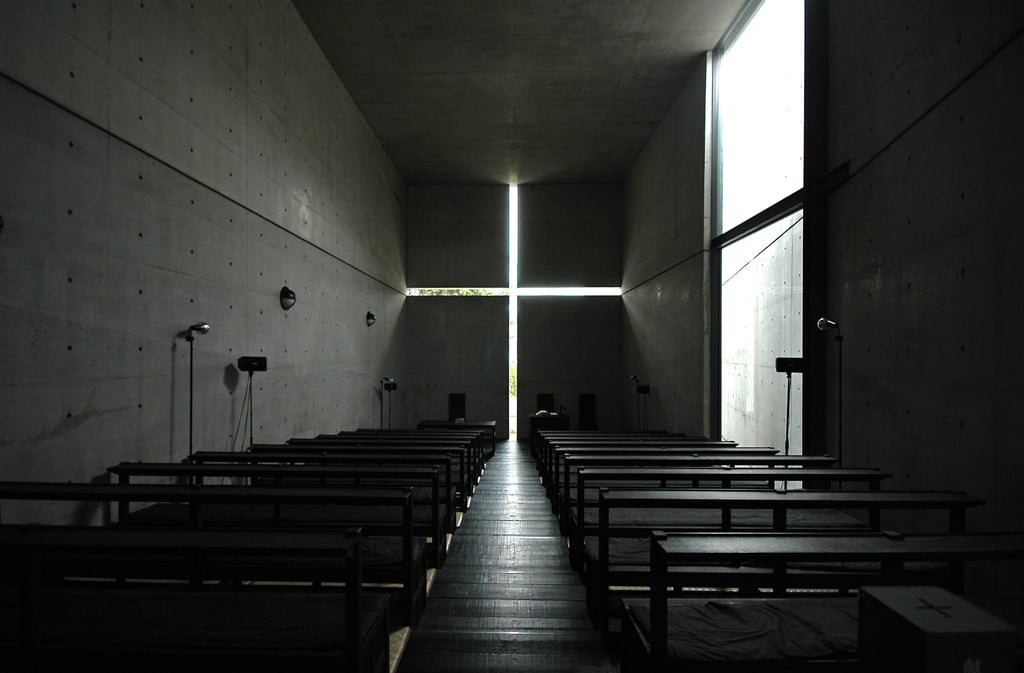
Church of the Light chapel, designed by Tadao Ando Architect & Associates in Ibaraki, Osaka Prefecture, completed in 1989, redefined contemporary sacred architecture through the controlled use of natural light and minimal reinforced concrete form. The chapel was built as an addition to an existing Christian compound and later became part of a broader redevelopment of the church complex, expanded in 1999 with a Sunday school building. The architecture is organized as a simple concrete volume intersected by a freestanding wall set at a 15-degree angle that shapes the entrance sequence and separates the worship space from the approach. Circulation follows a narrow path around this wall, guiding visitors through a controlled transition before aligning them with the altar and the cruciform opening in the east wall. Natural light entering through this cross-shaped void defines the interior atmosphere by projecting a luminous cross into the otherwise darkened chapel. Exposed reinforced concrete walls with carefully aligned formwork joints establish the primary structural and spatial order, while wood elements made from repurposed scaffolding boards form the floor and seating. The project reflects Tadao Ando’s exploration of architectural dualities, including light and darkness, solid and void, and spiritual and secular space. Construction was completed despite financial constraints faced by the congregation, reinforcing the building’s disciplined material and spatial language. The later Sunday school addition maintains the geometric language of the chapel while introducing brighter interiors suited for community use, and together the buildings form one of the most recognized examples of Ando’s architecture centered on light, structure, and contemplation.

Church of the Light chapel, designed by Tadao Ando Architect & Associates, stands in Ibaraki, Osaka Prefecture, approximately 25 kilometers (15.5 miles) northeast of Osaka. Completed in 1989, the chapel was conceived as an addition to an existing Christian compound that included a wooden chapel and a minister’s residence. The project formed the first stage of a broader reorganization of the church complex, which was later expanded in 1999 with the construction of a Sunday school building. The small structure occupies a corner site within a quiet residential neighborhood and reflects Ando’s continued investigation of the relationship between architecture, light, and spiritual experience.
 Church of the Light / Tadao Ando Architect & Associates | Classics on Architecture Lab 63
  Church of the Light / Tadao Ando Architect & Associates | Classics on Architecture Lab 64
  Church of the Light / Tadao Ando Architect & Associates | Classics on Architecture Lab 65
The chapel is organized as a simple reinforced-concrete volume measuring approximately 5.9 meters by 17.7 meters by 5.9 meters. The composition derives from three cubic modules and is penetrated by a freestanding wall set at an angle of roughly 15 degrees. This angled wall divides the building into two zones: an entrance sequence and the main worship space. Circulation follows the line of this wall and guides visitors through a compressed entry path before revealing the interior of the chapel. The circulation sequence reinforces the transition from everyday surroundings to a contemplative interior. Visitors approach along a narrow path that traces the diagonal wall before entering through a tall opening cut within it. Movement around the freestanding plane requires a slight turn before the chapel space becomes visible. This controlled sequence gradually aligns the visitor with the altar wall and the cruciform opening that forms the spatial focus of the interior.

Inside the chapel, the spatial experience is defined by the contrast between darkness and natural illumination. A cruciform void cut into the east wall behind the altar extends vertically from floor to ceiling and horizontally across the wall. Daylight enters through this opening and projects a luminous cross into the otherwise darkened interior. Because the chapel contains very few openings, the light entering through the cross becomes the primary spatial element within the room.
 Church of the Light / Tadao Ando Architect & Associates | Classics on Architecture Lab 66
  Church of the Light / Tadao Ando Architect & Associates | Classics on Architecture Lab 67
The structure is formed from exposed reinforced concrete cast in place. The walls, approximately 38 centimeters thick, were constructed with carefully aligned formwork to achieve smooth surfaces and precise joints. The grid of concrete seams corresponds with the geometry of the cruciform opening, reinforcing the order of the interior surfaces. Wood elements appear in the floor, pews, and liturgical furnishings, using repurposed scaffolding boards from the construction process. This contrast between concrete and wood introduces a tactile warmth within the restrained material palette.
 Church of the Light / Tadao Ando Architect & Associates | Classics on Architecture Lab 68
  Church of the Light / Tadao Ando Architect & Associates | Classics on Architecture Lab 69
The architectural composition reflects Tadao Ando’s recurring exploration of dualities such as light and darkness, solid and void, and spiritual and secular space. The concrete shell eliminates conventional religious ornament and reduces the chapel to a limited set of architectural elements. Within this restrained environment, light becomes the primary expressive material and defines the atmosphere of the interior.
 Church of the Light / Tadao Ando Architect & Associates | Classics on Architecture Lab 70
  Church of the Light / Tadao Ando Architect & Associates | Classics on Architecture Lab 71
Construction of the chapel faced financial constraints due to the limited resources of the congregation. The modest budget influenced both the choice of materials and the simplicity of the structure. During construction, the project nearly ran out of funds before the roof could be completed, and the contractor ultimately donated the remaining work necessary to finish the building. These circumstances reinforced the disciplined architectural language that defines the chapel.

The church complex was expanded in 1999 with the addition of a Sunday school building designed by Tadao Ando on the adjacent site of the former wooden church. The new building continues the geometric language of the chapel through a similar concrete volume intersected by a freestanding wall. Unlike the darkened chapel interior, the Sunday school incorporates natural wood finishes and larger openings that produce a brighter atmosphere suited for community use.
 Church of the Light / Tadao Ando Architect & Associates | Classics on Architecture Lab 72
  Church of the Light / Tadao Ando Architect & Associates | Classics on Architecture Lab 73
  Church of the Light / Tadao Ando Architect & Associates | Classics on Architecture Lab 74
Today the Church of the Light remains one of Tadao Ando’s most recognized works and a concise expression of his architectural approach. The chapel demonstrates how minimal form, precise construction, and carefully controlled natural light can shape a powerful spatial experience centered on contemplation and reflection.

Project Gallery
 © archigardener.com © archigardener.com
  © Ibaraki Kasugaoka Church © Ibaraki Kasugaoka Church
  © archigardener.com
  © Ibaraki Kasugaoka Church
  © Ibaraki Kasugaoka Church
  © Ibaraki Kasugaoka Church
  © archigardener.com © Ibaraki Kasugaoka Church © archigardener.com
  © Ibaraki Kasugaoka Church
  © Ibaraki Kasugaoka Church
  © Ibaraki Kasugaoka Church
  © Ibaraki Kasugaoka Church
  © archigardener.com
  © Ibaraki Kasugaoka Church © Ibaraki Kasugaoka Church © Ibaraki Kasugaoka Church
  © Ibaraki Kasugaoka Church © Ibaraki Kasugaoka Church
  © Ibaraki Kasugaoka Church
  © Ibaraki Kasugaoka Church © Bergmann © Ibaraki Kasugaoka Church
  © Ibaraki Kasugaoka Church
  © Ibaraki Kasugaoka Church © Buou © Naoya Fujii
  © Naoya Fujii
  © Naoya Fujii
  © Naoya Fujii
  © Ibaraki Kasugaoka Church
  © Ibaraki Kasugaoka Church
  © Ibaraki Kasugaoka Church
  © Ibaraki Kasugaoka Church
  © Antje Verena © Ibaraki Kasugaoka Church
  © archigardener.com
  © Tadao Ando Architect & Associates
  © Tadao Ando Architect & Associates
  © Tadao Ando Architect & Associates
  © Tadao Ando Architect & Associates
  © Tadao Ando Architect & Associates
  © Tadao Ando Architect & Associates
  © Tadao Ando Architect & Associates © Tadao Ando Architect & Associates © Tadao Ando Architect & Associates
  © Tadao Ando Architect & Associates
  © Tadao Ando Architect & Associates
Project Location
Address: 4 Chome-3-50 Kitakasugaoka, Ibaraki, Osaka Prefecture 567-0048, Japan
Location is for general reference and may represent a city or country, not necessarily a precise address.