

Architects: Peter Cook, Archigram
Year: 1964
Photography: Archigram, Plindberg
City: Conceptual Project
Country: United Kingdom
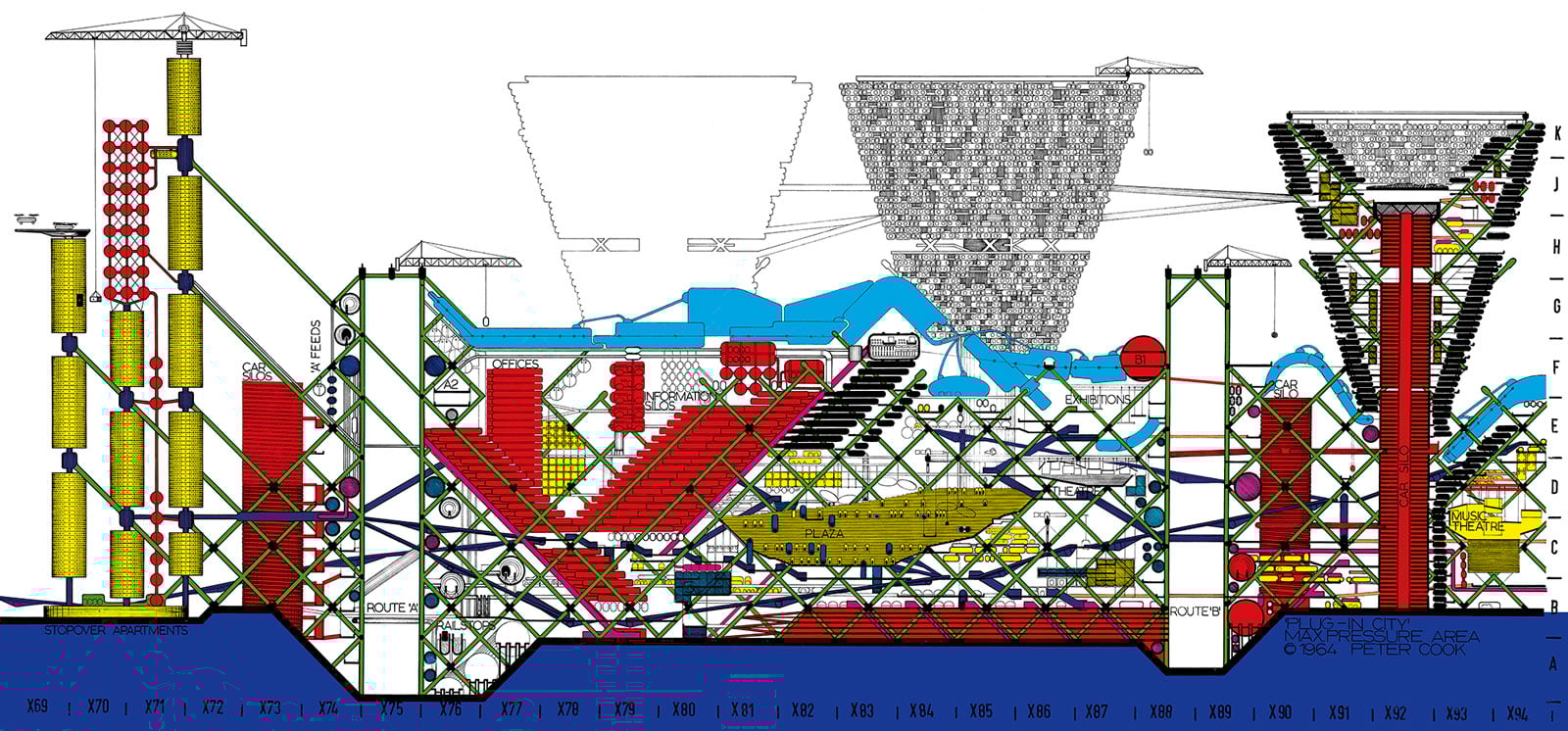
Plug-In City conceptual urban megastructure developed by Peter Cook and Archigram in 1964, proposed a flexible city organized around infrastructure rather than permanent buildings. Developed between 1963 and 1966 during research into prefabricated housing systems, the project explored how industrialized construction could produce an adaptable urban environment. The proposal envisioned a permanent structural framework containing transportation networks, service systems, and circulation infrastructure that supported replaceable architectural components. Within this megastructure, prefabricated residential capsules could be inserted, removed, and replaced over time using crane-ways that transported modular units throughout the city. Circulation systems, including escalator tubes, monorails, and service routes, distribute movement, utilities, and goods across multiple levels of the elevated framework. Housing modules were conceived as temporary components with defined lifespans, allowing domestic elements to be periodically upgraded while maintaining the larger structural system. Public spaces and communal facilities were distributed within the megastructure rather than confined to ground level, transforming the city into a three-dimensional network of infrastructure, circulation, and inhabitable space. Although never built, Plug-In City became one of the most influential speculative urban proposals of the 1960s and contributed significantly to architectural discussions on megastructures, modular construction, and technologically driven urbanism.

Plug-In City is a conceptual urban megastructure developed in 1964 by Peter Cook and members of the British avant-garde group Archigram. The project proposed a radically different approach to urbanism based on infrastructure, mobility, and replaceable architectural components. Instead of a traditional city composed of permanent buildings, the proposal envisioned a flexible structural framework capable of accommodating continuously changing residential and urban modules. Development of the project occurred between 1963 and 1966 while members of Archigram were working with the Taylor Woodrow Design Group. During this period, the architects were investigating prefabricated housing systems and the potential of industrialized construction. Plug-In City emerged from these explorations as a speculative urban model in which prefabrication could support a dynamic and evolving urban environment.

At the center of the proposal is a large-scale megastructure that acts as the permanent infrastructure of the city. The structural framework contains circulation routes, service networks, and transportation systems while providing support for temporary architectural components. Within this infrastructural skeleton, individual residential units are inserted and replaced over time, allowing the city to adapt continuously to changing needs.
 The Plug-In City / Peter Cook, Archigram | Classics on Architecture Lab 48
  The Plug-In City / Peter Cook, Archigram | Classics on Architecture Lab 49
  The Plug-In City / Peter Cook, Archigram | Classics on Architecture Lab 50
  The Plug-In City / Peter Cook, Archigram | Classics on Architecture Lab 51
  The Plug-In City / Peter Cook, Archigram | Classics on Architecture Lab 52
  The Plug-In City / Peter Cook, Archigram | Classics on Architecture Lab 53
A network of crane-ways forms a key part of the system. These mechanical infrastructures move building components across the megastructure and enable the installation or removal of modular units. The framework organizes multiple layers of circulation, including escalator tubes, monorail systems, and service routes responsible for distributing goods, utilities, and transportation throughout the city.
 The Plug-In City / Peter Cook, Archigram | Classics on Architecture Lab 54
  The Plug-In City / Peter Cook, Archigram | Classics on Architecture Lab 55
Housing within the proposal takes the form of prefabricated capsule dwellings constructed from lightweight metal-plastic elements. These units function as temporary living modules attached to the structural grid. Archigram proposed that domestic components would have predetermined lifespans, allowing elements such as kitchens and bathrooms to be periodically replaced while larger living spaces could remain in place for longer durations.

Public space forms an integral part of the megastructural system. Instead of being confined to ground level, open areas and communal facilities are distributed throughout the elevated framework. This arrangement transforms the traditional two-dimensional urban plan into a three-dimensional network of circulation routes, infrastructural systems, and inhabitable spaces.
 The Plug-In City / Peter Cook, Archigram | Classics on Architecture Lab 56
  The Plug-In City / Peter Cook, Archigram | Classics on Architecture Lab 57
Plug-In City was developed alongside other visionary Archigram projects that explored mobility, technological culture, and the transformation of everyday life. Although never realized, the proposal became one of the most influential speculative urban models of the 1960s. Its ideas about modular construction, adaptable infrastructure, and megastructural urbanism later influenced architectural discourse and projects associated with high-tech architecture.

Project Gallery
 © Archigram © Archigram
  © Archigram © Archigram
  © Archigram
  © Archigram
  © Archigram
  © Archigram © Archigram
  © Archigram © Archigram
  © Archigram
  © Archigram
  © Archigram
  © Archigram © Archigram
  © Archigram © Archigram
  © Archigram
  © Archigram © Archigram
  © Archigram
  © Archigram
  © Archigram © Archigram
  © Archigram
  © Archigram
  © Archigram
  © Archigram © Archigram
  © Archigram
  © Archigram
  © Archigram © Archigram
  © Archigram © Archigram
  © Plindberg