

Architects: Renzo Piano, Richard Rogers, Gianfranco Franchini
Area: 103,305 m²
Year: 1977
Photography: Centre Pompidou, Archives du Centre Pompidou, Renzo Piano, Renzo Piano Building Workshop, Fondazione Renzo Piano, Richard Rogers, Richard Rogers Estates, Rogers Stirk Harbor + Partners studio, MNAM-CCI / Dist. RMN-GP, Bibliothèque Kandinsky, Alain-Marie Markarian, Takashi Images, Christian Mueller, Kyiv.Victor, Vladislav Gajic, Shutterstock, NJIT, Francis Toussaint, Eric Schoendorf, Courtney Traub, Jean-Pol GRANDMONT, Guido Radig, Epizentrum, ChrisSampson87, Edal Anton Lefterov, Leland, Reinraum, Gianfranco Franchini, Thomas Claveirole, Jacques Faujour, G. Meguerditchian, y Kirill Neiezhmakov, Michel Denancé
Structural Engineer: Ove Arup & Partners
Services Engineer: Ove Arup & Partners
Quantity Surveyor: Ove Arup & Partners
Landscape Architect: Cuno Brullmann
Contractor: Grands Travaux de Marseille
City: Paris
Country: France
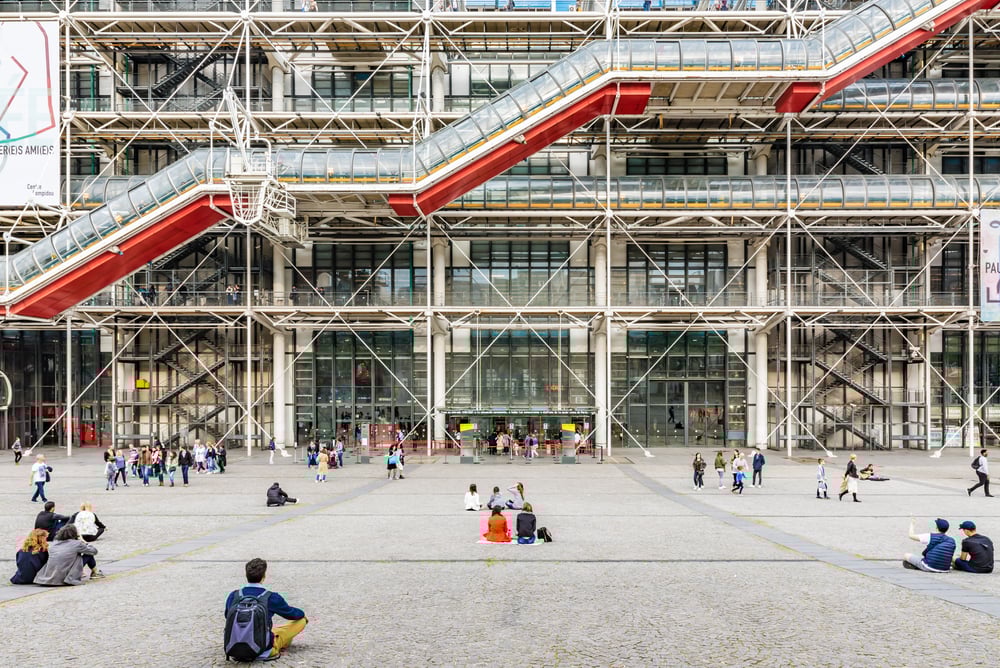
Centre Georges Pompidou cultural complex in Paris, designed by Renzo Piano, Richard Rogers, and Gianfranco Franchini and completed in 1977, emerged from President Georges Pompidou’s initiative to create a multidisciplinary cultural institution integrating art, literature, music, and public information. Selected through an international competition in 1971, the project occupies the Plateau Beaubourg site, where roughly half of the two-hectare parcel was reserved as a public piazza connecting the building with the surrounding city. The structure operates as a steel megastructure organized by long-span Warren trusses and cast-steel gerberettes supporting large unobstructed floor plates across seven levels above ground and three below. Circulation and mechanical systems were relocated to the exterior, producing the building’s characteristic inside-out architecture and allowing flexible interior spaces. Escalator tubes rise diagonally along the piazza façade, while the Rue Beaubourg elevation exposes color-coded services that distinguish air, plumbing, electrical, and circulation systems. The complex houses the Musée National d’Art Moderne, the Bibliothèque publique d’information, and IRCAM within large adaptable interiors. Developed with engineers from Ove Arup & Partners and structural engineer Peter Rice, the project became one of the defining works of high-tech architecture, reshaping the relationship between museum buildings and urban public space. Renovations between 1996 and 2000 updated technical systems while preserving the building’s original concept of a flexible cultural framework integrated with the life of the city.

The Centre Georges Pompidou in Paris, designed by Renzo Piano, Richard Rogers, and Gianfranco Franchini, originated from the cultural initiative launched by French President Georges Pompidou in 1969. Conceived as a multidisciplinary institution integrating art, literature, music, film, and public information, the project sought to establish a new cultural landmark in the historic center of the city. An international competition launched in 1971 attracted 681 entries, with the proposal by the young team of Piano and Rogers, developed in collaboration with Franchini and engineers from Ove Arup & Partners, ultimately selected as the winning scheme.
 Centre Georges Pompidou / Renzo Piano Building Workshop + Richard Rogers | Classics on Architecture Lab 129
  Centre Georges Pompidou / Renzo Piano Building Workshop + Richard Rogers | Classics on Architecture Lab 130
Located on the Plateau Beaubourg at the edge of the Marais district, the project occupies a dense urban site within central Paris. The design introduced a decisive urban strategy by reserving roughly half of the two-hectare site for a large public piazza while concentrating the building on the remaining portion. This sloping forecourt establishes a continuous relationship between the cultural institution and the surrounding city, functioning as an open civic space for gatherings, performances, and everyday urban life.
 Centre Georges Pompidou / Renzo Piano Building Workshop + Richard Rogers | Classics on Architecture Lab 131
  Centre Georges Pompidou / Renzo Piano Building Workshop + Richard Rogers | Classics on Architecture Lab 132
  Centre Georges Pompidou / Renzo Piano Building Workshop + Richard Rogers | Classics on Architecture Lab 133
  Centre Georges Pompidou / Renzo Piano Building Workshop + Richard Rogers | Classics on Architecture Lab 134
Structurally, the building operates as a steel megastructure with reinforced concrete floor slabs designed to accommodate changing programs over time. Seven levels rise above ground with three additional levels below, organized by 48-meter Warren trusses spanning the full width of the building. These trusses connect to vertical columns through large cast-steel gerberettes, producing expansive unobstructed floor plates capable of supporting a wide range of cultural functions.
 Centre Georges Pompidou / Renzo Piano Building Workshop + Richard Rogers | Classics on Architecture Lab 135
  Centre Georges Pompidou / Renzo Piano Building Workshop + Richard Rogers | Classics on Architecture Lab 136
  Centre Georges Pompidou / Renzo Piano Building Workshop + Richard Rogers | Classics on Architecture Lab 137
  Centre Georges Pompidou / Renzo Piano Building Workshop + Richard Rogers | Classics on Architecture Lab 138
  Centre Georges Pompidou / Renzo Piano Building Workshop + Richard Rogers | Classics on Architecture Lab 139
Spatial flexibility was achieved by relocating circulation systems, mechanical services, and structural expression to the exterior of the building. Escalators, lifts, ducts, stairs, and technical infrastructure are attached to the façade, freeing the interior floors from structural or service interruptions. This strategy produced the building’s characteristic “inside-out” architecture while making its functional systems visible from the surrounding city.
 Centre Georges Pompidou / Renzo Piano Building Workshop + Richard Rogers | Classics on Architecture Lab 140
  Centre Georges Pompidou / Renzo Piano Building Workshop + Richard Rogers | Classics on Architecture Lab 141
  Centre Georges Pompidou / Renzo Piano Building Workshop + Richard Rogers | Classics on Architecture Lab 142
  Centre Georges Pompidou / Renzo Piano Building Workshop + Richard Rogers | Classics on Architecture Lab 143
  Centre Georges Pompidou / Renzo Piano Building Workshop + Richard Rogers | Classics on Architecture Lab 144
  Centre Georges Pompidou / Renzo Piano Building Workshop + Richard Rogers | Classics on Architecture Lab 145
The west façade facing the piazza contains the main circulation devices, including the transparent escalator tubes that ascend diagonally along the elevation. Movement through the building becomes part of the architectural experience, providing visitors with progressively expanding views across Paris. Along the Rue Beaubourg façade, exposed mechanical systems are arranged in a clear visual hierarchy and distinguished through a color-coding system: blue for air-handling ducts, green for plumbing, yellow for electrical systems, and red for circulation and safety elements.
 Centre Georges Pompidou / Renzo Piano Building Workshop + Richard Rogers | Classics on Architecture Lab 146
  Centre Georges Pompidou / Renzo Piano Building Workshop + Richard Rogers | Classics on Architecture Lab 147
  Centre Georges Pompidou / Renzo Piano Building Workshop + Richard Rogers | Classics on Architecture Lab 148
  Centre Georges Pompidou / Renzo Piano Building Workshop + Richard Rogers | Classics on Architecture Lab 149
  Centre Georges Pompidou / Renzo Piano Building Workshop + Richard Rogers | Classics on Architecture Lab 150
  Centre Georges Pompidou / Renzo Piano Building Workshop + Richard Rogers | Classics on Architecture Lab 151
  Centre Georges Pompidou / Renzo Piano Building Workshop + Richard Rogers | Classics on Architecture Lab 152
  Centre Georges Pompidou / Renzo Piano Building Workshop + Richard Rogers | Classics on Architecture Lab 153
Within the structure, the Centre houses several major cultural institutions. These include the Musée National d’Art Moderne, the Bibliothèque publique d’information, and IRCAM, the Institute for Research and Coordination in Acoustics and Music. The lower levels accommodate large public facilities such as theaters, forums, and reception spaces, while the upper floors provide vast gallery areas and flexible exhibition platforms. The building was conceived less as a conventional museum than as a cultural infrastructure capable of accommodating evolving programs.
 Centre Georges Pompidou / Renzo Piano Building Workshop + Richard Rogers | Classics on Architecture Lab 154
  Centre Georges Pompidou / Renzo Piano Building Workshop + Richard Rogers | Classics on Architecture Lab 155
  Centre Georges Pompidou / Renzo Piano Building Workshop + Richard Rogers | Classics on Architecture Lab 156
  Centre Georges Pompidou / Renzo Piano Building Workshop + Richard Rogers | Classics on Architecture Lab 157
  Centre Georges Pompidou / Renzo Piano Building Workshop + Richard Rogers | Classics on Architecture Lab 158
  Centre Georges Pompidou / Renzo Piano Building Workshop + Richard Rogers | Classics on Architecture Lab 159
Realization of the project required close collaboration between architects, engineers, and specialized construction teams. Structural engineer Peter Rice and the firm Ove Arup & Partners developed the building’s distinctive gerberette system and exposed steel framework. Massive prefabricated steel elements were fabricated off-site and assembled into a permanent structural grid capable of supporting adaptable interior arrangements and replaceable building components.
 Centre Georges Pompidou / Renzo Piano Building Workshop + Richard Rogers | Classics on Architecture Lab 160
  Centre Georges Pompidou / Renzo Piano Building Workshop + Richard Rogers | Classics on Architecture Lab 161
  Centre Georges Pompidou / Renzo Piano Building Workshop + Richard Rogers | Classics on Architecture Lab 162
  Centre Georges Pompidou / Renzo Piano Building Workshop + Richard Rogers | Classics on Architecture Lab 163
Completed in 1977, the Centre Georges Pompidou rapidly became one of the most influential works of high-tech architecture. Its radical exposure of structure and services challenged traditional museum design while redefining the relationship between cultural institutions and urban public space. The building’s piazza, flexible interior organization, and visible technological systems transformed the museum into an active social and civic environment.

Intensive use over subsequent decades led to major renovation work between 1996 and 2000, aimed at improving accessibility and updating technical systems while preserving the original architectural concept. Despite these interventions, the fundamental idea of the project remains intact: a transparent, adaptable cultural framework in which technology, movement, and public life are openly expressed.

Project Gallery
© Centre Pompidou / Bibliothèque Kandinsky © Renzo Piano Building Workshop / Richard Rogers © Renzo Piano Building Workshop / Richard Rogers © Rogers Stirk Harbor + Partners studio © Center Pompidou © Center Pompidou © Rogers Stirk Harbor + Partners studio © Rogers Stirk Harbor + Partners studio © Rogers Stirk Harbor + Partners studio © Renzo Piano Building Workshop / Richard Rogers © Rogers Stirk Harbor + Partners studio © Rogers Stirk Harbor + Partners studio  © Rogers Stirk Harbor + Partners studio
  © Jean-Pol GRANDMONT © Center Pompidou © Rogers Stirk Harbor + Partners studio
  © Thomas Claveirole © Jacques Faujour
  © Rogers Stirk Harbor + Partners studio © Renzo Piano Building Workshop / Richard Rogers © Vladislav Gajic / Shutterstock © Renzo Piano Building Workshop + Richard Rogers © y Kirill Neiezhmakov
  © NJIT
  © Rogers Stirk Harbor + Partners studio
  © Renzo Piano Building Workshop / Richard Rogers
  © Renzo Piano Building Workshop / Richard Rogers © Takashi Images / Shutterstock
  © Rogers Stirk Harbor + Partners studio
  © Rogers Stirk Harbor + Partners studio © Leland
  © Francis Toussaint
  © Francis Toussaint © Center Pompidou
  © Rogers Stirk Harbor + Partners studio
  © Renzo Piano Building Workshop / Richard Rogers
  © NJIT
  © Reinraum
  © Francis Toussaint © Rogers Stirk Harbor + Partners studio © Kiev.Victor / Shutterstock © NJIT © Michel Denancé
  © Rogers Stirk Harbor + Partners studio
  © Center Pompidou
  © Epizentrum
  © ChrisSampson87
  © Guido Radig
  © Center Pompidou
  © Francis Toussaint © Renzo Piano Building Workshop / Richard Rogers © Edal Anton Lefterov © Edal Anton Lefterov
  © Rogers Stirk Harbor + Partners studio
  © Rogers Stirk Harbor + Partners studio
  © Christian Mueller / Shutterstock © Rogers Stirk Harbor + Partners studio © Rogers Stirk Harbor + Partners studio © Rogers Stirk Harbor + Partners studio © Francis Toussaint © Rogers Stirk Harbor + Partners studio
  © Rogers Stirk Harbor + Partners studio © Renzo Piano Building Workshop / Richard Rogers
  © Renzo Piano Building Workshop / Richard Rogers © Renzo Piano Building Workshop / Richard Rogers
  © Renzo Piano Building Workshop / Richard Rogers
  © Courtney Traub
  © G. Meguerditchian / Centre Pompidou
  © Flickr: User – Eric Schoendorf
  © Rogers Stirk Harbor + Partners studio
  © Renzo Piano Building Workshop / Richard Rogers
  © Renzo Piano Building Workshop / Centre Pompidou, MNAM-CCI / Dist. RMN-GP © Renzo Piano Building Workshop + Richard Rogers
  © Fondazione Renzo Piano, Richard Rogers Estates
  © Renzo Piano Building Workshop / Centre Pompidou, MNAM-CCI / Dist. RMN-GP
  © Alain-Marie Markarian / Archives du Centre Pompidou
  © Alain-Marie Markarian / Archives du Centre Pompidou
  © Alain-Marie Markarian / Archives du Centre Pompidou
  © Alain-Marie Markarian / Archives du Centre Pompidou
  © Alain-Marie Markarian / Archives du Centre Pompidou
  © Renzo Piano Building Workshop + Richard Rogers
  © Renzo Piano Building Workshop + Richard Rogers
  © Renzo Piano Building Workshop + Richard Rogers
  © Rogers Stirk Harbor + Partners studio
  © Renzo Piano Building Workshop + Richard Rogers
  © Gianfranco Franchini / Renzo Piano
  © GreatBuildings.com
  © Renzo Piano Building Workshop + Richard Rogers
  © Renzo Piano Building Workshop + Richard Rogers
  © Renzo Piano Building Workshop + Richard Rogers
  © Renzo Piano Building Workshop / Richard Rogers
  © Renzo Piano Building Workshop / Richard Rogers
  © Renzo Piano Building Workshop + Richard Rogers
Project Location
Address: Place Georges-Pompidou, 75004 Paris, France
Location is for general reference and may represent a city or country, not necessarily a precise address.