

Architects: KCAP
Area: 30,000 m²
Year: 2018–2022
Photography: Ossip van Duivenbode
Interior Architect: Kraaijvanger Architects
Contractor: J.P. van Eesteren / BESIX
Landscape Architecture: DELVA Landscape Architecture & Urbanism
Installations: Unica
Management and Sustainability: Traject
Interior Construction: Coors
Client: LIFE, SENS Real Estate, PostNL
City: The Hague
Country: The Netherlands
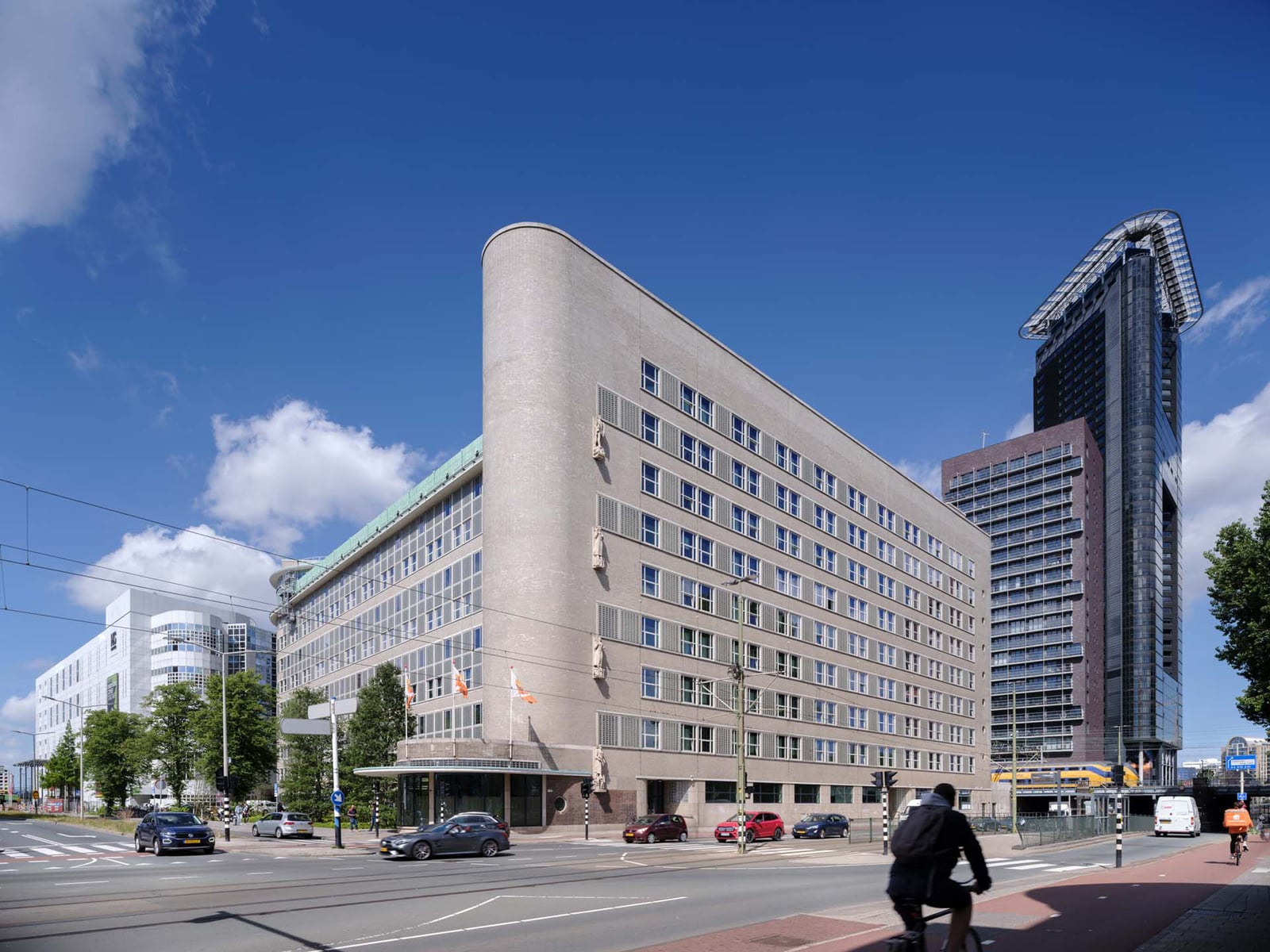
The transformation of the Station Post Building in The Hague reimagines a historic postal sorting center as a contemporary and sustainable workplace. Designed by KCAP with interior architecture by Kraaijvanger Architects, the project converts a 30,000-square-meter national monument into the headquarters of PostNL while accommodating flexible office spaces, community facilities, and collaborative work environments. The intervention carefully balances preservation and modernization, maintaining the Functionalist identity of the original structure while introducing spatial and environmental improvements suited to contemporary working patterns. A new central atrium carved through the deep floor plates increases daylight penetration and strengthens visual connections across levels. Sustainability measures include the installation of an internal glass “second skin” that improves thermal performance without altering the protected facade, alongside circular construction strategies that prioritize the reuse of existing materials. Together these interventions enable the building to meet ambitious environmental standards while reinforcing its role as a catalyst for the regeneration of the surrounding HS Kwartier district.

Located adjacent to Hollands Spoor railway station, the Station Post Building occupies a prominent position along one of The Hague’s major infrastructural corridors. Originally designed in 1939 by Chief Government Architect G.C. Bremer, the building served as one of the most advanced postal sorting centers in the Netherlands at the time of its completion. Its pale brick facade, articulated by curved forms and glass block windows, exemplifies the principles of Functionalist architecture while reflecting the technological optimism of early twentieth-century infrastructure. Over time the building became a recognizable urban landmark, its monumental scale and proximity to the railway establishing a strong visual presence within the city.

The recent intervention by KCAP responds to the challenge of adapting this protected national monument for contemporary use while preserving its structural and architectural identity. Because the building’s heritage status limited structural modifications, the transformation strategy centered on maintaining the original load-bearing framework. Concrete beams and columns, including some of the earliest prefabricated concrete structural elements used in the Netherlands, remain intact and visible. By preserving this structural system, the architects retained the building’s industrial character while creating a robust framework capable of supporting new spatial configurations.
 Station Post Building / KCAP + Kraaijvanger Architects 55
  Station Post Building / KCAP + Kraaijvanger Architects 56
A central design move was the insertion of a sequence of vertical openings through the deep floor plates. These staggered voids introduce daylight into the building’s interior while generating a dynamic spatial composition of single- and double-height spaces. The resulting atrium forms the social core of the building, linking multiple levels through bridges and stairways. This network of circulation routes encourages visual connections and movement between floors while recalling the mechanical systems that once transported mail through the building from the adjacent station.
 Station Post Building / KCAP + Kraaijvanger Architects 57
  Station Post Building / KCAP + Kraaijvanger Architects 58
Environmental performance was another critical component of the renovation. To achieve contemporary sustainability standards without altering the historic facade, the design introduces a glass “second skin” placed behind the existing envelope. This internal layer improves thermal insulation while preserving the building’s characteristic exterior appearance. The intervention also contributes to acoustic comfort by reducing noise from nearby rail and road traffic. Together with energy-efficient installations and the reuse of existing materials, these measures enabled the building to achieve the highest energy label attainable for a national monument in the Netherlands.

The interior design by Kraaijvanger Architects interprets the monumental structure as a flexible working landscape centered on well-being and collaboration. Inspired by the spatial logic of domestic environments, the interior organizes large floor plates into interconnected zones of varying scale and privacy. The first floor functions as a community-oriented hub with reception areas, meeting rooms, hospitality spaces, and informal workplaces, while the upper floors accommodate adaptable office environments capable of evolving with future workplace needs. Through this layered approach, the revitalized Station Post Building reconnects its industrial heritage with contemporary urban life, contributing to the emerging identity of the HS Kwartier district while welcoming PostNL back to the building as its headquarters.

Project Gallery
 © Ossip van Duivenbode
  © Ossip van Duivenbode
  © Ossip van Duivenbode
  © Ossip van Duivenbode
  © Ossip van Duivenbode
  © Ossip van Duivenbode
  © Ossip van Duivenbode
  © Ossip van Duivenbode
  © Ossip van Duivenbode
  © Ossip van Duivenbode
  © Ossip van Duivenbode
  © Ossip van Duivenbode © Ossip van Duivenbode © Ossip van Duivenbode
  © Ossip van Duivenbode
  © Ossip van Duivenbode
  © Ossip van Duivenbode © Ossip van Duivenbode
  © Ossip van Duivenbode
  © Ossip van Duivenbode
  © Ossip van Duivenbode
  © Ossip van Duivenbode
  © Ossip van Duivenbode
  © Ossip van Duivenbode
  © Ossip van Duivenbode
  © Ossip van Duivenbode
  © Ossip van Duivenbode © Ossip van Duivenbode
  © Ossip van Duivenbode
  © Ossip van Duivenbode
  Station Post Building / KCAP + Kraaijvanger Architects 59
  Station Post Building / KCAP + Kraaijvanger Architects 60
  Station Post Building / KCAP + Kraaijvanger Architects 61
  Station Post Building / KCAP + Kraaijvanger Architects 62
  Station Post Building / KCAP + Kraaijvanger Architects 63
  Station Post Building / KCAP + Kraaijvanger Architects 64
  Station Post Building / KCAP + Kraaijvanger Architects 65
  Station Post Building / KCAP + Kraaijvanger Architects 66
  Station Post Building / KCAP + Kraaijvanger Architects 67
  Station Post Building / KCAP + Kraaijvanger Architects 68
  Station Post Building / KCAP + Kraaijvanger Architects 69
  Station Post Building / KCAP + Kraaijvanger Architects 70
  Station Post Building / KCAP + Kraaijvanger Architects 71
  Station Post Building / KCAP + Kraaijvanger Architects 72
  Station Post Building / KCAP + Kraaijvanger Architects 73
  Station Post Building / KCAP + Kraaijvanger Architects 74
  Station Post Building / KCAP + Kraaijvanger Architects 75
  Station Post Building / KCAP + Kraaijvanger Architects 76
  Station Post Building / KCAP + Kraaijvanger Architects 77
  Station Post Building / KCAP + Kraaijvanger Architects 78
Project Location
Address: The Hague, The Netherlands
The location specified is intended for general reference and may denote a city or country, but it does not identify a precise address.