
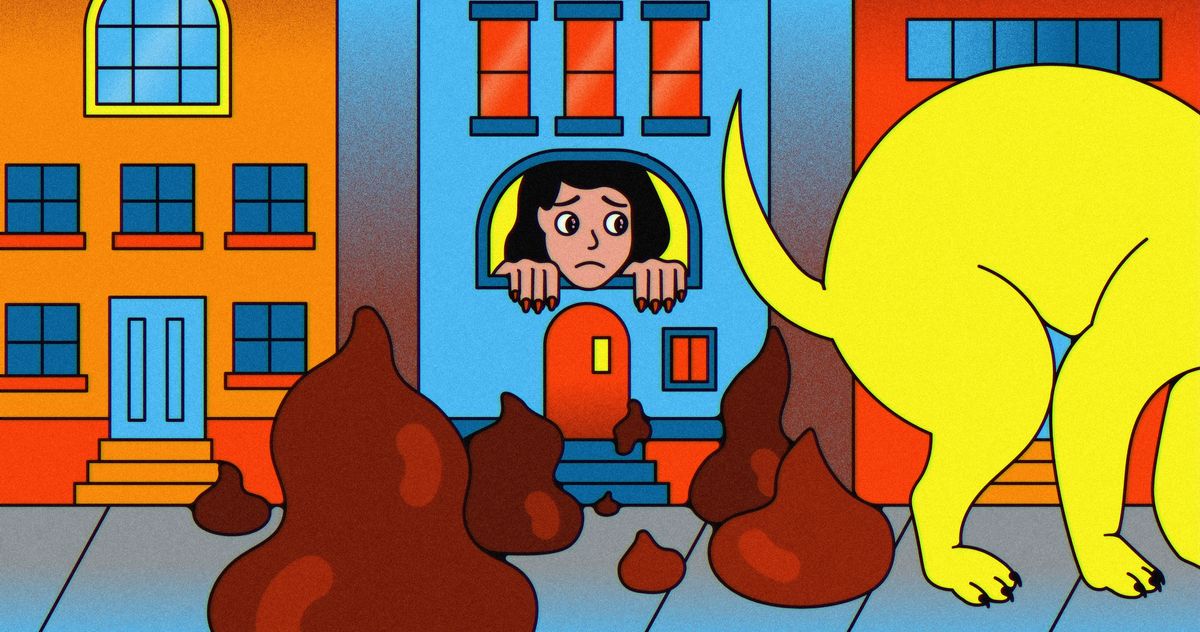
Illustration: Emma Erickson
Welcome to “Apartment Department,” Curbed’s advice column by Clio Chang. Join us every other Wednesday for questions about making peace with noisy-sex neighbors, the nuances of roommate fridge etiquette, and whatever else you might need to know about renting, buying, or crying in the New York City housing market.
Got a problem? Email [email protected].
Dear Apartment Department,
There’s a person in my building who routinely doesn’t clean up after his dog. Ever. In the years that I’ve lived in my building, I’ve seen him on an almost weekly basis let his dog do his thing and leave it right on our block. He’s an older teenager — maybe 18 or 19 — and I’ve talked to him and his dad about it. Nothing’s changed. At this point, I’m curious about public shaming. Is it too aggro if I post a sign in our lobby along the lines of: “Tenants of [THIS GUY’S APARTMENT], please be a good neighbor and clean up after your dog! — Signed, Your Neighbors!” I swear I’m an otherwise normal-tempered person!
Sincerely,
Ready to Shame
Dear Shamer,
First of all, I need you to know that you are not alone. When I wrote about pet owners failing to pick up after their dogs during the blizzards this winter, tons of people — dog owners and non–dog owners alike — were frantic about this kind of behavior. It’s not an exaggeration to say the people who leave their dog shit on the sidewalk are threatening the very social fabric of our city!
You’re in a unique position where you actually know the person who is doing this. This is an incredible opportunity to try and understand what is going on in the mind of someone who doesn’t clean up after their dog. (And, of course, to hopefully get them to change their ways.) Talking to your neighbors was a good start — and aggravating that it didn’t do anything. To aid your cause, I reached out to Jonah Berger, a marketing professor at University of Pennsylvania’s Wharton School who wrote a book called The Catalyst: How to Change Anyone’s Mind, which sounds exactly what you’re trying to do. “Try to find out why he is so reticent to clean up the poop,” Berger said. “Is he just lazy? Is there no easy place to throw it out? Does he forget to bring poop bags? Or does he not understand why it’s important to clean up afterwards?” Once you know his reasoning, it’s easier to apply your own: “If the issue is he doesn’t understand why it’s important, ask him how he would feel if no one cleaned up after their dog and the neighborhood was filled with poop.” This may seem obvious, but I think teenagers are, by nature, vaguely sociopathic and sort of immune to social norms. So maybe this person really doesn’t know that what he’s doing is disgusting and rude.
If this doesn’t work, then is it time for the sign? I will say most of my colleagues were sort of thrilled at the strategy. There’s a real bloodlust percolating in the city among non–dog owners and more upstanding dog owners, I think. The experts I spoke to, however, agreed that it was a bad idea. (Sorry!) Publicly shaming your neighbor will probably feel amazing, but that doesn’t mean it will work. Colin Wayne Leach, a psychology professor at Barnard College who has researched the effectiveness of public shame, says that the sign could “easily backfire if the shamed party sees it as more like disparaging public humiliation.” The problem with this kind of thing is that people are more likely to react defensively rather than with a desire to improve themselves. Leach suggests posting a less pointed message: “Everyone, let’s all be good neighbors and keep our neighborhood tidy by cleaning up after our dogs.”
But don’t lose heart. Another option is to call in the city and ask for a dog-waste bag dispenser on your block. (The problem is so universal that New York City Council Speaker Julie Menin has sponsored a bill to install dispensers on all of the city’s public trash cans.) We’ve also seen people install their own, if you’re feeling more DIY. This would probably help keep the block clean as a whole, but if your neighbor’s issue is a lack of decency rather than a lack of bags, then it won’t actually change their behavior.
A more narc-ish route, and something I would advise only after multiple conversations with your neighbor, is to inform your landlord that there is constantly dog waste on the block — it’s their responsibility to keep the sidewalks in front of their property clean. (You don’t actually have to say who it is, just that there is constantly poop in front of the building.) Let your management company put up the scolding sign on your behalf!
Another option: Submit a request to the Department of Sanitation’s dog-walker surveillance team. This is kind of fun-sounding, honestly. DSNY sometimes sends a special patrol to enforce the $250 fine for not picking up after your dog. The problem is that it rarely works, since it’s hard to catch someone actually in the act of dog crime. (“It is clear that people only leave piles behind when they know no one is watching,” per Vincent Gragnani, DSNY spokesperson.) But you have an advantage — you can keep tabs on your neighbor to see when they usually walk their dog and send all that information to 311. If all of this fails, then you might have to make peace with the situation. Maybe even pick up the poop yourself? I shudder at this suggestion, but sometimes, it’s our only option in a cruel world. At the very least, take solace in knowing everyone else in the city is just as annoyed as you are.
Sign Up for the Curbed Newsletter
A daily mix of stories about cities, city life, and our always evolving neighborhoods and skylines.
By submitting your email, you agree to our Terms and Privacy Notice and to receive email correspondence from us.