

Architect: E. Fay Jones (Euine Fay Jones)
Area: Approx. 120 m² (1291.68 ft²)
Photography: Randall Connaughton, University of Arkansas, John Langholz, Clinton Steeds, EEJCC
Project Type: Chapel / Religious building
Client: Jim Reed
City: Eureka Springs
Country: United States
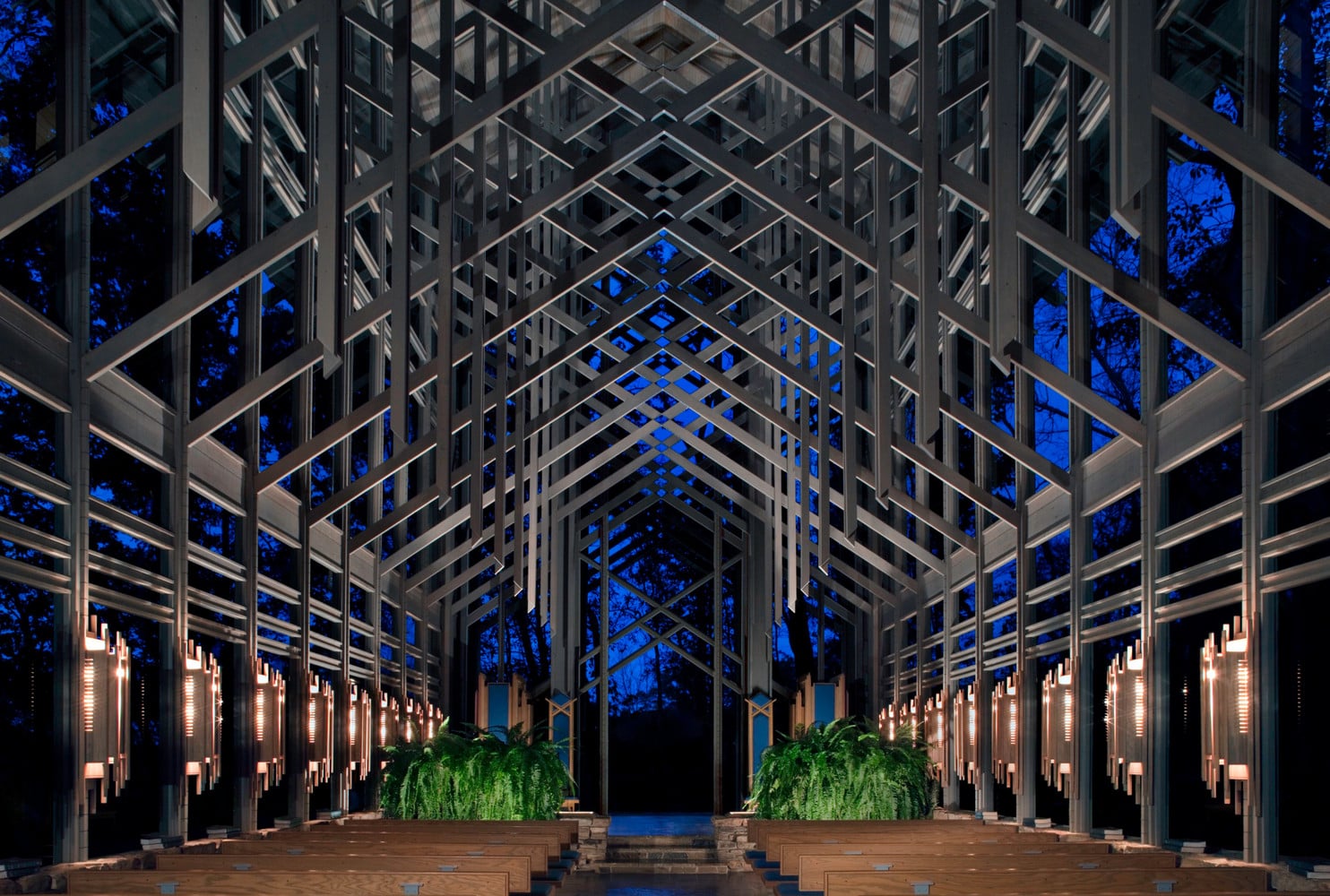
Thorncrown Chapel, a religious building designed by E. Fay Jones and completed in 1980 in Eureka Springs, United States, redefined the relationship between architecture, nature, and spiritual space. Set within the wooded Ozark landscape, the chapel was conceived as a non-denominational retreat for reflection and meditation. The structure measures 24 by 60 feet and rises 48 feet, with over 425 windows and approximately 560 square meters of glass creating a transparent enclosure that merges interior and exterior. The design follows principles of organic architecture influenced by the Wayfarers Chapel of Frank Lloyd Wright, while reinterpreting Gothic spatial qualities through a lightweight timber framework. Constructed primarily from local pine and flagstone, the building was assembled using elements small enough to be carried through the forest, minimizing site impact. The repetitive truss system and vertical members evoke the surrounding trees, forming a layered spatial experience often described as a forest within a forest. Light, shadow, and reflection define the interior atmosphere, shifting throughout the day and seasons. The project received significant recognition, including the AIA Twenty-five Year Award and listing on the National Register of Historic Places. Thorncrown Chapel remains a key work in American architecture, demonstrating how modest scale, material clarity, and environmental sensitivity can produce a lasting architectural presence.

Thorncrown Chapel stands within the wooded hills near Eureka Springs, Arkansas, designed by E. Fay Jones and completed in 1980. Commissioned by retired schoolteacher Jim Reed as a non-denominational place for reflection, the project occupies a forested site in the Ozark Mountains. The chapel was conceived as a quiet retreat, positioned to engage directly with its natural surroundings.

The commission emerged from Reed’s observation of visitors drawn to the landscape. Rather than building a private residence, he envisioned a public chapel where people could pause and reflect. Jones responded with a design that prioritizes simplicity, describing the project as “a place to think your best thoughts.” The building reflects both the client’s intention and the architect’s commitment to a restrained, site-driven approach.
 Thorncrown Chapel / E. Fay Jones | Classics on Architecture Lab 79
  Thorncrown Chapel / E. Fay Jones | Classics on Architecture Lab 80
  Thorncrown Chapel / E. Fay Jones | Classics on Architecture Lab 81
  Thorncrown Chapel / E. Fay Jones | Classics on Architecture Lab 82
  Thorncrown Chapel / E. Fay Jones | Classics on Architecture Lab 83
  Thorncrown Chapel / E. Fay Jones | Classics on Architecture Lab 84
The structure measures 24 feet in width and 60 feet in length, rising to a height of 48 feet. Despite its compact footprint of approximately 120 square meters, the chapel achieves spatial complexity through its vertical emphasis and layered construction. The building contains over 425 windows, amounting to roughly 6,000 square feet of glass, which dissolves the boundary between interior and exterior.
 Thorncrown Chapel / E. Fay Jones | Classics on Architecture Lab 85
  Thorncrown Chapel / E. Fay Jones | Classics on Architecture Lab 86
  Thorncrown Chapel / E. Fay Jones | Classics on Architecture Lab 87
  Thorncrown Chapel / E. Fay Jones | Classics on Architecture Lab 88
Material and construction strategies were guided by the need to preserve the site. The structure is composed primarily of locally sourced pine, assembled from standard dimensional lumber such as 2x4s, 2x6s, and 2x12s. Each element was designed to be carried by hand through the forest, avoiding heavy machinery and minimizing disturbance. Trusses were assembled on the ground and lifted into position, while steel is limited to small connectors forming diamond-shaped patterns within the timber framework.
 Thorncrown Chapel / E. Fay Jones | Classics on Architecture Lab 89
  Thorncrown Chapel / E. Fay Jones | Classics on Architecture Lab 90
  Thorncrown Chapel / E. Fay Jones | Classics on Architecture Lab 91
  Thorncrown Chapel / E. Fay Jones | Classics on Architecture Lab 92
  Thorncrown Chapel / E. Fay Jones | Classics on Architecture Lab 93
  Thorncrown Chapel / E. Fay Jones | Classics on Architecture Lab 94
  Thorncrown Chapel / E. Fay Jones | Classics on Architecture Lab 95
  Thorncrown Chapel / E. Fay Jones | Classics on Architecture Lab 96
  Thorncrown Chapel / E. Fay Jones | Classics on Architecture Lab 97
  Thorncrown Chapel / E. Fay Jones | Classics on Architecture Lab 98
The architectural language draws from both organic and Gothic traditions. Vertical members and repetitive trusses echo the surrounding trees, creating a spatial condition described as a “forest within a forest.” At the same time, the upward movement and filtered light recall Gothic precedents such as Sainte-Chapelle, translated into a lightweight, modern structure rooted in the Ozark context.

Light plays a central role in shaping the interior experience. Sunlight filters through the dense lattice of wood and glass, producing shifting patterns of light and shadow that change throughout the day and across seasons. Reflections in the glazing extend the perception of the forest into the interior, reinforcing the building’s integration with its environment.
 Thorncrown Chapel / E. Fay Jones | Classics on Architecture Lab 99
  Thorncrown Chapel / E. Fay Jones | Classics on Architecture Lab 100
  Thorncrown Chapel / E. Fay Jones | Classics on Architecture Lab 101
Recognition followed soon after completion. The chapel received the American Institute of Architects National Honor Award in 1981 and later the AIA Twenty-five Year Award. It was listed on the National Register of Historic Places in 2000, earlier than the typical eligibility threshold, reflecting its architectural significance. The project is widely regarded as one of the most important works in E. Fay Jones’ career.
 Thorncrown Chapel / E. Fay Jones | Classics on Architecture Lab 102
  Thorncrown Chapel / E. Fay Jones | Classics on Architecture Lab 103
Thorncrown Chapel demonstrates how modest means can produce a highly resolved architectural work. Its integration of structure, material, and landscape establishes a model for environmentally responsive design, where construction, experience, and setting are closely aligned.
 Thorncrown Chapel / E. Fay Jones | Classics on Architecture Lab 104
  Thorncrown Chapel / E. Fay Jones | Classics on Architecture Lab 105
  Thorncrown Chapel / E. Fay Jones | Classics on Architecture Lab 106
Project Gallery
© University of Arkansas © University of Arkansas © University of Arkansas © University of Arkansas © University of Arkansas © University of Arkansas © University of Arkansas © University of Arkansas  © University of Arkansas © University of Arkansas
  © University of Arkansas
  © University of Arkansas
  © University of Arkansas
  © University of Arkansas © University of Arkansas
  © University of Arkansas
  © University of Arkansas
  © University of Arkansas © University of Arkansas
  © Randall Connaughton
  © Randall Connaughton
  © Randall Connaughton
  © Randall Connaughton
  © Randall Connaughton
  © Randall Connaughton
  © Randall Connaughton
  © Clinton Steeds
  © Flickr User: John Langholz © Randall Connaughton © Randall Connaughton © Randall Connaughton © Randall Connaughton © Randall Connaughton © Flickr User: John Langholz © Flickr User: John Langholz © EEJCC
  © Randall Connaughton
  © Randall Connaughton © Randall Connaughton © Randall Connaughton © Randall Connaughton © Randall Connaughton
  © Randall Connaughton
  © Randall Connaughton © University of Arkansas © University of Arkansas © E. Fay Jones
  © E. Fay Jones © E. Fay Jones © E. Fay Jones
Project Location
Address: 12968 US-62, Eureka Springs, Arkansas 72632, United States
Location is for general reference and may represent a city or country, not necessarily a precise address.