

Architects: Charles and Ray Eames
Area: 140 m² (1507 ft²)
Year: 1949
Photography: eamesfoundation.org, eamesoffice.com, Library of Congress, Carol M. Highsmith, Stephen Canon, An Amateur, edward stojakovic, Dystopos, ercwttmn, “Ilpo’s Sojourn”, rpa2101, architecture-history.org, architectenwerk.nl
City: Los Angeles
Country: USA
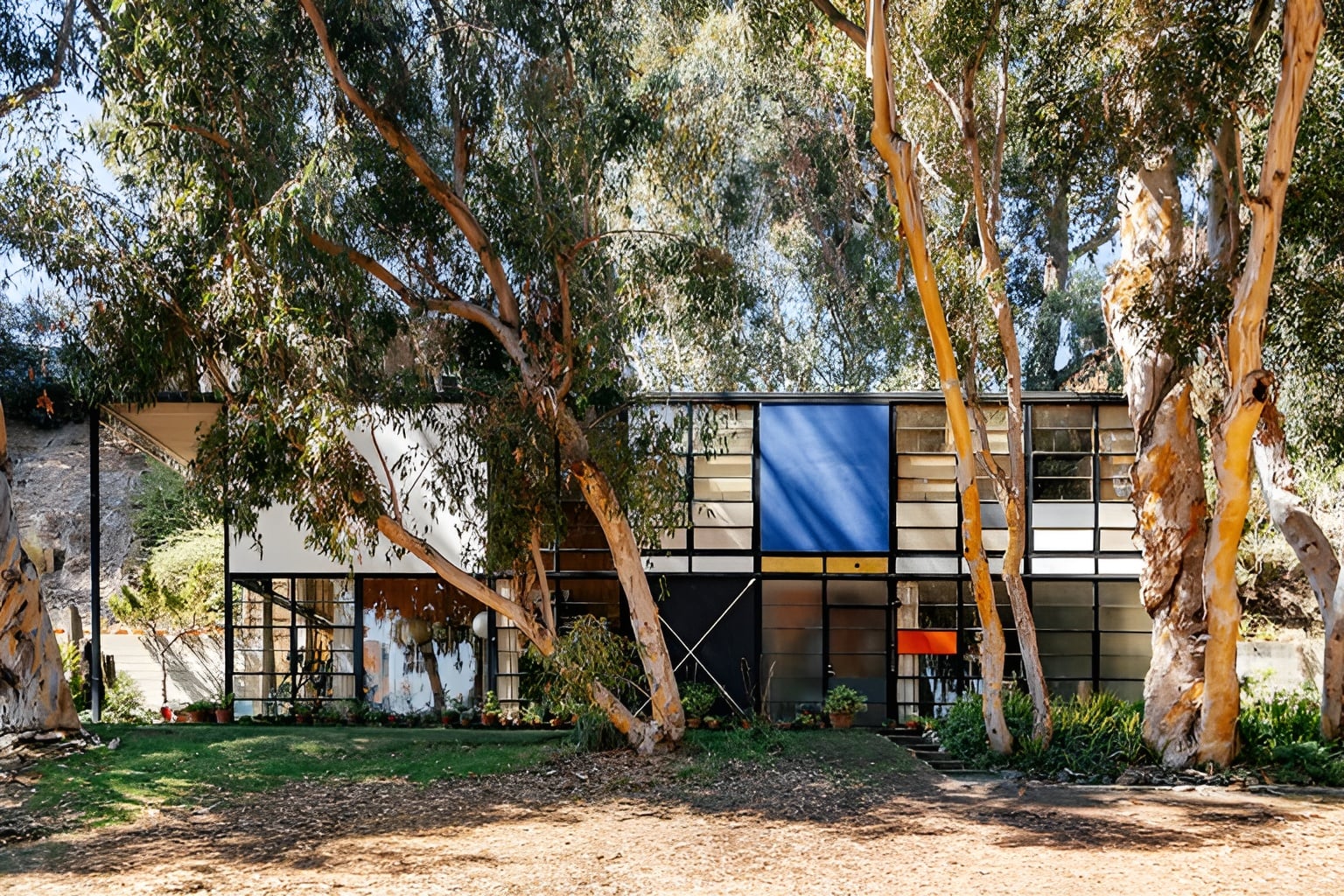
Eames House residential building designed by Charles and Ray Eames in Los Angeles has redefined postwar domestic architecture through prefabrication, spatial continuity, and integration with landscape, completed in 1949. Eames House operates as both residence and studio within the Case Study House Program, advancing industrialized construction methods developed during World War II. Eames House organizes two volumes—a living unit and a studio—separated by a courtyard and anchored by a concrete retaining wall. A steel frame infilled with standardized panels constructs a flexible facade that modulates light. Double-height spaces and transparency establish a continuous relationship between interior and exterior. The project demonstrates how prefabricated systems support spatial richness while accommodating everyday life and work.

Eames House, originally known as Case Study House No. 8, was developed for the Case Study House Program initiated by Arts & Architecture magazine. The program tested new materials and construction methods derived from wartime production. The design relied on prefabricated components, reduced site impact, and defined a modern domestic language. An earlier 1945 scheme developed with Eero Saarinen proposed a cantilevered “Bridge House,” but material shortages led to a revised configuration completed in 1949.
 Eames House / Charles and Ray Eames | Classics on Architecture Lab 115
  Eames House / Charles and Ray Eames | Classics on Architecture Lab 116
  Eames House / Charles and Ray Eames | Classics on Architecture Lab 117
  Eames House / Charles and Ray Eames | Classics on Architecture Lab 118
  Eames House / Charles and Ray Eames | Classics on Architecture Lab 119
  Eames House / Charles and Ray Eames | Classics on Architecture Lab 120
The house sits on a 1.4-acre site on a bluff overlooking the Pacific Ocean. Two rectilinear volumes—a residence and a studio—are arranged around an open courtyard and tied together by a long concrete retaining wall. The composition responds to a flat terrace within a steep landscape while preserving the existing meadow and a row of eucalyptus trees that frame the structure and provide shade.
 Eames House / Charles and Ray Eames | Classics on Architecture Lab 121
  Eames House / Charles and Ray Eames | Classics on Architecture Lab 122
  Eames House / Charles and Ray Eames | Classics on Architecture Lab 123
  Eames House / Charles and Ray Eames | Classics on Architecture Lab 124
  Eames House / Charles and Ray Eames | Classics on Architecture Lab 125
  Eames House / Charles and Ray Eames | Classics on Architecture Lab 126
  Eames House / Charles and Ray Eames | Classics on Architecture Lab 127
  Eames House / Charles and Ray Eames | Classics on Architecture Lab 128
The program is divided between the two volumes, each containing double-height spaces at their ends to create visual continuity and spatial layering. The courtyard operates as an intermediary void, linking both parts while maintaining functional separation. The studio accommodates work-related activities, reinforcing the dual domestic and creative use of the project.

A steel structural frame composed of standardized elements, including 4-inch H-columns and deep web joists, defines the construction system. Opaque and transparent panels are arranged in a geometric grid, producing shifting light conditions throughout the day. Standardized window modules and off-the-shelf components reinforce the prefabricated logic.
 Eames House / Charles and Ray Eames | Classics on Architecture Lab 129
  Eames House / Charles and Ray Eames | Classics on Architecture Lab 130
The interior contrasts the industrial frame with natural materials. Wood flooring and furnishings introduce warmth, while light penetrates deep into the space. Double-height volumes and open connections maintain continuity across levels, while the arrangement of objects, furniture, and collections reflects the occupants’ daily life and design practice.
 Eames House / Charles and Ray Eames | Classics on Architecture Lab 131
  Eames House / Charles and Ray Eames | Classics on Architecture Lab 132
  Eames House / Charles and Ray Eames | Classics on Architecture Lab 133
  Eames House / Charles and Ray Eames | Classics on Architecture Lab 134
  Eames House / Charles and Ray Eames | Classics on Architecture Lab 135
  Eames House / Charles and Ray Eames | Classics on Architecture Lab 136
  Eames House / Charles and Ray Eames | Classics on Architecture Lab 137
  Eames House / Charles and Ray Eames | Classics on Architecture Lab 138
The spatial organization avoids rigid separation between private and public areas. The upper-level bedroom overlooks the living space, reinforcing continuity. A fluid sequence of spaces emerges, where boundaries dissolve and movement extends across volumes and levels.
 Eames House / Charles and Ray Eames | Classics on Architecture Lab 139
  Eames House / Charles and Ray Eames | Classics on Architecture Lab 140
Project Gallery
 © Flickr User: Stephen Canon © Library of Congress
  © Library of Congress © Library of Congress
  © Library of Congress
  © Library of Congress
  © Library of Congress
  © architecture-history.org
  © architecture-history.org © architecture-history.org © architecture-history.org © architecture-history.org
  © Library of Congress © architecture-history.org
  © eamesfoundation.org
  © architecture-history.org
  © architecture-history.org
  © Dystopos
  © eamesoffice.com
  © Flickr User: rpa2101
  © architecture-history.org © architecture-history.org
  © architecture-history.org © architecture-history.org © architecture-history.org
  © architecture-history.org © Flickr User: “Ilpo’s Sojourn”
  © architecture-history.org © Carol M. Highsmith
  © architecture-history.org
  © Flickr User: Stephen Canon
  © architecture-history.org
  © architecture-history.org
  © architecture-history.org
  © architecture-history.org
  © ercwttmn
  © Flickr User: rpa2101
  © Flickr User: Stephen Canon
  © Flickr User: An Amateur
  © Flickr User: Stephen Canon
  © architecture-history.org
  © architecture-history.org
  © architecture-history.org
  © architecture-history.org
  © architecture-history.org
  © architecture-history.org
  © Flickr User: “Ilpo’s Sojourn” © architecture-history.org
  © Flickr User: Stephen Canon
  © eamesoffice.com © architecture-history.org
  © eamesoffice.com
  © architecture-history.org
  © architecture-history.org
  © architecture-history.org
  © architecture-history.org © eamesoffice.com © eamesoffice.com
  © architecture-history.org
  © architecture-history.org © architecture-history.org © architecture-history.org © architecture-history.org © architecture-history.org
  © architecture-history.org © edward stojakovic
  © architecture-history.org
  © architecture-history.org
  © architecture-history.org
  © architecture-history.org
  © architecture-history.org
  © architecture-history.org
  © architectenwerk.nl
  © Flickr User: An Amateur
  © architecture-history.org
  © architecture-history.org
  © architecture-history.org
  © architecture-history.org
  © architecture-history.org © architecture-history.org © architecture-history.org
  © architecture-history.org
  © Canela.colores © Charles and Ray Eames © Charles and Ray Eames © architecture-history.org © Charles and Ray Eames © Charles and Ray Eames
Project Location
Address: 203 Chautauqua Boulevard, Pacific Palisades, Los Angeles, California 90272, United States
Location is for general reference and may represent a city or country, not necessarily a precise address.