

Architects: LUO studio
Area: 73.55 m²
Year: 2025
Photography: Zhu Yumeng, Han Dawang, Cao Yutao, Jin Weiqi,
Design Team: Luo Yujie, Wang Beilei, Hong Lun, Cao Yutao, Liang Jiahui
Contractor: Shinewood Building Technology (Beijing) Co., Ltd.
Landscape & Interior Design: LUO studio
Art Collaboration: Liu Qingyuan
Art Creation: Liu Qingyuan, Song Qi, Wu Di
Client: Huizhou Huanliangshan Investment & Development Co., Ltd.
Project Organizer: Shanghai Fengyuzhu Culture Technology Co., Ltd.
Location: Shisanba Bridge, Mazha Town, Longmen County, Huizhou, Guangdong
Country: China
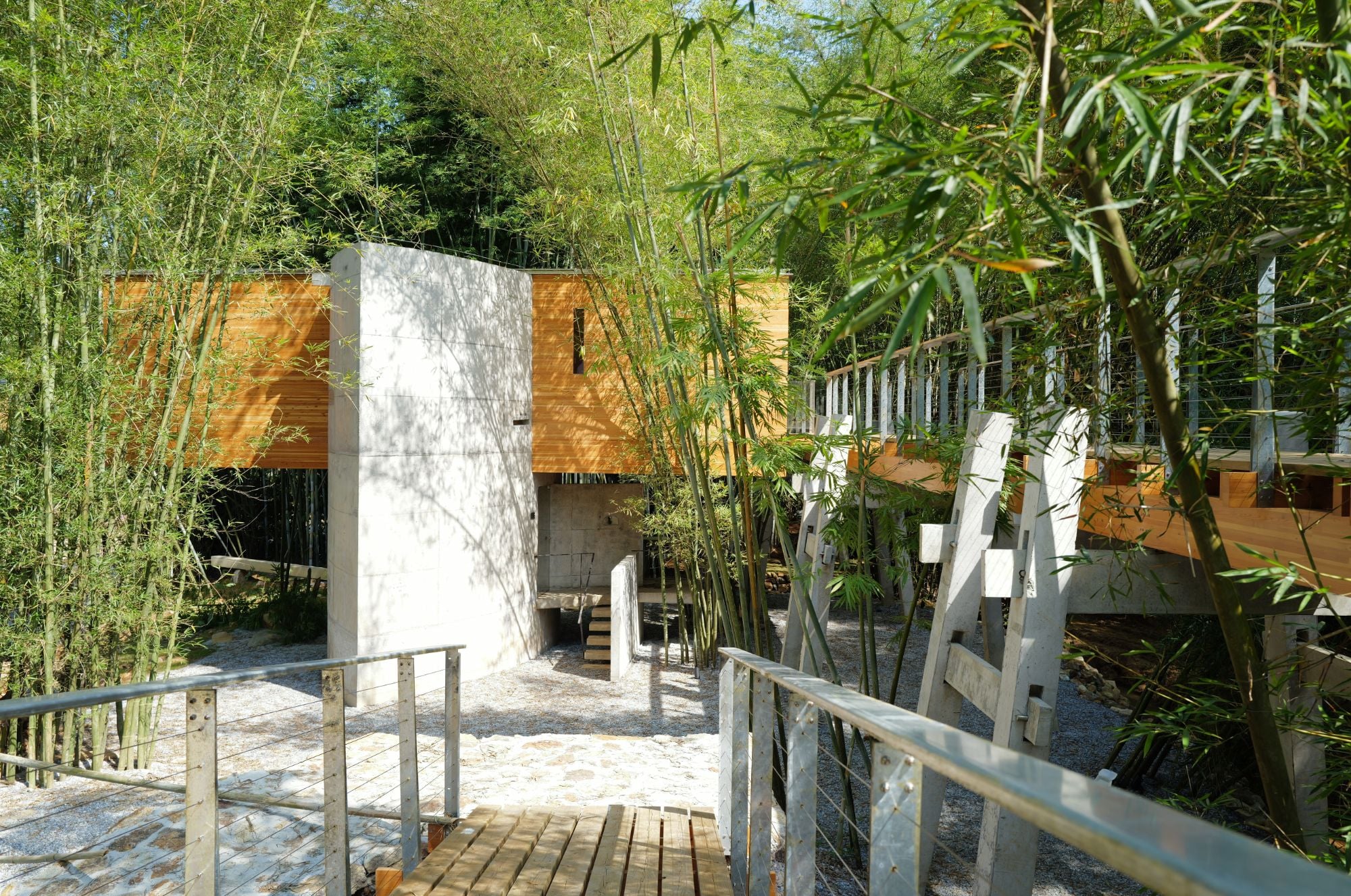
Huizhou Vernacular Historic Bridges Micro-Museum is a small cultural pavilion set within a bamboo grove beside Shisanba Bridge in Huizhou, Guangdong. Designed by LUO studio as part of the Nankunshan-Luofushan Rim Pioneer Zone Architectural Art Project, the building operates as both an exhibition space and a modest visitor facility, combining a gallery with tea and coffee service, restrooms, and outdoor seating. The project emerged from field research into Huizhou’s vernacular stone bridges, especially two local types: the low baqiao, also known as the “goose-chest bridge,” and the elevated gaoqiao, or “bench-leg bridge.” Drawing from these precedents, the architects developed a compact two-level concrete volume paired with a long raised walkway through the bamboo grove. The museum also incorporates artworks by printmaker Liu Qingyuan documenting the region’s historic bridges. Rather than treating heritage as a static subject, the project frames rural infrastructure, craft memory, and landscape as an active cultural narrative, giving overlooked local bridges a renewed public presence.

The project is most compelling not as an isolated object, but as an act of architectural listening. Instead of approaching the site beside Shisanba Bridge as a scenic backdrop for a new pavilion, LUO studio treated it as a place already shaped by intelligence, labor, and repetition. The ancient bridge, with its thirteen stone piers and worn bluestone slabs, became less a picturesque artifact than a prompt to reconsider how vernacular infrastructure encodes local knowledge. In that sense, the micro-museum begins not with form-making, but with attention to the latent logic of the landscape.

That logic was uncovered through research into Huizhou’s historic bridge-building traditions. The architects identified two principal types that informed the proposal. The first, the baqiao, is defined by tapered piers oriented upstream, their lifted profiles giving rise to the local name “goose-chest bridge.” The second, the gaoqiao or “bench-leg bridge,” uses slender stone supports that angle outward to stabilize crossings over narrower channels with greater elevation changes. What interested the architects was not only their structural ingenuity, but also the way these bridges expressed a broader system of stone craftsmanship visible across the region, from thresholds and window frames to the carved details of Hakka walled compounds.
 © Cao Yutao
  © Jin Weiqi
  © Hong Lun
  Huizhou Vernacular Historic Bridges Micro-Museum / LUO Studio 97
This research shaped a project that is both interpretive and infrastructural. Conceived as a micro-museum dedicated to Huizhou’s increasingly overlooked rural bridges, the building had to satisfy the practical requirements of the wider curatorial initiative while preserving a coherent architectural position. The program, therefore, combines exhibition space with a café, washbasins, restrooms, and areas for rest, allowing the project to serve travelers on the scenic route while establishing a venue for the documentation of local bridge culture. Artworks by Guangdong printmaker Liu Qingyuan extend that ambition, transforming the museum into a collaborative curatorial platform in which architecture provides the spatial frame and art provides another register of testimony.
 © Zhu Yumeng
  © Zhu Yumeng
  © Zhu Yumeng
  © Zhu Yumeng
  © Zhu Yumeng
Formally, the project is divided into two related gestures. The enclosed building volume reinterprets the spatial logic of the baqiao through a spindle-shaped concrete mass pierced by a timber-framed passage, an abstraction of the relationship between pier and deck. Within this compact figure, the lower level accommodates entry, part of the exhibition, and public amenities, while the upper level contains the main gallery and refreshment area. From there, visitors proceed directly to an elevated exterior walkway that offers a new vantage point over Shisanba Bridge and the surrounding river landscape. The walkway, in turn, draws from the tectonic language of the gaoqiao, translating the traditional bridge’s mortise-and-tenon sensibility into a cast-in-place reinforced concrete structure with a slender trapezoidal section.
 © Zhu Yumeng
  Huizhou Vernacular Historic Bridges Micro-Museum / LUO Studio 98
  © Zhu Yumeng
Its details are handled with notable restraint. Timber planks on the walkway are separated by widened joints, recalling the spacing between stone slabs in traditional bridge decks and producing subtle shifts of light and view. The concrete walls are punctured with gourd-shaped, semicircular, and triangular openings derived from the apertures found in nearby vernacular compounds. A salvaged gourd-shaped stone fragment, gathered during fieldwork, is displayed inside as a small but precise piece of material evidence. Even construction byproducts are folded back into the site: steel molds become drainage channels, and extra concrete beams are reused as a bench along the water’s edge.
 © Zhu Yumeng
  © Zhu Yumeng
  © Zhu Yumeng
  © Zhu Yumeng
  © Zhu Yumeng
  © Zhu Yumeng
Just as important is what the project declines to do. The bamboo grove is largely preserved, allowing the new intervention to move through the site lightly rather than overwrite it. This restraint gives the micro-museum a particular clarity. It does not monumentalize the past or attempt to simulate vernacular form. Instead, it reframes inherited construction knowledge through contemporary means, making local bridge culture legible without reducing it to nostalgia. In a rapidly urbanizing region where rural artifacts are easily dismissed as obsolete, Huizhou Vernacular Historic Bridges Micro-Museum offers a quieter proposition: that architecture can serve as a medium for recognition, helping overlooked infrastructures of everyday life re-enter public consciousness with dignity and precision.
 © Zhu Yumeng
  Huizhou Vernacular Historic Bridges Micro-Museum / LUO Studio 99
Project Gallery
 © Han Dawang
  © Han Dawang
  © Han Dawang
  © Zhu Yumeng © Zhu Yumeng
  © Zhu Yumeng © Zhu Yumeng © Zhu Yumeng © Zhu Yumeng
  © Han Dawang © Zhu Yumeng
  © Zhu Yumeng
  © Zhu Yumeng © Zhu Yumeng © Zhu Yumeng
  © Zhu Yumeng
  © Zhu Yumeng
  © Zhu Yumeng
  © Zhu Yumeng
  © Zhu Yumeng © Zhu Yumeng © Zhu Yumeng © Zhu Yumeng © Zhu Yumeng
  © Zhu Yumeng
  © Zhu Yumeng © Zhu Yumeng
  © Zhu Yumeng
  © Zhu Yumeng
  © Zhu Yumeng
  © Zhu Yumeng
  © Zhu Yumeng
  © Zhu Yumeng © Zhu Yumeng © Cao Yutao © Hong Lun
  © Cao Yutao
  © Zhu Yumeng © Zhu Yumeng
  © Han Dawang
  © Han Dawang
  © Han Dawang
  © Han Dawang
  © Han Dawang
  © Han Dawang
  © Han Dawang
  © Han Dawang
  © Han Dawang
  © Han Dawang
  © Zhu Yumeng
  © Zhu Yumeng
  © Zhu Yumeng
  © Zhu Yumeng
  © Zhu Yumeng
  © Zhu Yumeng
  © Zhu Yumeng
  © Zhu Yumeng
  © Zhu Yumeng
  © Zhu Yumeng
  © Zhu Yumeng
  © Jin Weiqi
  © Jin Weiqi © Jin Weiqi
  © Jin Weiqi
  © Jin Weiqi
  © Jin Weiqi
  © Jin Weiqi
  © Jin Weiqi
  Huizhou Vernacular Historic Bridges Micro-Museum / LUO Studio 100 Huizhou Vernacular Historic Bridges Micro-Museum / LUO Studio 101
  Huizhou Vernacular Historic Bridges Micro-Museum / LUO Studio 102
  Huizhou Vernacular Historic Bridges Micro-Museum / LUO Studio 103
  Huizhou Vernacular Historic Bridges Micro-Museum / LUO Studio 104 Huizhou Vernacular Historic Bridges Micro-Museum / LUO Studio 105
  Huizhou Vernacular Historic Bridges Micro-Museum / LUO Studio 106 Huizhou Vernacular Historic Bridges Micro-Museum / LUO Studio 107
Project Location
Address: Shisanba Bridge, Mazha Town, Longmen County, Huizhou, Guangdong, China
The location specified is intended for general reference and may denote a city or country, but it does not identify a precise address.