
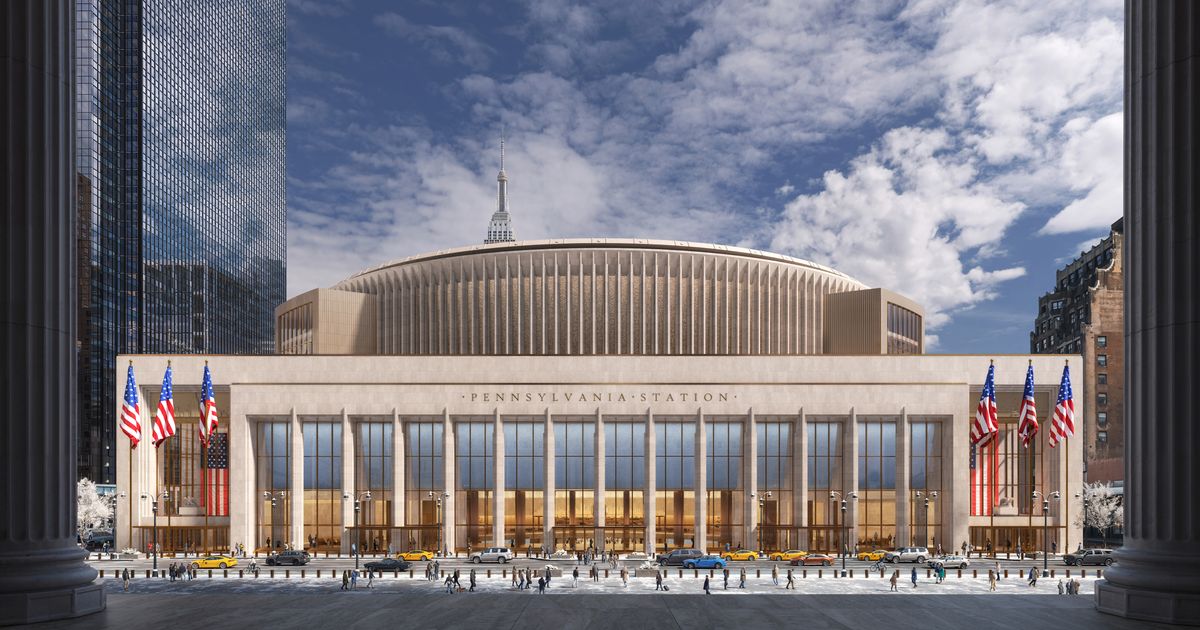
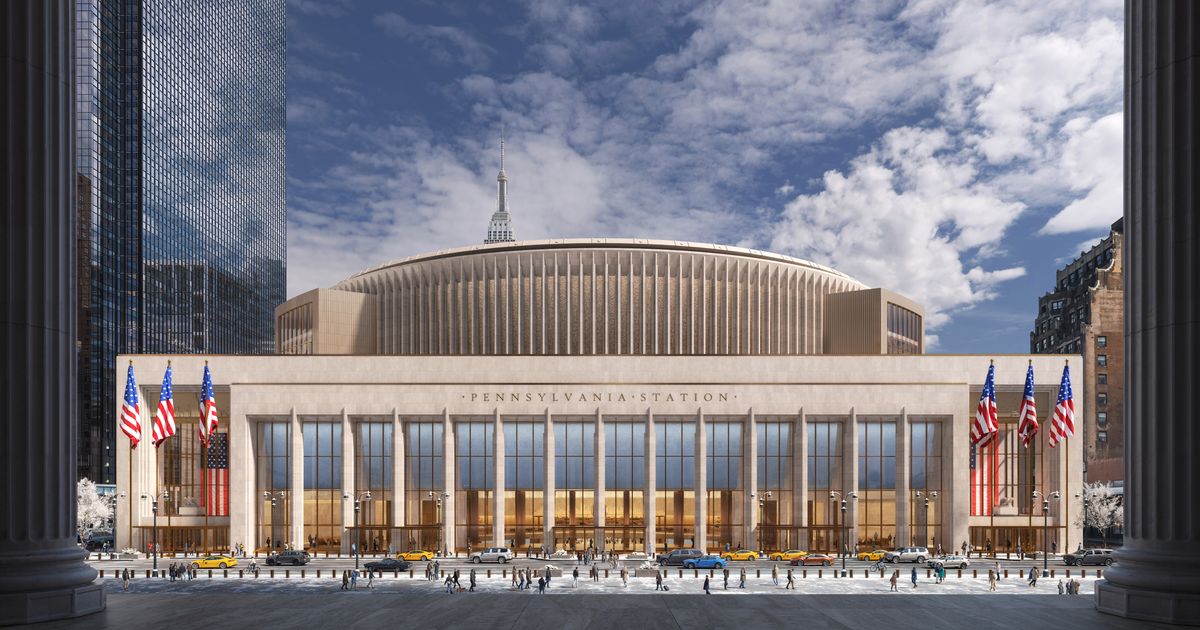
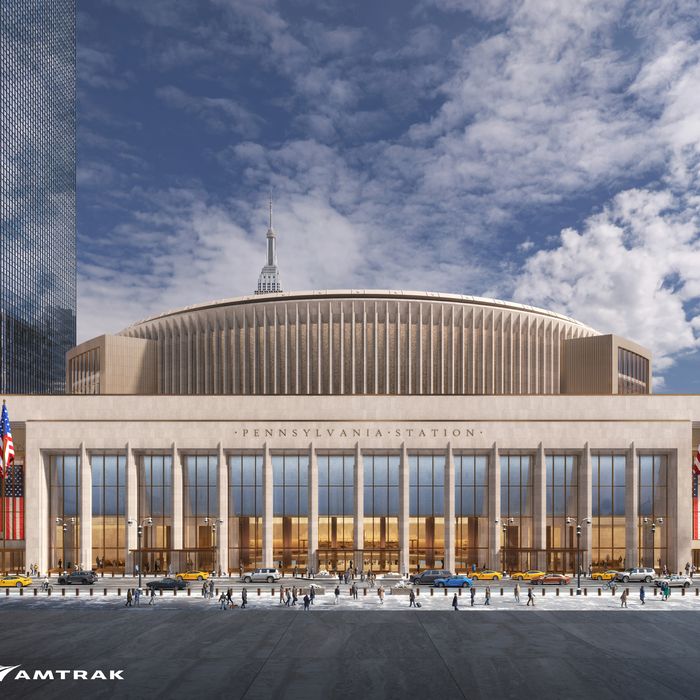
The new Penn Station faces Eighth Avenue with a grand ceremonial façade … Photo: PAU
At last! You may have lost track of how many proposals and promises for an airy and gorgeous new Penn Station have come and gone, but the Charlie Brown football of transportation projects is back, urging us to believe that this time the plan will stick. The design is done, restive partners are onboard, technical conundrums have been resolved, and the check just might be in the mail. A mere 18 months from now, work will get started on the building that will replace the nasty hive we’ve made do with since 1968, after we demolished McKim, Mead & White’s gracious original. Redemption is at hand. Right?
Believe it or not, it’s possible.
In real life, contingencies abound. The design is still in progress, and while NJ Transit has joined Amtrak in shaping the latest proposal, the MTA remains sulkily aloof. The big news is that the Trump administration, which snatched the project from the MTA, has picked a lead developer, a consortium led by Halmar International, and promised to kick in $8 billion, theoretically enough to pay for the whole shebang. And that puts a new Penn Station in the less-than-reassuring category of Trump Sure Things. (In the end, funding the project will require a complicated mix of private and public sources.)
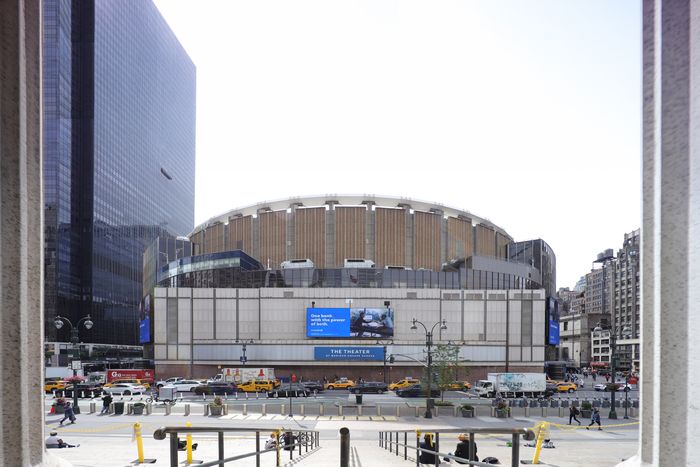
… Reframing the cluttered, clunky oil drum of Madison Square Garden Photo: PAU
And yet, a skeptic can indulge in some tentative celebration. The latest version of this perpetual top priority just might dispel the curse of inertia — because it should dramatically alleviate crowds, delays, and misery, and because it comes with architecture we can treasure rather than tolerate. The new stone-clad commuter palace, designed by the architecture boutique PAU and the global firm HOK, updates and softens a more austere iteration that the same team produced in 2023. In this iteration, the cylindrical bulk of Madison Square Garden acquires a certain classical nobility, wrapped in terra-cotta tiles that glitter through a corset of stone ribs. Rising above the rectangular podium, the form suggests the stump of a fluted column sitting on a marble base. The station below emerges from a form of urban surgery: a radical theaterectomy. The venue that now clings to the underside of the Garden’s bowl, and which you may know as the WaMu, Hulu, Paramount, Felt, or (as of last February) Infosys Theater, will be cut away, leaving space for an ample train hall. That grand and sunlit, high-ceilinged room and its Eighth Avenue façade anchor all the below-ground complexity of concourses, connections, and platform access.
The design resolves a host of inherent frustrations, though not all. It doesn’t magically run New Jersey trains through Manhattan and out to Long Island or Connecticut, which could provide one-fare rides throughout the region and eliminate the cumbersomeness of backing every train out of its terminal. It won’t wreak widespread destruction, as Governor Hochul’s 2022 plan would have, but it does raise questions about how it will change the area around it. And there’s still debate about placing the ceremonial façade on Eighth Avenue when so many more people currently arrive from Seventh. The new orientation could serve the growth in commuters who arrive from New Jersey and commute to midtown’s western flank — or it could amount to sticking the building’s front on at the back. What the plan does accomplish is it clears away columns from the congested platforms and adds escalators, so commuters don’t have to stand in line to exit or rush to board in the few minutes between the platform announcement and departure. An orderly grid of wide, high-ceilinged concourses, all on one level, replaces the multilevel ant farm of today, making the station safer and less stressful for its 650,000 daily passengers. The 18-wheelers serving Madison Square Garden, which now trundle in, back out, and cause gridlock on the street, will move through the building’s innards and stay out of sight.
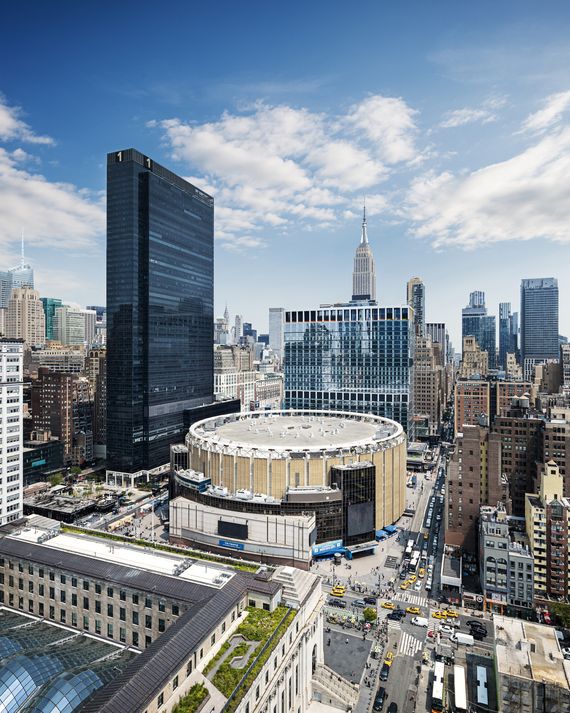
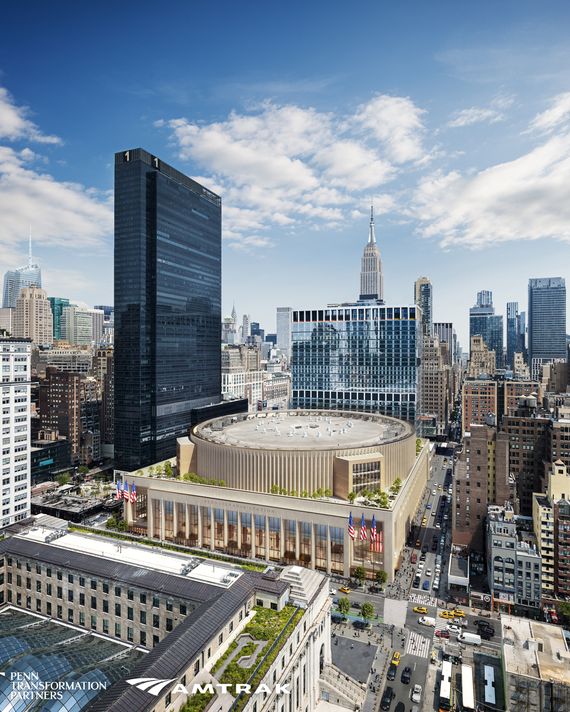
From left: Boxing the cylinder in with a square podium gives the whole complex the look of a truncated classical column. Photo: DBOXPhoto: PAU
From top: Boxing the cylinder in with a square podium gives the whole complex the look of a truncated classical column. Photo: DBOXPhoto: PAU
New Yorkers are used to the craziness of a transportation hub you can’t see until you’re inside and can’t navigate unless you know where you’re going. But it doesn’t have to be this way. What PAU does is offer the city a real work of architecture that stitches together not just three different transit agencies, but also New York needs with White House diktats, the oil-drum Garden and the rectilinear block, Manhattan’s spine to its western flank, tunnels to the skyline, and the great railroad era of the past with the commuting needs of the future. The design that emerges from this tangle of technological, institutional, urban, and aesthetic forces is a triumph of clarity. Those corner porticos will ensure that nobody ever has to hunt for an entrance again.
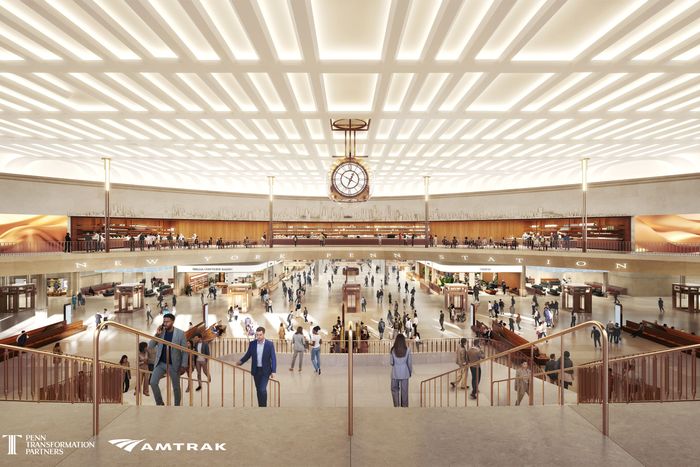
The biggest changes are on the inside: Finally, the nation’s busiest train station gets an ample train hall. Photo: PAU
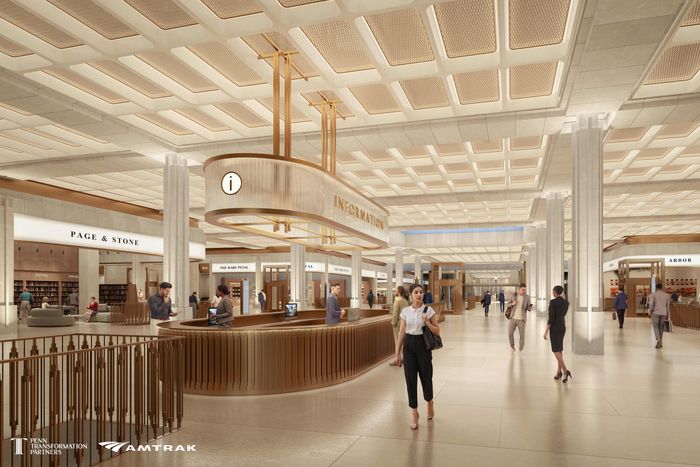
Photo: PAU
When a handful of renderings leaked prematurely, the initial reactions focused on ostensibly vulgar details, especially bronze accents that looked implausibly golden in the renderings and a presidential seal etched on one wall. The images renewed fears that the four-foot-high letters spelling out “Pennsylvania” will be amended to “T-R-U-M-P.” It would be ironic if a New Yorker who traveled by subway as a child and boarded an Amtrak train exactly once as an adult bequeathed the city a temple to rail travel.
But PAU’s design is far from a sop to a vainglorious potentate, because it possesses integrity and poise. The architects have managed to avoid the off-the-shelf monumentality of that grotesque triumphal arch now being planned for Washington, D.C. Instead, they balance detail and scale, rational planning and theatrical appeal, sumptuousness and efficiency. With its anthology of familiar tropes — columns that reach up to grip the entablature, bronze canopies, and terra-cotta friezes, this Penn won’t inaugurate a new age of civic architecture in New York, but it might refresh a run-down district. It will, at long last, look like a train station from blocks away, mirror the civic heft of the Farley Post Office Building across Eighth Avenue, and be a pleasure to hustle through. Unlike Amtrak’s chilly and benchless Moynihan Train Hall, it even has places to sit.
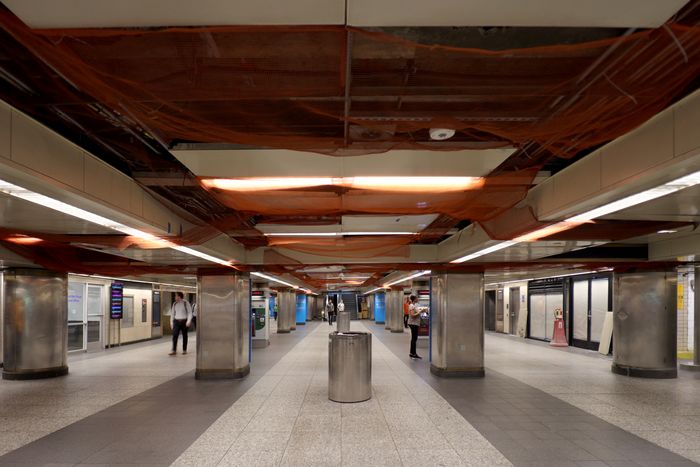
The present-day interior is a low-ceilinged warren. Photo: PAU
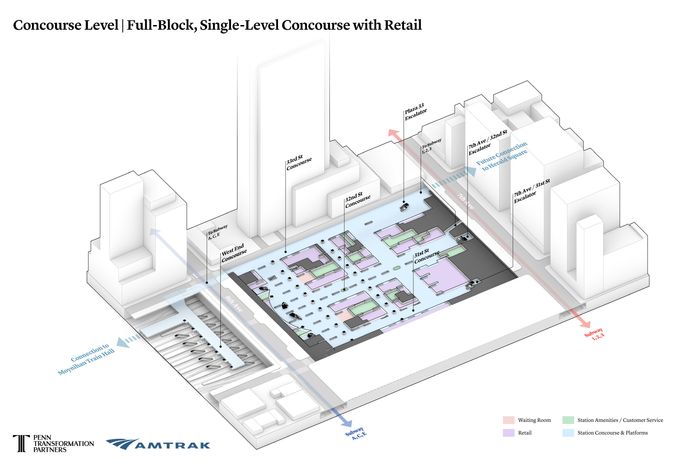
A simple grid of wide, high-ceilinged concourses does away with the mystifying warren of tunnels. Photo: PAU
You might think that the nation’s busiest train station, the engine of New York’s life as a business hub, demands a more radical design. One reason it’s not is that the man footing the bill — or promising to — has decreed the nation’s allegiance to Ye Olde Styles in an executive order making “classical architecture” the “preferred architecture for applicable Federal public buildings.” PAU’s founder, Vishaan Chakrabarti, and his partners have clearly agonized over how to confront the White House’s roster of acceptable official revivalisms (“Neoclassical, Georgian, Federal, Greek Revival, Beaux-Arts, and Art Deco”) while maintaining their professional honor. They wisely chose the version of neoclassicism that birthed the modernist era: Art Deco, perhaps the last fresh architectural style that Americans could agree to love, and that spread across the country in the form of federally funded WPA buildings. A century after it first became fashionable, Art Deco still has a hold on New Yorkers’ imagination in a way that no other movement could ever manage. Even now, its fins and pilasters adorn plenty of new construction, and in real-estate-speak, the phrase is code for high class. PAU’s Penn could wind up being Neo-Deco’s apotheosis or its epitaph. Either way, it’s hard to imagine another public building outdoing it in sleek retro splendor. (The renderings have been toned down since the leak, and the accents look more bronze and less Las Vegas now.)
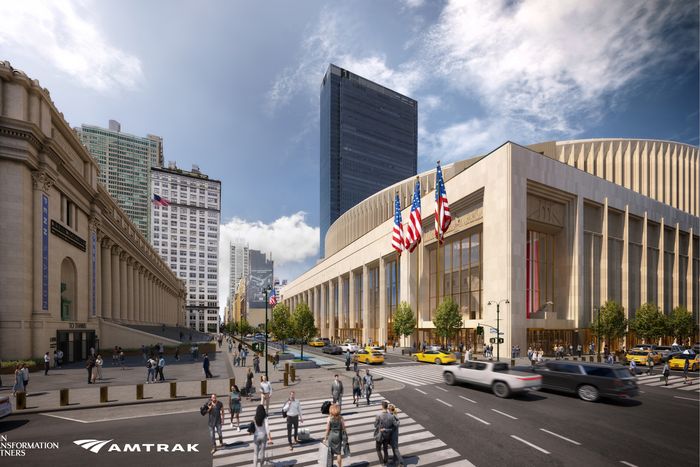
Replacing signage with architecture gives Eighth Avenue a dignity it’s never had. Photo: PAU
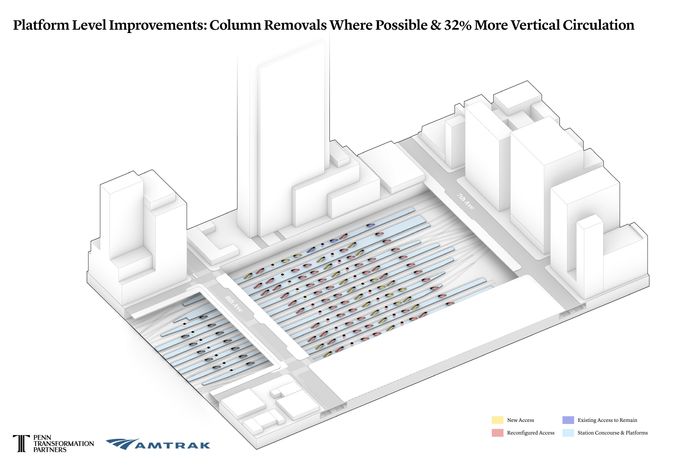
Removing columns and adding escalators goes a long way to getting arriving passengers off the platforms quickly and speeding up train maneuvers. Photo: PAU
But even without Trump ordering up porticoes and colonnades, the architects would likely have looked backward to look forward. Chakrabarti has been mulling over the problem of Penn since at least 2016, when he fantasized that Madison Square Garden would decamp, leaving a circular steel skeleton that could be repurposed into a glass pavilion above a giant hall. It was a brilliant but impractical solution, for the same reason relocating the Garden isn’t happening now: Paying off the owners to move out would make the project astronomically expensive. But even that speculative scheme showed how sophisticated PAU could be in adapting an assortment of seductive pasts. At the Domino Refinery, it slipped a modern office building inside an industrial shell. Renovating the Rock & Roll Hall of Fame means coming to grips with I.M. Pei’s original design. A new residential college at Princeton will negotiate with a gathering of neo-Gothic and variously modern predecessors.
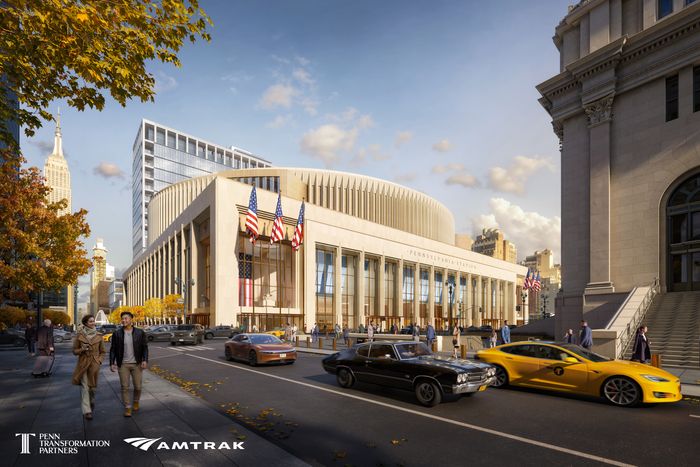
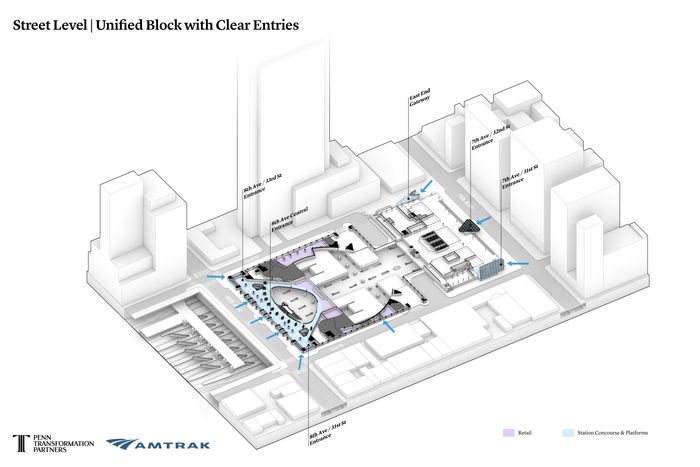
A long colonnade and strong corners make the entrances clear from blocks away. Photo: PAU
With all the circulation and ticketing downstairs, the boomerang-shaped mezzanine walkway leads to a single destination: the bar. Photo: PAU
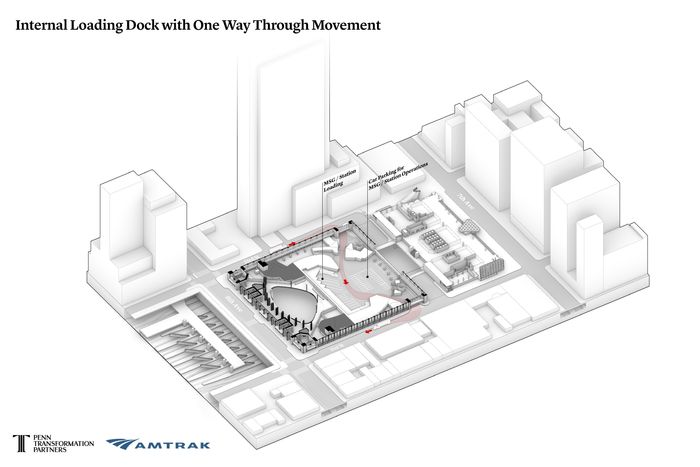
The internal one-way loading dock simplifies the Garden’s load-ins and gets 18-wheelers off the street. Photo: PAU
Besides, there is no such thing as starting from scratch at Penn Station. The 120-year-old foundations still dictate both the structure above and the flow of trains in and out. The demolition of McKim Mead and White’s masterpiece unleashed the preservation movement and a multigenerational tide of nostalgia, which should rightly get refracted into any new design. (This one incorporates four salvaged stone eagles from the original structure.) And the new architecture is entwined with an intricate and antique web of regional train lines. Even in the age of video conferencing, self-driving cars, and delivery drones, hundreds of thousands of workers schlep into Manhattan from the suburbs by train every morning and back the other way each evening, just as they have for a century. The future of commuting looks pretty similar to the past.
And so, in the constant tug-of-war between tradition and innovation, the latest design heaves toward history, meeting the future’s infrastructure needs in comfortingly familiar costume. It’s got as many backstory references as the latest Avengers movie. Here’s Paul Cret, high priest of stripped-down, monumental Art Deco in the 1930s. You might sense the ghost of the 19th-century Berliner Karl Schinkel, whose Altes Museum hints at complex goings-on behind the elongated colonnades. The stepped-back columns on Penn’s façade have several parents, including the ceiling in Carlo Scarpa’s Tomba Brion, coffered like an inverted stepwell, and Foster & Partners’ JP Morgan headquarters at 270 Park Avenue; if you flip that skyscraper’s setback crown on its side, you get the plan view of the PAU’s piers. There’s even a trace of Eero Saarinen’s TWA terminal in the parabolic, boomerang-shaped mezzanine that embraces a sinuous staircase.
And then, in absentia, there’s Santiago Calatrava, the architect whose example Penn Station tries to exorcise from the story of New York transportation design. His World Trade Center Transportation Hub offers a stripped-down neoclassicism so extreme it resembles a skeletal ruin bleaching in the Mediterranean sun — and it’s too futuristic for the White House’s squad of traditionalist aesthetes. And so here we get grey stone instead of white steel, columns that go straight up and down, and no tricky movable roof. But even without that auteurial branding, PAU’s design remains visionary.
To get this far, the architects navigated an unholy gauntlet of constraints. The result is a project that feels thoroughly coherent across different scales, linking handheld detail to grand gesture in a continuous architectural flow. That thread is fragile, though. The mezzanine’s railing alternates plain bronze spindles with miniature art deco skyscrapers. The train hall’s coffered ceiling reproduces a schematic map of Manhattan, and a blue-tiled wall that sweeps down from a double height window represents the Hudson River. These flourishes, recalling New York’s Jazz Age flamboyance, give the vast interior its fizz — and will inevitably have value engineers salivating to trim, slice, and simplify. To them, anything that smacks of architectural excess in a public building looks like a waste of money, even if the sums are piddling compared to the cost of invisible features like truck ramps, security systems, and ventilation. And so the end result could still wind up looking disappointingly generic.
But ornament wasn’t always treated as an indulgence; once, it expressed a collective elan and pride. At the turn of the 20th century, the great institutions of urban life — libraries, museums, post offices, train stations — were conceived as luxurious refuges for those who could only afford necessities. In 1910, you might live in a hovel, but you could read in a public palace. All the elaborate stonework, paint, and marble of those Beaux-Arts extravaganzas served to make New Yorkers feel that, though they might be individually poor, they shared in society’s wealth. PAU’s design for Penn doesn’t display that era’s democratic opulence or its stylistic confidence, but it does hint at that past, not by slathering on scrolls and Corinthian capitals, but by giving the whole ensemble a muted grandeur.
See All