
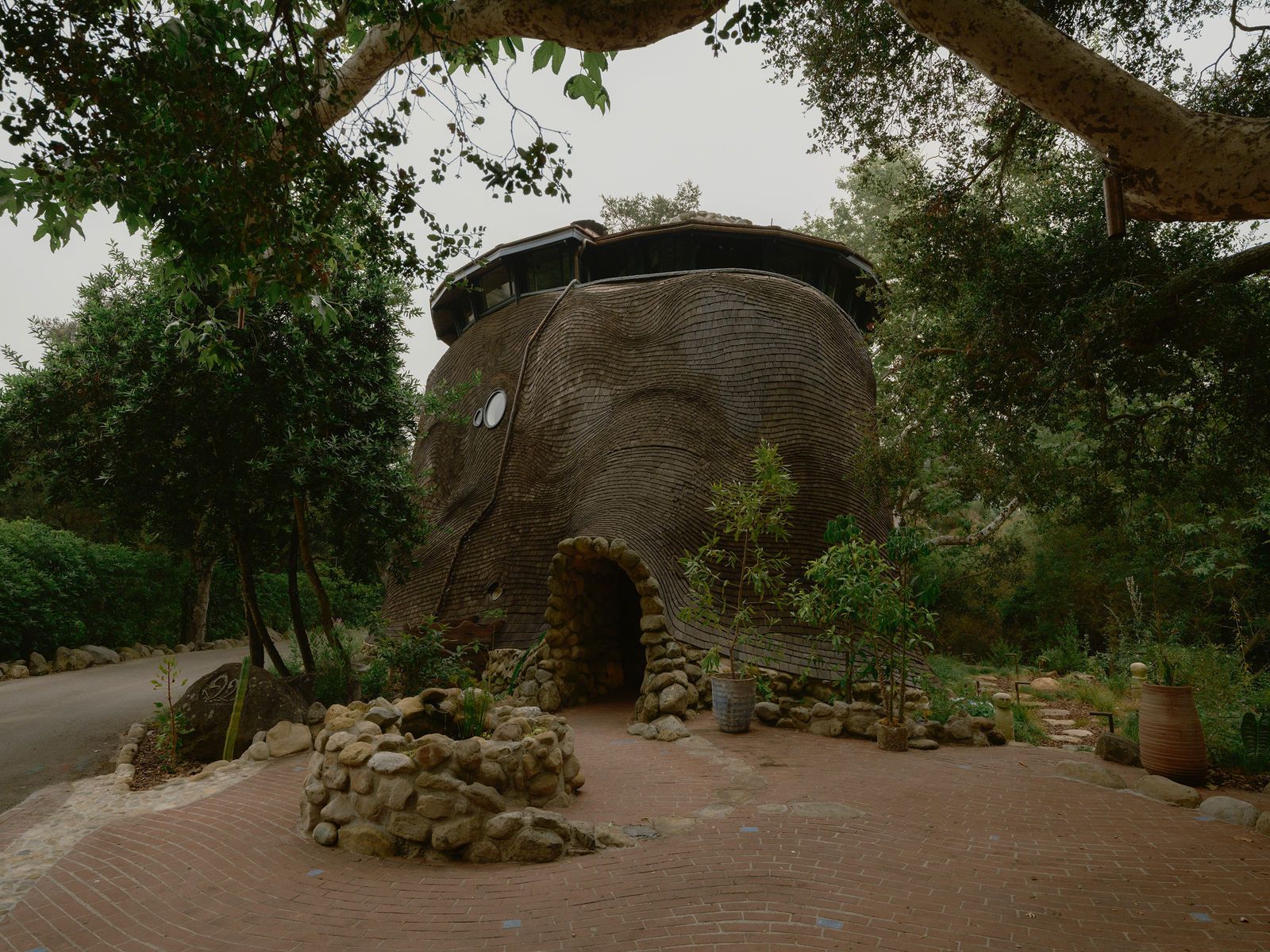
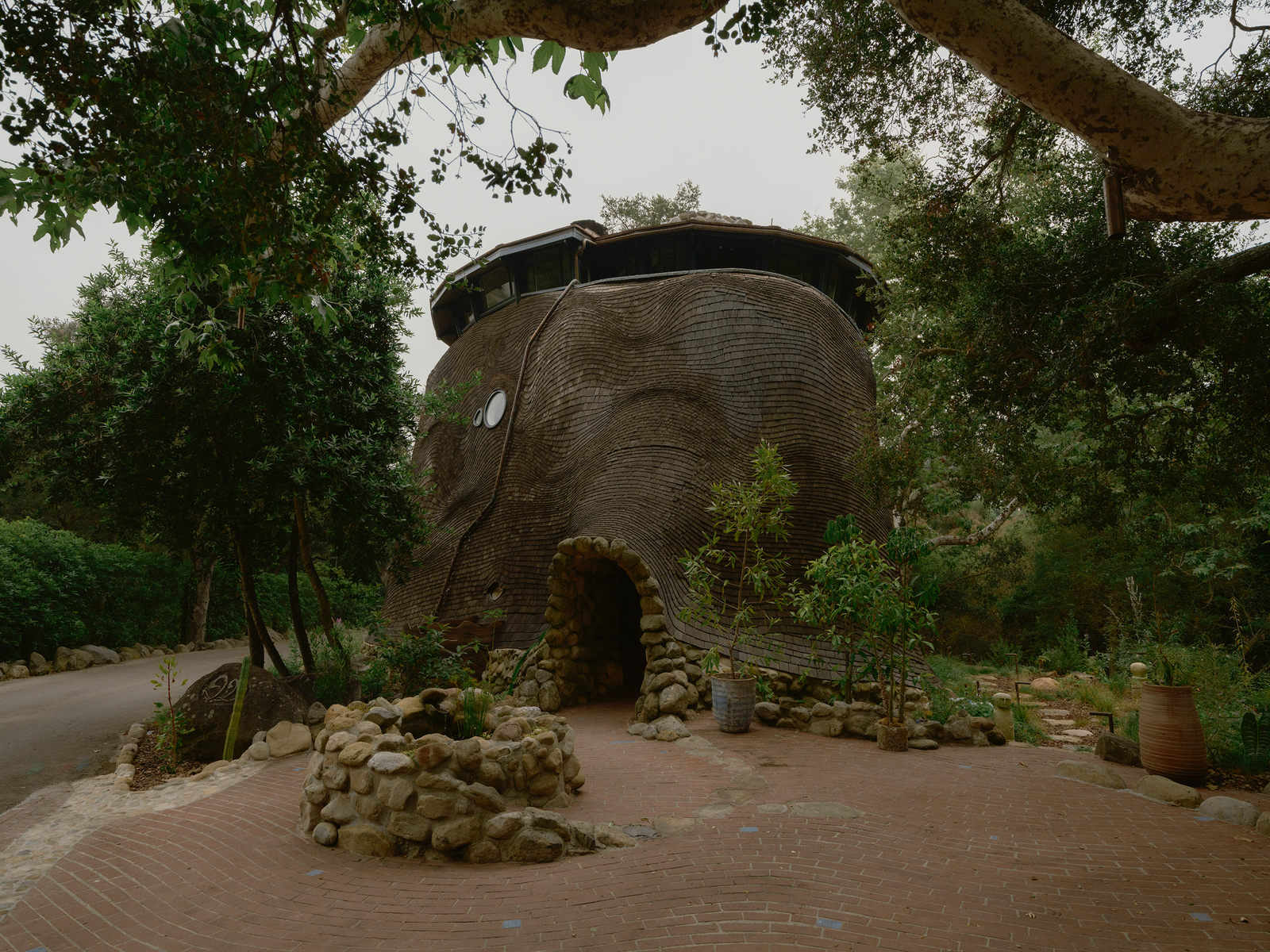
After Jeff “Jade” Spangler’s rental burned down in the 2009 Jesusita Fire in Santa Barbara, he moved into his motor home on the property, keeping an eye on Craigslist rental listings between runs to Northern California to trade at art festivals. His trips served a dual purpose: Many of the vendors were fronts for grow operations, so he’d sell his jade artwork and pick up pounds of marijuana to haul back to Los Angeles to sell to dispensaries. He kept a low profile by transporting goods in a Mini Cooper. “I never got greedy,” he says, pointing out that marijuana had yet to be legalized beyond medical use in California. Business was humming—he’d socked away nearly a million dollars by then, he says—when he saw an ad for the Whale House, a residence in Mission Canyon famed for being built in the likeness of, yes, a whale. He went to look at it immediately, wrote a check for the requested rent, and used it as home base for his operations for the next five years.
Spangler quite liked living at 999 Andante Road. Completed in 1978 by Michael Carmichael, an architect and builder with an engineering degree from UC Berkeley, the Whale House is cloistered and surreptitious in its plan, presenting as an Epic Bachelor Pad. Carmichael called it a high-tech hobbit house: The living area has a river rock hearth facing a very sexy lounge that, when it was built, had an entire wall of cascading plush purple and pink seating and a state-of-the-art sound system. On the second floor is a “bed-womb,” a hollow inside the second story wall with a door etched with moonbeams shooting from clouds. “Near a crackling river rock fireplace, [Carmichael] can slide from the hot tub and Jacuzzi straight into his waterbed cave,” wrote Anette Burden for the fall 1980 issue of Santa Barbara Magazine, her description seeming to parody the trimmings of double-oh agent-style philandering. “Inside, fabric panels hide a telephone, stereo system, color TV, and refrigerator stocked with champagne. It’s a safe, intimate space…” Not mentioned by Burden: a red-tiled primary bath with a urinal that lit up when approached, and a shower with several sprayers large enough for a group.
Spangler made a few enhancements over the years. Notably, in the backyard pool, he installed a 40-foot stripper pole with a redwood deck where his live-in personal assistant practiced her dancing. On occasion, she and two other women would don Hollywood-grade mermaid tails to perform at events in the garden, ensconced by old-growth oaks and cedar-clad walls topped with massive Gaudí-esque fiberglass tiles that resemble vertebrae. (Antoni Gaudí and Frank Lloyd Wright greatly influenced Carmichael.) Spangler dreamt of buying the home—he loved it. But he and the then-owners couldn’t agree on a price. So in 2014 it went on the market. “An architectural masterpiece on a creekside lot in Mission Canyon,” started a Prudential Realty ad taken out by Spangler’s landlords. “The ‘Whale House’ offers an escape from the ordinary! Offered at $1,795,000.”
The open-air foyer of the Whale House leads in three directions: to the left, the sauna and pool; straight ahead, inside the home; and to the right, a stair that spirals upward.
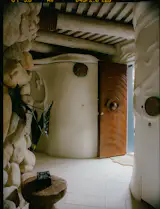
Through the front door and off to the left is the lounge, which has a hearth nested within the home’s river-rock core. The wavy white wall was originally covered in cascading, plush seating, and the floor was shag carpet.
Get the Dwell Newsletter
Be the first to see our latest home tours, design news, and more.
Subscribe
—
For more than 30 years, Fran Galt has had a distinct vantage of the Whale House and its rotating cast of admirers from her home across the street. Massive boulders that tumbled down the canyon in a mudslide around a thousand years ago frame a path to her driveway, and through a tangle of old oaks to the left she can see the home’s flowing rows of cedar shingles. “I guess it wasn’t for everybody, because very traditional people don’t want to live next to it,” she says. “But I’m an artist, so to me, it’s a work of art.” Galt vaguely remembers Spangler’s name, but definitely his parties. Signs reading “bathing suits optional” were posted around the property. “We got a kick out of that,” she says. One nice and unassuming couple who rented the home were, she says, arrested for making a business of selling pharmaceuticals under the table. Eddie Vedder apparently stayed in the house in the ’90s. “My neighbor said he told her that he played the guitar.” Did she ever hear him play? “No, I never did. I guess he liked to keep a low profile.”
In 2023, about a decade after the house sold and Spangler moved out, it listed again, and word spread fast. Shelter publications, including Dwell, circulated the news of the psychedelic home, and Sam Arneson, a California realtor who specializes in cedar-clad, shag-carpeted West Coast listings, even chimed in on socials that the Final Boss of ’70s organic architecture was once again up for sale. Word eventually made its way to Marley and Josh Raab, a millennial couple from Santa Barbara with two kids who were living at the top of the mountain behind the home. Ever since Marley was young, the myth of the Whale House has loomed large. She would leave her “grid reality” of a condo by the beach and drive into leafy Mission Canyon for summer camp, eager to catch a glimpse. “Counselors told us elves and gnomes lived there, and we were five, so we were like, it could be true,” says Marley. “It just looked like something out of Snow White to me. I remember my brain being like, Oh. My. God.” Marley grew up in a spiritual community, and later, becoming a yoga teacher led to psychedelic exploration, which came to include a curiosity for fringe real estate. “I am always looking for weird shit that’s kind of forgotten,” she says. She and Josh had agreed that if the home ever became available, they would put in an offer. Now here it was. By the time they heard back, they had already moved to Portland, Oregon, where they’d been living for nine months. But soon, they were officially Galt’s newest neighbors.
—
Since buying the home in 2023, Marley and Josh have been untangling its murky past and fantastical lore. Yes, it probably did its time as a Temple to Hedonism. Steven Handelman, who designed the home’s impossibly flowy stained glass and runs a lighting design business in town, describes Carmichael as a wild man who burned the candle at both ends. (Nobody I spoke to for this story was in touch with Carmichael or knew where he was. A message to his purported family was not returned by press time.) He built the home with a large crew of young men, many of them just out of high school, paying them in experience, the satisfaction of contributing to a once-in-a-generation build, perhaps, but also, a good hang. “Every Friday, they had a party, and all their friends would come around and everybody would get stoned and drink, with loud music,” says Handelman, who occasionally joined in. But maybe Carmichael’s uncompromising vision is much more than just a really great place to get high. Marley thinks he might have been unknowingly partying on hallowed ground of his own making: “To use New Age speak, a lot of people come here and they’re like, ‘It feels like it’s like a portal.’ And we’re like, ‘It could be.’”
She and Josh weren’t going to make the Whale their primary address, and not many have in the residence’s nearly 50-year existence. But what makes it unhinged as a place to live full-time also makes it great for a few weird nights. It has been used often as a short-term rental, and under the couple’s stewardship, psychonaut Meta executives have already done a lap, searching the contours of its slippery Möbius strip interiors. The couple have also extended an open-ended invitation to the local Indigenous community, since the home sits within an old Chumash Indian village. But what else? “I was like, I’m open to God on this one,” Josh says. Wedding inquiries have been pouring in, but endorsing couples’ commitments felt like, well, too much of a commitment. Concerts would be cool. Photo shoots, sure. Brand partnerships seem plausible.
Architect Michael Carmichael designed a “bed-womb” on the second floor.

The Whale’s new owners, Josh and Marley Raab, brought in new furnishings that freshen up the home while complementing its fantasy.

Actor and director Eric Wareheim brought in plantings from his Los Angeles shop, Serpentine. One rises from the ground floor up to the second-level primary.
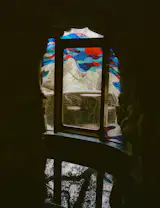
Original stained glass by Santa Barbara designer Steven Handelman completes the “bed-womb’s” river-rock hot tub, which opens to a balcony.
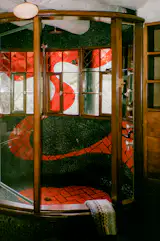
A shower big enough for a crowd features multiple sprayers and a view down over the garden.
At the same time, there was a pretty big maintenance punch list to work through. The home’s riparian position along a shady creek basically makes it a giant wet log. “Termites, ants, bees, rats, bats—you name it. Everything that’s going to feed on a rotting structure of a log is there,” says Spangler. There was once a beehive in the wall on the third floor, and to remove it, a section had to be cut open. In fact, ever since Carmichael built the home, it has gone through cycles of disrepair and restoration, its ferrocement construction style and building code-defying elements making it all the more difficult for its string of owners to maintain. In one instance, the home’s elevator, nested inside the river rock core of the home, needed servicing, if only Marley and Josh could find a licensed mechanic willing to address the unlicensed lift. “Literally plumbers, electricians, everyone was like…No,” Josh says. “It became a joke where it’s like the only people that work on this are crazy people who are like, ‘Yeah, let’s do it.’”
“It always seemed like a place where we would have gatherings where people could relate to each other in a deeper way.”
—Marley Raab, owner
Among them is Luis Velazquez, whose combination of disciplines makes him uniquely qualified to care for the gesamtkunstwerk of a pot-smoking architect cosplaying fantasy edgelord. A master carpenter with an art degree, Velazquez has brought brass-tacks know-how to shaping up dilapidated kitchen cabinetry, but also an art conservator’s eye to more delicate matters: Where the vertebrae forming spines along the garden wall had broken or deteriorated, he made molds from ones that were intact to craft fresh pieces; to address moisture penetrating the interiors, he charted a path around the Whale with a ladder, spraying it down with tung oil to moisturize its cedar shingles (the oil restores them, but also expands them, which has helped patch up leaks). In another detail few will see but telegraphs commitment to the continuity of the home’s fantasy, Velazquez has been shaping layers of copper to form new chimney stacks.
In the time it has taken to get the Whale house back in the water, so to speak, Josh and Marley have designed a new website, complete with a wink: “All is Whale,” reads the homepage. Googling “whale house” reveals its Airbnb listing. The grid of a new Instagram account unfurls as a heartfelt patchwork of personal moments from the couple, curious historical vignettes, and glimpses into gatherings held in the garden. A brand of spirituality seems to be forming around the home that is disarmingly self-aware, which lands with one specific update in the foyer, through the Whale’s mouth, formed by a lip of river rocks. Off to the left, pinned to the top of a tunnel with a set of descending stairs, a sign freshly handpainted in a neon pink by a friend, reads: “Sauna & Pool this way. Cultivate awareness—Watch your Head!”
—
“Would you like to be saged?” It’s a cold-for-Santa Barbara February night in Mission Canyon, and outside the Whale House, a greeter is asking. Tiny windows in the Whale’s head, the work of Handelman, are like eyes, watching us. The sager looks a little busy with another couple, and I’m feeling spiritually spic and span at the moment. That’s OK, not tonight, thank you. I’m ushered along a path hemmed in on one side by moisturized shingles, and on the other, Mission Creek. Not two minutes through a door carved with a yin-yang that leads into the garden, somebody offers up a tab of acid. Another wearing a big fuzzy hat extends a lit joint. At any other home on a Wednesday night in the dead of winter, these party favors might feel extra. But inside of a Whale, I feel prudish as I politely decline.
It’s a birthday party for Marley, a Pisces, and the tart smell of burning terpenes swirls with the oaky smoke of a fire fittingly by the pool, its cellophane crackles punctuating the nervous murmur of attendees clustered in the backyard—on the lawn, on a balcony, on brick steps. Their breath swirls with the smoke, forming wisps that spill out over the cedar walls. Out of the grotto at the far end of the pool, glowing electric blue, swimmers appear—no mermaid tales, no pole or platform—bouncing through the water as they take in a few moments of a band tuning up. Tonight, an outdoor shower added by Spangler, and later rebuilt by Velazquez, is a stage, a fulcrum from which the party pivots. Drums begin to thump, a droning, fuzzed-out bass pulsates, a vocal howls. Old oaks form a canopy over the Whale and its visitors, glowing hauntingly, their branches frozen by lighting cast upwards.
It almost goes without saying that the Whale house can draw a crowd. An event planner told Josh that the last time they were hired, they were asked to get estimates for airlifting a camel into the yard. On a few occasions, Spangler was asked to host a fundraiser for a local electronic music festival, so the mermaids prepared their routine for a group of around 200. One of the home’s realtors, Tobias Hildebrand, isn’t one to name drop, but says through the ’90s the home saw its share of celebrities and their cliques. (Galt heard that Eddie Vedder was so taken by the Whale House that he borrowed its goopy interiors in the design of his own Seattle home.) To attract a buyer for one of his clients, Hildebrand hosted a Ferrari owners’ club reception and, once, a Playboy shoot. “These weren’t philanthropic acts,” he says with a laugh.
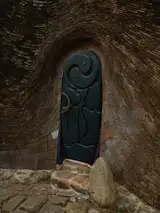
A door on the side of the home running along Mission Creek leads into the backyard.
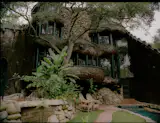
Carmichael designed the home around the property’s oak trees. The Raabs have relandscaped the yard to include grass and native and edible plantings.
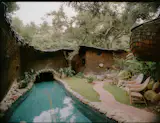
Down a few steps from the sauna is a lap pool that runs into a grotto, which connects with the guest house at the rear of the property.
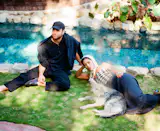
The Raabs lounge on newly planted grass with their dog, Snail Shell.
Marley’s party was just one of several ways she and Josh have been sharing the Whale. Where breweries hire white guy reggae and chopped unc cover bands that are, tragically, perma-de rigueur for a central California beach town, the couple have brought in the sorceress howlings of Priestusssy, the joyful canciónes of Juan Wauters, the existential poetry-comedy of Joshua Turek, and the socially and ecologically attuned work of Living Earth, a Los Angeles-based nonprofit that pairs live music with remarkable nature-facing spaces. So far, nothing too prescriptive. “It always seemed like a place where we would have gatherings where people could relate to each other in a deeper way,” Marley says.
She wants to use the Whale as a bathhouse, too, and it does feel like a spa in how its looping plan creates pockets of privacy; the foyer circles down the stairs, into the sauna, the pool, the garden, and grotto. Layers of new landscaping lend a wellness vibe, some of which is in the hands of the Whale’s self-annointed Mystic Maven, Hayden Bean. An Ojai-based horticulturalist cultivating awareness of his own via a meme account satirizing Ojai as a spiritual mecca, Bean has planted Thai guava, black banana, kiwi, strawberries, and more. “My hope is that people are catching on to wanting deeper embodiment and that’s like a huge recalibration for everything that’s happening right now,” says Marley. “Because if we’re in our bodies, you can’t really bombard people with as much bullshit. They just won’t take it.”
On the list of said “bullshit”: the patriarchy, civilization’s collapse, all of the above. The Whale’s position in Mission Canyon, though, entangles it specifically with the area’s past. Across the street in Galt’s front yard, a few paces down from the boulders, is one of several out-of-commission aqueducts running from a dam upstream, built by Chumash laborers under the rule of Franciscan padres more than 200 years ago. Down the canyon, the Mission’s rose garden is a popular setting for picnics, weddings, after-school soccer, or frisbee. But it’s also a Chumash burial ground. “The Mission was literally a murderous operation,” says Marley. “And it’s really interesting because you come up against this really deep attachment to Spanish colonial identity that has infiltrated so many communities. But it feels like you’re such an antagonizer for questioning it. And it’s really sad because I’m like, Wow, people are missing out on a level of devotion that the lands open up to when you fully acknowledge who’s been here.”
At Marley’s birthday, one of the swimmers watching the band play is the event’s headliner, Phil Elverum of The Microphones and Mount Eerie, the freak folk musical artist responsible for an early-2000s movement that translated the Pacific Northwest’s moss-covered wilderness to tape. (Elverum is a friend of the couple.) After disappearing inside the grotto in a bathing suit, he returns, fully dressed, taking a seat on the shower stage, where he begins to sing: Just wanting to live outside the kingdom walls to watch the river and sing it / I just want to make artistic music full of ideas…. And I tried / But how can one turn away from a world boiling alive? / I know something else is whispering below…. Elverum later makes clear in an email exchange that any correlation to the home’s context within the canyon or its broader desires for awareness were a coincidence. He had been reading the 1,300-year-old “hermit poems” of Chinese artist, poet, and musician Wang Wei, and realized that he is not at all alone as he “squirms for meaning.” But at Marley and Josh’s Whale, his words smoldered: I try to reject the empire but it’s only wishingstance / There’s no for real stepping all the way out of the violently vibrating here and now / So tangled in complicity….
—
In 1974, Carmichael had already designed 69 homes, including ones for Wilt Chamberlain and Janis Joplin, when he purchased the Mission Canyon lot where the Whale House now stands. Any home builder would readily describe it as undesirable: One edge traces Mission Creek, and is slender, sloped and tapering down the canyon. Instead of forcing an arrangement of boxes, he let the lot’s contours bring to life an endlessly curving home. If there was ever a book written about the residence, Carmichael’s suggested blurb, he told Jenny Perry of the Santa Barbara News Press in 1980, when he wanted to sell the residence, was: “There is not a corner in it, not even in the elevator.” And he had every intention of selling it. “Every artist needs to sell his work,” he said to Santa Barbara Magazine the same year. “From Picasso right on down to the rest of us. In order to keep going, keep creating, I think you have to get rid of what you’ve done and go on to other things.”
In the fall of 1980, Carmichael told Santa Barbara Living he’d listen to any offer over $1 million, around $4 million in today’s dollars. A few years later, realtor Bruce Venturelli took out an ad in a local paper: “LIVE OUT YOUR FANTASY…Here’s an opportunity to tour a most UNIQUE and freeform contemporary, nestled under and among towering trees, lush foliage…Cannot replace! Offered at only $425,000.”
To this day, nobody has paid close to the pie-in-the-sky figure Carmichael originally sought when adjusted for inflation. Even so, suitors have kept coming, and in one view, the Whale House’s legacy is a tale of serial infatuation: When the right buyer comes along, they fall deeply under its spell. Such was the case for one of Hildebrand’s clients, Jean and David Avrick, who owned the home longer than anyone. Before they were married, they decided to move in together, and chose the Whale House as their first home. They gave their five indoor cats and a dog free range of the grounds, and David ran his marketing and advertising business from the backyard, in the garage he and Jean turned into an office. But Jean describes living in the home as a full-time job. It regularly needed renovations because of Carmichael’s commitment to form. On a few occasions, she had to remove sections of walls to replace appliances, because he’d plastered them in, leaving doorways too narrow to move anything in or out. For a time, the price of admission was worth the trouble. But the couple was making another sacrifice to live in a giant sculpture: the curving walls couldn’t hold artwork, so Jean and David had to put their massive art collection in a storage container, which sat in the Whale’s driveway. After about four years, longing for their art, they put the home on the market. Struggling to find a buyer, they turned it into a rental. Just a few years later, they’d get an email from another of the Whale’s future suitors. “He was a little quirky, sure,” says Jean, “but he was absolutely our best tenant—Jade Spangler.”

The guest house at the rear of the home was once a garage.
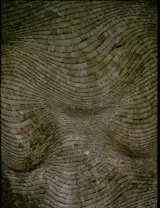
Flowing rows of thousands of cedar shingles give the home’s facade a scaled look.
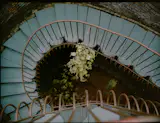
Luis Velazquez, a master carpenter and artist, has been maintaining and updating the home, including refurbishing the stairs in the foyer.

One of the home’s renter’s, Jade Spangler, installed a shower in the garden, which now sometimes doubles as a stage for shows.
As the home’s current devotees, Josh and Marley are learning firsthand the challenges of wielding such a magnetic and temperamental space. After Marley’s birthday party in February, the city of Santa Barbara slapped them with a violation, effectively shutting down events for the foreseeable future. Their short-term rental license was also in limbo, but was recently renewed. The couple says there’s a possibility of moving to Thailand at some point, where Marley’s family is from, and where she and Josh’s kids can learn to speak the language. In the end, Josh isn’t all that interested in forcing anything with the home. “I just really want this to flow,” he says, sipping tea in the lounge one afternoon in March.
But right now, the floodgates of possibility are back open. What else can they do with the Whale’s magnificent pull while it’s theirs? Maybe it can also be a Palace of Potential Partnerships? They recently struck two major deals with influencers via Airbnb’s creators program, and brands have come knocking, too, looking for a fit. Who’s their dream get? “Marley will probably have a better answer, but something like, I don’t know, Balenciaga would be cool,” says Josh. (When asked later, Marley wasn’t ready to give one, but found Josh’s pick funny.) The couple are thinking through how to merchandise the Whale, too, pointing to Flamingo Estate, the Los Angeles property selling branded candles and bathroom sets. Do they want the Whale House to be an empire? “Yeah, if it’s easy,” Josh says. “But if I think I need to pay for some ads to push it and these aren’t selling, that doesn’t feel right. I’m not comfortable with creating more shit. I’m not going to be filling a warehouse and then forcing it down people’s throats.” For now, hats are in the works. On the front, the Whale House logo. On the back? A gentle imperative: cultivate awareness.
With so much interest in the home, some of the trouble has been how to gatekeep with discretion. Josh makes it clear who, exactly, is not invited to the Whale House: no brimmed hats, and no spiritual people. No spiritual people? “Just because we’re afraid of the New Age white California yogi vibe,” Josh says. Marley points out that, yes, while there is a spiritual layer to the Whale House, to leverage its lingo is a hostile act, which is very not welcome here. “For anyone that says I manifested this house,” she says, “that is so not what this is.”
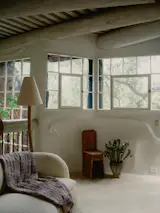
Another of Wareheim’s plantings on the second level joins a chair brought in by John Hein, a photographer who Marley and Josh hired as a decorator.

Stained-glass windows by Handelman that look like eyes give the home a sentience.

A “spine” with Gaudí-esque detailing contours the garden walls.
—
On a crisp spring day in April, John Hein, a photographer who’s taking one of his first cracks at interiors with the Whale House, is lugging vintage furniture through a backdoor with the help of an assistant. In tow is actor and director Eric Wareheim who’s brought along some exotic plants from his Los Angeles shop. Hein and Marley had connected over Instagram and started talking about tying up some loose ends with the decor. A black-topped table and chair set with metal legs in the dining area, Hein points out, is clashing with the architecture. If there were any wrinkles disrupting the fabric of the Whale as a portal, any incongruous decor choices to trip on for the visitor, they have now mostly been ironed out. (Josh doesn’t love a set of plush white towels in one of the bathrooms. But for the time being, this is a rental.) In ways, this is a return to form in how Carmichael committed to the fantasy. Hein brought in some freaky wood stools and chairs, exactly the kind you’d hope to find in a place where gnomes, elves, or hobbits might reside. In others, it signals the newest chapter. Wareheim’s updates include a big moment for a two-level window overlooking the pool and in the bed-womb, the urinal is no longer for peeing into; instead, it warmly embraces a single spindly plant rising from a tufted bed of sagey moss.
At Marley’s birthday party, there was an encore. When the music had ended, someone presented her with a birthday cake, and here, across the street from ancient boulders and aqueducts, on Chumash land, on an undesirable lot in the canyon where many have gotten high, squirmed for meaning, or probably both, someone began to sing a call-and-response birthday song that grew into a joyful chorus as friends and perfect strangers caught on. Marley smiled, glowing in the candlelight, with Josh beside her. It was one more revolution around the sun for Marley, one more for the Whale House, and one more for anyone who’s swam in its oceans, all of us blissfully along for the ride for as long as we hope it can last.
—
Top photo by Jared Chambers
Related Reading: