
Nitsan Bartov, a PhD Candidate at Henning Larsen and The Royal Danish Academy and Ambassador for Architecture for Krea.ai, is a speaker at RELEASE [AEC] — the first tech event designed to help professionals stay on the cutting edge of innovation and master the tools of the future. The next edition will be held in Paris on October 20, 2026. The event is 100% free for AEC practitioners: register today!
In a recent Architizer publication, I saw a metaphor for AI that I really liked — that of a highly ambitious and capable intern with great technical skills and near-zero understanding. In architecture, this would be the intern who has read every architecture book ever written, toured every major building through photographs, and can produce a drawing faster than anyone in the office. But they have never stood on a construction site, never felt a ceiling that was too low, never watched a client’s face fall in a presentation. Such an intern will answer every question with complete conviction, but will never flag when something is wrong. And they will never, ever ask questions.
AI is storming into the architectural field like an army of mindless junior employees, but mostly in firms, there is still high frustration over the lack of nuanced understanding, precision and deterministic capabilities, which are core to our profession. Most architects’ first attempts with AI go towards trying to get AI to do EXACTLY what they want it to do: automate repetitive tasks, populate floor plans, speed up intentional rendering and collapse multiple sources of knowledge into design concepts. These attempts to force the technology onto our challenges are mostly unsuccessful, leaving architects with the feeling of either “the tools are not there yet” or “I’m probably just not good enough at prompting”. Both are, to an extent, correct — but very partially so.
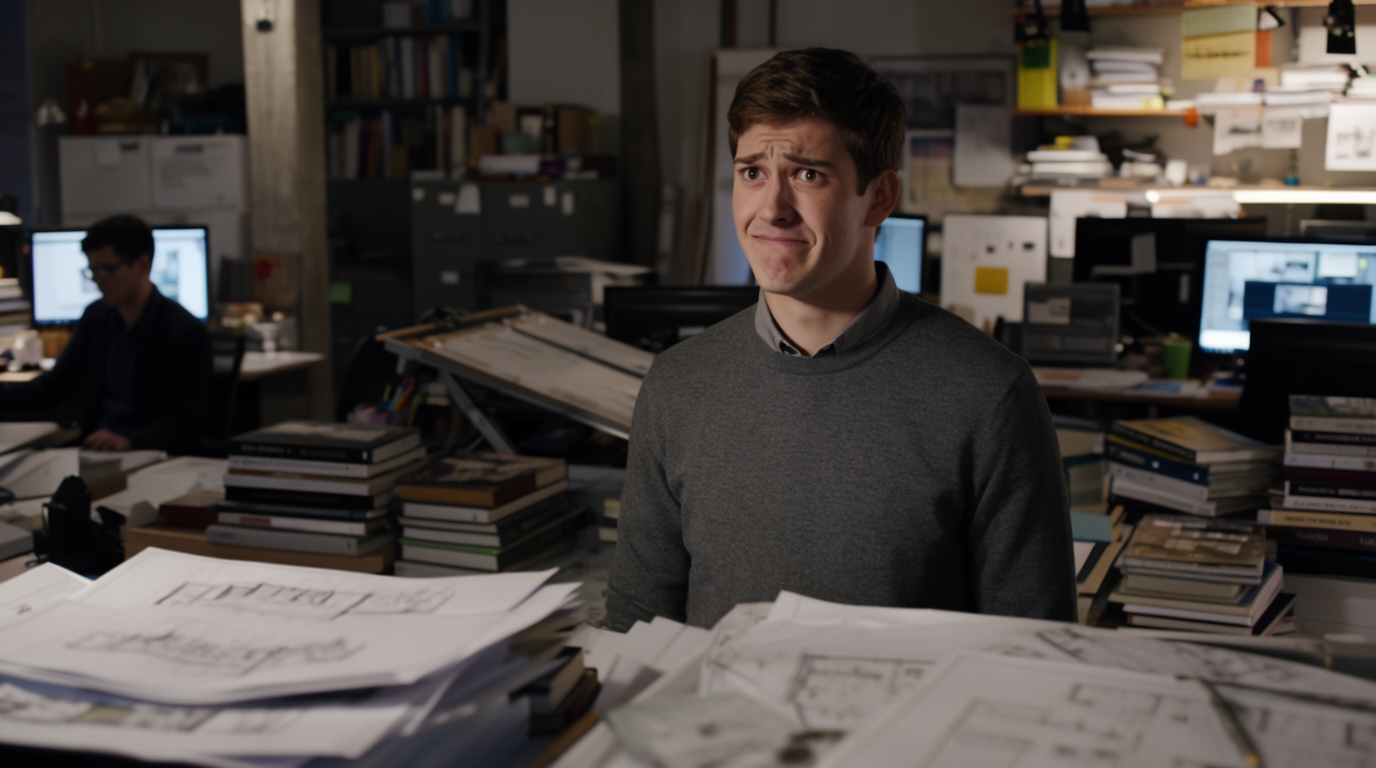
Prompt: An architecture office with a brilliant but clueless intern surrounded by books, drawings, and screens. Model: Krea K2
The key barrier for adoption is the understanding of the technology itself, and matching the right tool to the right tasks. As architects, we are used to being very hands-on and deterministic in our work — every little piece of detail that exists in the drawing or the rendering is there because we put it there. We are not comfortable with AI adding some random elements to the design, making some obscure decisions and taking its own initiatives and creative agency.
That said, the technology is improving exponentially. It may never achieve the 100% accuracy and determinism we hope for, but it sure is getting close. It is an asymptote that will quickly pass the “good enough” threshold — and in many cases, it already has.
We are seeing more and more tasks within architectural work that we comfortably delegate to AI, and can tolerate whatever is left of its margin of error. And that gives birth to a new problem: The loss of agency. It is one thing if AI makes a mistake within the project. It is another if AI makes little to no mistakes, but takes over so many tasks that we end up not knowing our own project. We know this from using LLMs for writing. We start by saying, “I will never release a text from Claude without reading through it and verifying.” But reading through becomes skimming through, becomes reading just a few lines, and then one day we are facing a text that we supposedly wrote but couldn’t recognize.
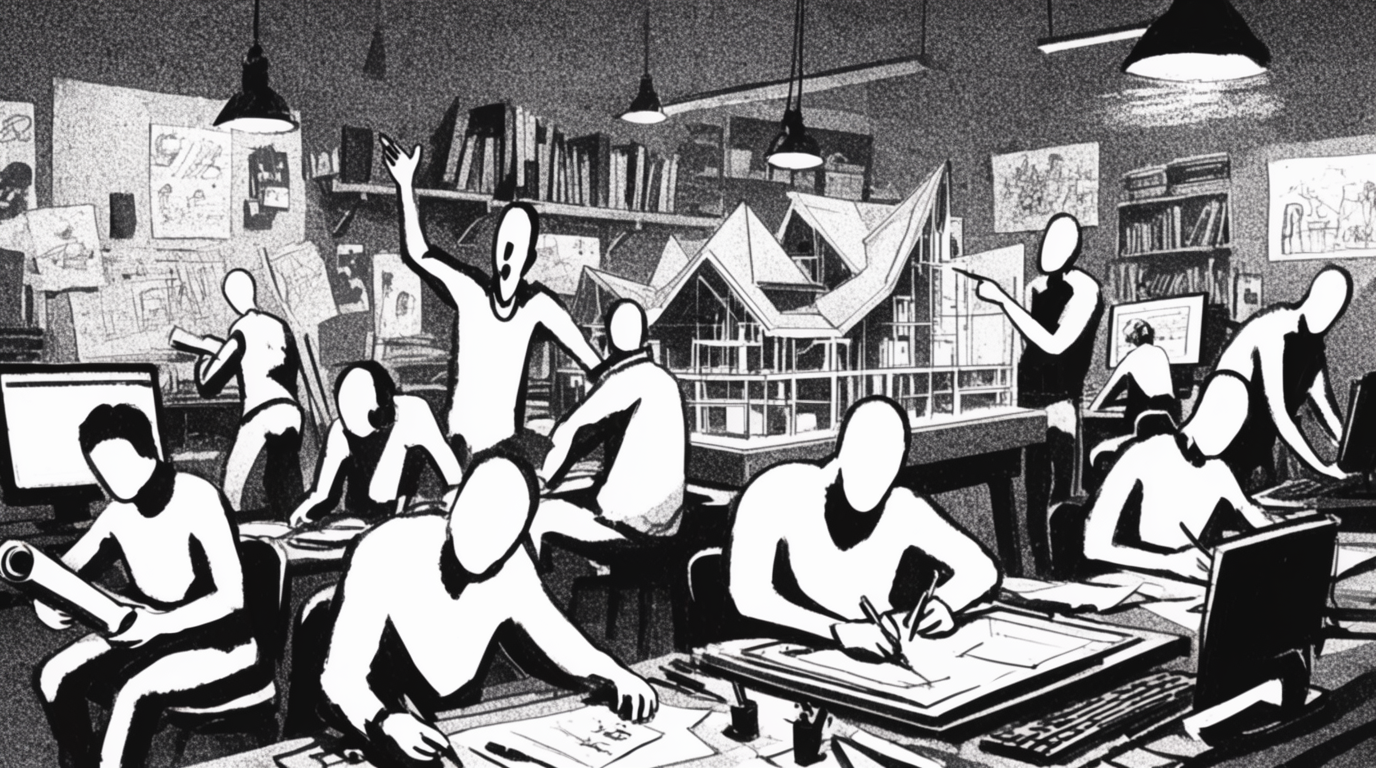
Prompt: A group of faceless junior architects rushing into a studio filled with models, plans, and computers. Model: Krea K2
For an architecture practitioner, this is a problem. We don’t just get paid to produce, but to know the project, to adjust and respond to changes, and to solve problems. We are the master builders. And when we don’t know our own project to its core, because much of it we did not create ourselves, we will not be able to solve issues that come or account for early decisions later on. The same applies to vibe coding.
In architecture, we are observing some interesting trends in AI adoption. On one side, you see the expected advantage of youngsters and juniors in digital fluency and creative exploration as they quickly master the lingo and the most prominent tools for completing tasks at unprecedented speed. But we are also seeing a different trend: seniors and experts who “break the barrier” and start using AI are reporting a huge increase in their capabilities. They are not only working faster and more effectively, but achieving better results, for far less cost.
There is something key about the mediative role of experience. A junior can now generate 100 design iterations in the amount of time it would have taken them to model just one or two a year ago. But they have limited experience to draw on to distinguish, curate and choose the right iteration. They have limited precedents to inform how they evaluate which iteration is the proper one given the context, site, language and style, and whether it is even buildable or within budget. A seasoned architect, however, would not need to generate 100 iterations. With intentional prompting, five would be enough, and the time saving is immense. In practice, we often see very talented juniors using 200 euros on compute units for one rendering, with experienced ones producing a similar rendering for the same project for less than 10. Similar things happen in other industries, by the way.
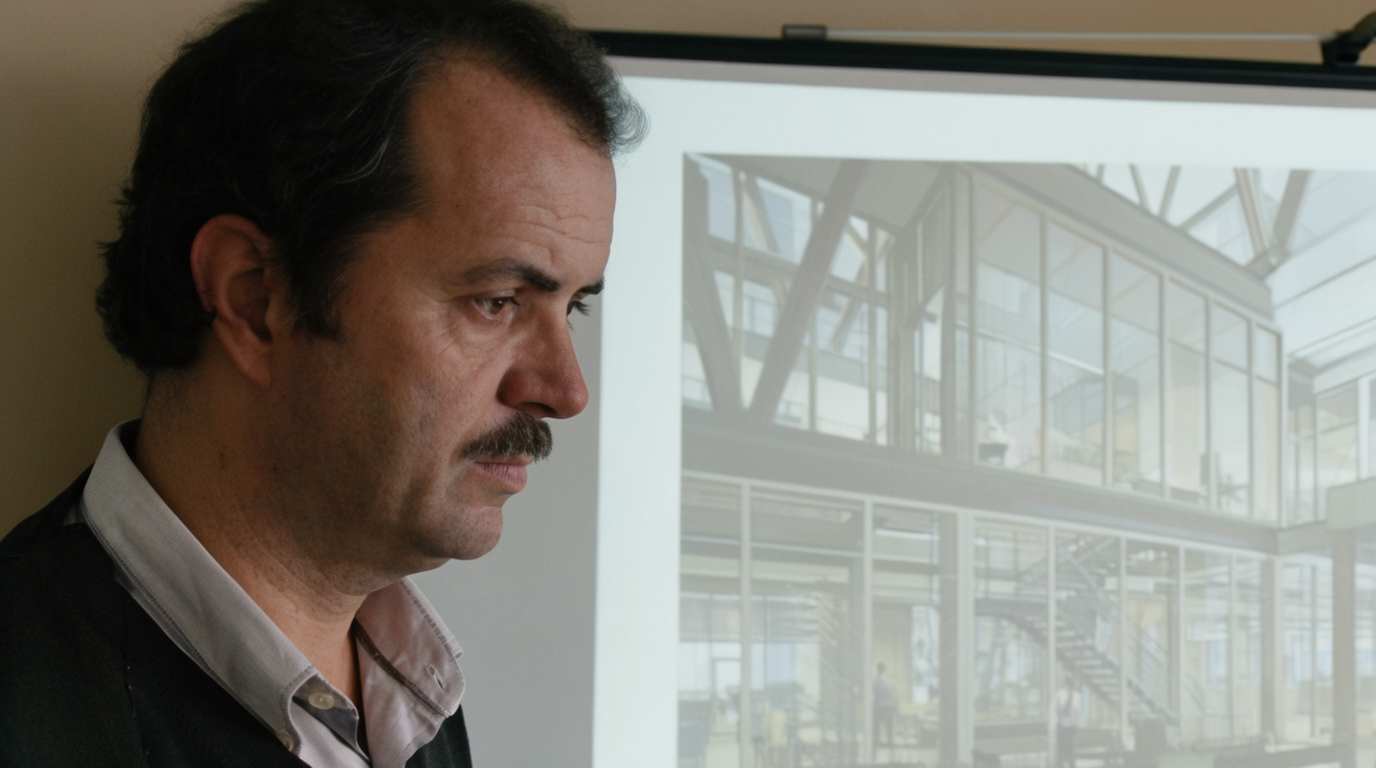
Prompt: An architect looking at a finished project on a screen, unsure if it still belongs to them. Model: Krea K2
The unreplaceable skills are not prompt engineering or vibe coding – it is the foundational knowledge these tools rely on and are attempting to replace, but their training datasets and reasoning capacities can only get so far.
If you want to become good at rendering, go study art history and practice oil painting. Learn about color theory and composition. This is the kind of knowledge that will automatically increase your “prompting” skills, as your creation becomes more intentional, more nuanced and more deep.
The same holds well beyond the rendering. The architect who understands how a structure stands up, how a material ages, how people move through a space, writes sharper instructions for the machine and judges its output more critically. This foundation is not what the tools replace. It is what lets you direct them at all, and it is exactly the kind of knowledge you can only build by doing the work the tools now offer to skip.
In the era of AI, the real risk to architects is not a sudden takeover by the technology. Architecture is not one task, not even just ten; it is the orchestration of hundreds of different tasks that require different skillsets, holistic and systemic thinking, communication skills, decision making, design thinking and much more. Rather, the danger faced by the profession is the slow and steady slide of tasks towards automation, one delegation at a time, so gradual that we barely notice until we look up and find the muscle is already gone.
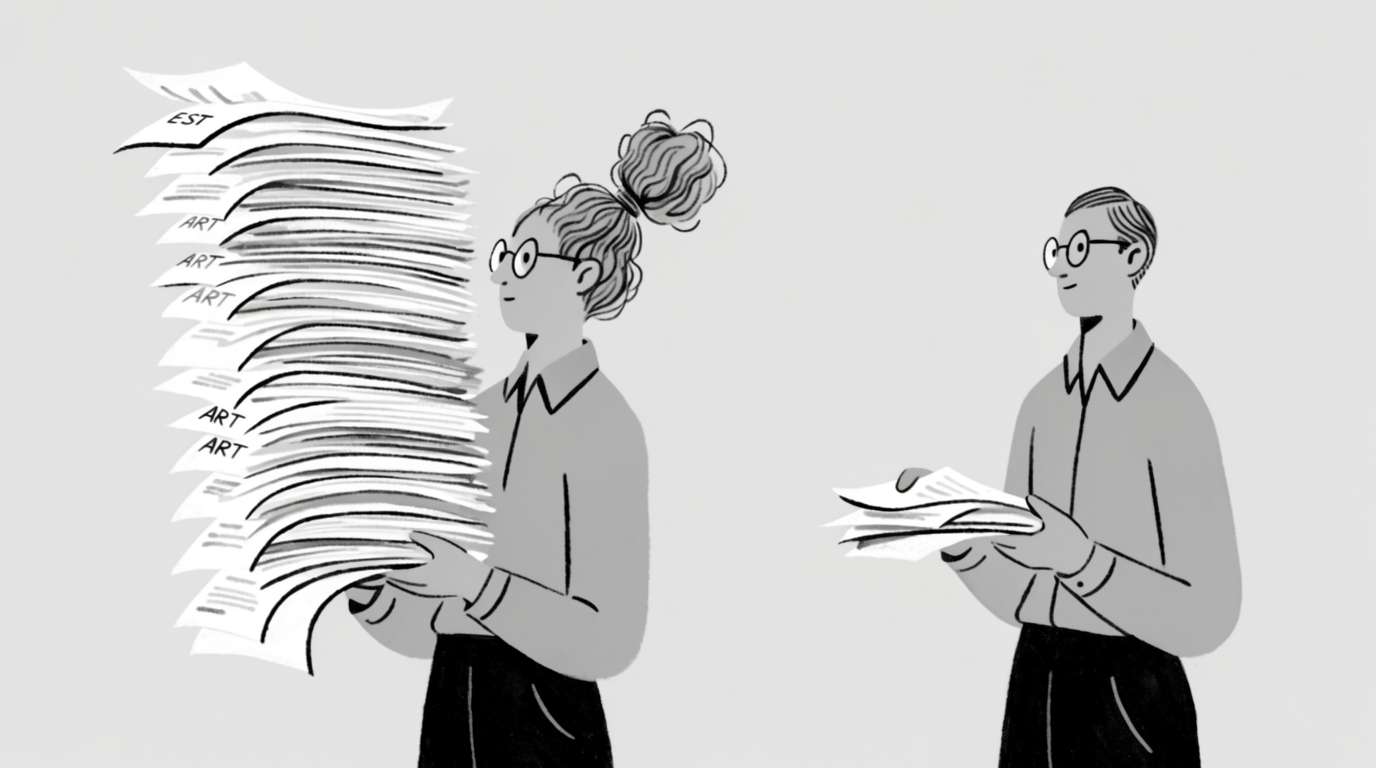
Prompt: Two architects reviewing design iterations, one overwhelmed by hundreds of options, one calmly choosing from a few. Model: Krea K2
Life on our planet used to be very physical. Plowing the fields, fixing the house, protecting the family, traveling, etc. Basic tasks required what we would consider today to be immense physical effort. During the course of the last millennia, however, we have incrementally been delegating physical work to animals, machines and specialists. But when we started doing this, we became fat. Physical work was no longer a necessity for survival, but we realized that it is essential in and of itself, not just as a means to an end. So, we started lifting weights and running around, not to move things around or get to places faster, but just to stay in shape. This historical note serves as an interesting metaphor for thinking about the transition to AI in the architectural field: certain skills are gained through labor.
The ability to evaluate good design comes with manually producing hundreds of iterations, facing the clashes and inconsistencies, the comments from superiors and the hardships of trying and trying to make it work. But with AI, we can reach design iterations without actually designing them from scratch. We can produce texts describing our decisions, without having to write them ourselves. Today, the experienced are enjoying not having to technically do things and can achieve incredible results, and the juniors are able to rely on the experts to curate and direct them.
What happens in 10 years? In 20? The experts will retire, and the juniors will become seniors. Will they have the same skills? Will their understanding of design and space develop in the same way without having to manually craft their way to it?
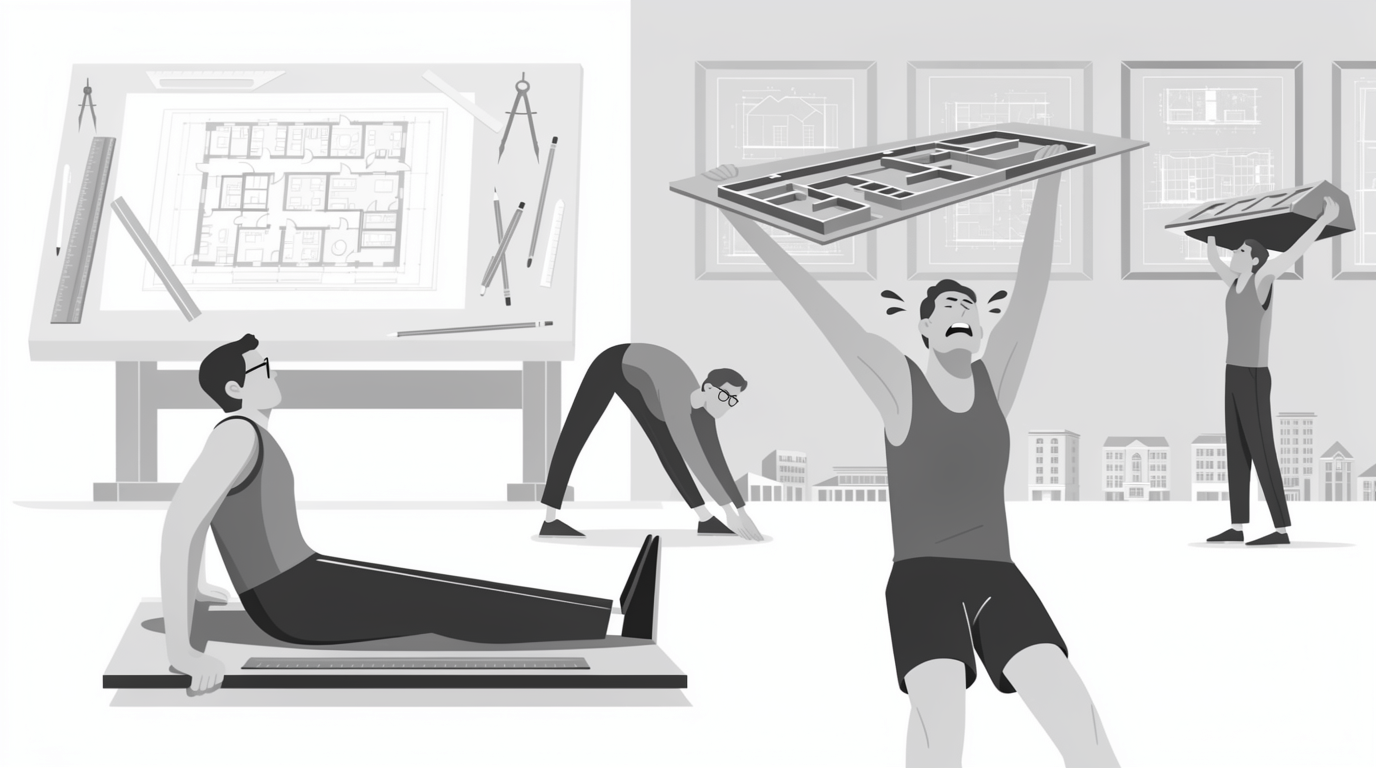
Prompt: Architects training manually with drawings, models, and tools like a gym for design skills. Model: Krea K2
Perhaps we should consider the process of skill-gaining more proactively and “sacrifice” some time to let juniors work manually, instead of being drawn to automation and relying on expert eyes for accountability. I know it might sound optimistic to ask firms to forgo time-saving opportunities in favor of something harder to measure. But other professions have already made this choice. Surgery is arguably further along the automation curve than architecture. Robotic systems can already perform certain procedures with greater precision than human hands. And yet surgical residents still operate with their own hands, slowly, under supervision, because the field understands that judgment develops through doing and cannot be shortcut. Medicine didn’t debate this. It built it into the structure of the profession. I believe our field holds the same moral obligation, and it should not only come down to equitable and sustainable designs. We also have a responsibility for the future of our profession. After all, very few of us are in it for the money anyway…
So why not build the equivalent into our own training, with architecture “gyms” as part of internships and academic education? We could challenge ourselves with architectural tasks to solve manually, not just to reach the optimal solution through the fastest route, but to make sure that we stay in the “shape” required to maintain agency over our own decisions and hold accountability for them.
The alternative is a profession that got very good at prompting, but has forgotten how to build.
*All images in this article were produced in the following way: I fed the entire article to Claude and asked it to generate five simple prompts for images for different parts of the article. No other instructions. Then I fed those into the Krea K2 model to interpret. I would let you judge the results – do you think it did well?
Nitsan Bartov, a PhD Candidate at Henning Larsen and The Royal Danish Academy and Ambassador for Architecture for Krea.ai, is a speaker at RELEASE [AEC] — the first tech event designed to help professionals stay on the cutting edge of innovation and master the tools of the future. The next edition will be held in Paris on October 20, 2026. The event is 100% free for AEC practitioners: register today!