

Architects: Barozzi Veiga, Tab Architects
Year: 2025
Photography: Simone Marcolin
Lead Architects: Fabrizio Barozzi, Alberto Veiga, Tom Debaere, Bert Bultereys
Architects Team: Pieter Janssens, Chen-Hsin Chang, Tomás Mesquita, Ivanna Sanjuán, Guillermo Sidrach, Antonis Tasoulis, Maria Ubach, Jonathan Toye, Bert Lescouhier, Bert Devos, Pieter Frantzen, Ilja De Pelsmaeker, Lotte Engelborghs, Maxime Honoré, Luisa Soares
Design Team: Yorgos Apostolopoulos, Jonghyun Choi, Pieter Janssens, Alessandro Lussignoli, Tea Marta, Toni Poch, Eva De Bels, Lando De Keyzer, Jonathan Toye, Ilja De Pelsmaeker
Heritage Architect: Koplamp Architecten
Structural Engineering: Sileghem & Partners Architecten en Ingenieurs
Services Engineering: Studiebureau Boydens Engineering
Building Physics and Acoustic Consultant: Daidalos Peutz Bouwfysisch Ingenieursbureau bvba
Façade Consultant: Xmade
Materials: Dark-colored brick, custom-made bricks from recycled construction components, red terracotta floor
Client: Stad Kortrijk
City: Kortrijk
Country: Belgium
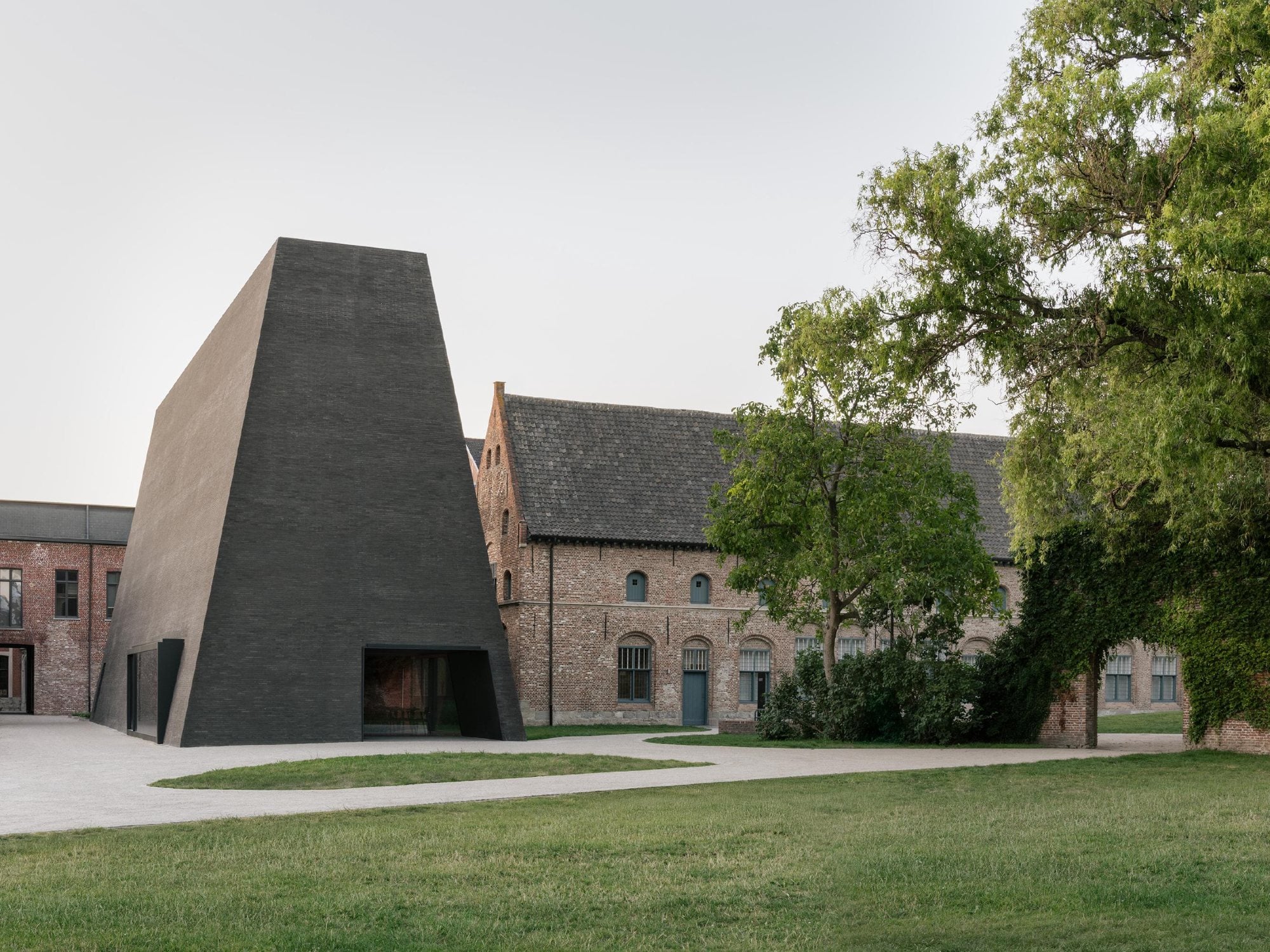
Abby Kortrijk transforms the historically significant Groeninge Abbey complex in Kortrijk into a contemporary arts space for site-specific temporary exhibitions and public events. Designed by Barozzi Veiga and Tab Architects, the project repositions the former abbey as an open cultural venue within Begijnhof Park, combining restored historic rooms with new exhibition infrastructure. The intervention clarifies the original spatial identity of the ensemble by restoring the chapel and dormitory, reinstating the courtyard, and introducing a subterranean exhibition level. A new dark brick pavilion establishes a measured dialogue with the historic buildings while providing a bar and restaurant for public use. The project balances persistence, restoration, and transformation, allowing the abbey to retain its architectural memory while adapting to contemporary civic and cultural needs. Its sequence of spaces offers varied atmospheres for art, gathering, and everyday public life.

Abby Kortrijk approaches heritage not as a static artifact, but as an active framework for public life. The project by Barozzi Veiga and Tab Architects gives the former Groeninge Abbey a renewed civic role, expanding its function beyond exhibition-making to become a permeable urban setting where art, memory, and daily use converge.

The design begins with a precise understanding of the abbey’s historic configuration. Later additions that weakened the clarity of the original composition were removed, allowing the former cloister, chapel, and dormitory to regain a more coherent spatial relationship. This act of architectural editing reestablishes the courtyard and opens a new passage from Groeningestraat toward Begijnhof Park, strengthening the connection between the cultural institution and the surrounding city.
 © Simone Marcolin
  © Simone Marcolin
  © Simone Marcolin
The former dormitory has been treated with restraint. Its original windows, ceiling, and red terracotta floor were restored, preserving the quiet material character of the building while allowing it to support new forms of display and gathering. A long display case introduces works from the city of Kortrijk’s collection, creating a setting in which artists can respond to local cultural memory. This part of the complex is accessible without a ticket, reinforcing the ambition to make the institution open and approachable.

The chapel, one of the oldest components of the ensemble, has been returned to a more powerful spatial condition. By removing attached corridors and mezzanine levels, the sixteenth-century volume regains its verticality and atmosphere. Its restored interior offers a distinctive setting for exhibitions, where the historic scale of the room becomes an active part of the visitor’s experience rather than a neutral backdrop.
 © Simone Marcolin
  © Simone Marcolin
  © Simone Marcolin
  © Simone Marcolin
To provide flexible exhibition facilities without overburdening the park or the historic structures, the project places the main new gallery spaces underground. These museum-quality rooms offer a neutral environment for changing exhibitions, complementing the more atmospheric qualities of the chapel, dormitory, and pavilion above. The contrast between the subterranean “white boxes” and the restored historic rooms gives the project a varied but coherent internal sequence.

The new pavilion forms the most visible contemporary addition to the ensemble. Positioned orthogonally to the existing abbey composition, it continues the logic of the historic layout while asserting a clear architectural identity. Its inclined façades echo the vertical presence of the surrounding sloped roofs, while its dark brick cladding distinguishes it as a new element within the site. Housing a bar and restaurant, the pavilion extends the project’s public role and introduces a social dimension that recalls the communal traditions of monastic life.
 © Simone Marcolin
  © Simone Marcolin
  © Simone Marcolin
  © Simone Marcolin
  © Simone Marcolin
Material choices reinforce the project’s balance between continuity and transformation. The historic façades were restored in line with their original drawing, while the pavilion uses custom-made bricks produced from recycled construction components. This gives the new structure a monumental yet restrained presence, linking the contemporary intervention to both the urban fabric and broader questions of material reuse.
 © Simone Marcolin
  © Simone Marcolin
  © Simone Marcolin
  © Simone Marcolin
  © Simone Marcolin
Through these calibrated interventions, Abby Kortrijk becomes more than the adaptive reuse of an abbey. It is a layered cultural complex in which restoration, subtraction, and addition work together to create a renewed public institution. The project preserves the historical depth of Groeninge Abbey while giving it a flexible future as an art house, civic passage, and shared urban room.

Project Gallery
 © Simone Marcolin
  © Simone Marcolin
  © Simone Marcolin
  © Simone Marcolin © Simone Marcolin © Simone Marcolin
  © Simone Marcolin
  © Simone Marcolin © Simone Marcolin
  © Simone Marcolin
  © Simone Marcolin
  © Simone Marcolin © Simone Marcolin © Simone Marcolin © Simone Marcolin
  © Simone Marcolin
  © Simone Marcolin
  © Simone Marcolin
  © Simone Marcolin © Simone Marcolin
  © Simone Marcolin
  © Simone Marcolin © Simone Marcolin © Simone Marcolin © Simone Marcolin © Simone Marcolin © Simone Marcolin
  © Simone Marcolin
  © Simone Marcolin © Simone Marcolin
  © Simone Marcolin © Simone Marcolin © Simone Marcolin
  © Simone Marcolin © Simone Marcolin
  © Simone Marcolin
  © Simone Marcolin
  © Simone Marcolin © Simone Marcolin
  Abby Kortrijk / Barozzi Veiga + Tab Architects 64
  Abby Kortrijk / Barozzi Veiga + Tab Architects 65
  Abby Kortrijk / Barozzi Veiga + Tab Architects 66
  Abby Kortrijk / Barozzi Veiga + Tab Architects 67
  Abby Kortrijk / Barozzi Veiga + Tab Architects 68
  Abby Kortrijk / Barozzi Veiga + Tab Architects 69
  Abby Kortrijk / Barozzi Veiga + Tab Architects 70
Project Location
Address: Begijnhofpark, 8500 Kortrijk, West Flanders, Belgium
The location is provided for general reference and may represent a city or country, rather than a specific address.