

Architects: Walter Gropius
Year: 1938
Photography: Wikimedia Commons, WikiArquitectura, victorgrigas, SHendry11, HABS MA-1228, Jack E. Boucher, Daderot, geneva_wirth, architecture-history.org
City: Lincoln
Country: United States
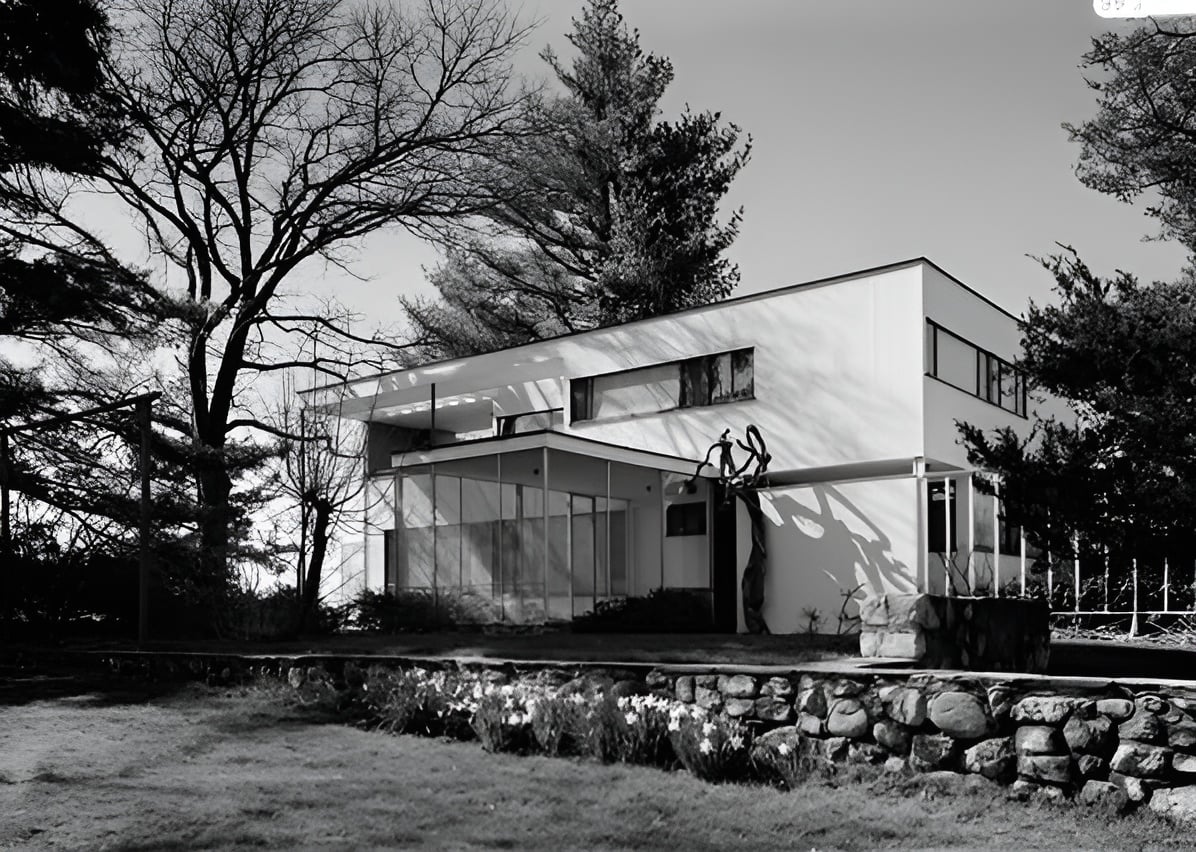
The Gropius House in Lincoln, Massachusetts, designed by Walter Gropius and completed in 1938, served as his family’s residence and marked a key transition of Bauhaus principles into the American context. Conceived as both a domestic space and a pedagogical model, it adapts European modernism to a New England setting. Situated within a rural landscape, the house reflects a deliberate balance between regional traditions and modernist ideals, integrating itself with its surroundings rather than imposing a foreign architectural language. Its rectilinear form and functional planning combine a traditional timber frame with industrial materials such as glass block, steel, and ribbon windows, while local materials anchor it within the vernacular context. The interior emphasizes efficiency, clear zoning, and access to natural light, with a restrained palette that allows Bauhaus-influenced furniture and artworks to define the space. The design extends into the landscape through a sequence of outdoor “rooms,” reinforcing the relationship between architecture and site. Despite its modest scale, the house redefined American domestic architecture by merging modernist principles with regional sensibilities. Preserved as a museum and designated a National Historic Landmark, it remains a key example of the adaptation of Bauhaus ideas in the United States.

The Gropius House in Lincoln, Massachusetts, completed in 1938, served as the family residence of Walter Gropius during his tenure at the Harvard Graduate School of Design. As his first built work in the United States, the house marks a critical moment in the transition of Bauhaus principles into the American context, translating European modernism into a new cultural and material landscape.
 Gropius House / Walter Gropius | Classics on Architecture Lab 63
  Gropius House / Walter Gropius | Classics on Architecture Lab 64
  Gropius House / Walter Gropius | Classics on Architecture Lab 65
Set within a rural environment of fields, orchards, and traditional New England farmhouses, the project was conceived as both a domestic environment and a pedagogical model. Gropius selected a site near Concord Academy, attended by his daughter, and positioned the house on a gentle rise to engage the surrounding landscape. Rather than imposing a foreign architectural language, the design reflects a deliberate negotiation between regional building traditions and modernist ideals.

The building adopts a restrained, rectilinear form organized according to functional principles rather than formal symmetry. Its construction combines a conventional New England timber frame with industrial materials such as glass block, steel elements, and ribbon windows. Vertical tongue-and-groove siding painted white reinforces the building’s planar clarity, while brick and fieldstone elements anchor it within the local material palette. The flat roof—uncommon in the region—further distinguishes the house while accommodating modern drainage solutions.

Internally, the spatial organization reflects Gropius’ emphasis on efficiency, clarity, and adaptability. Living, sleeping, and service functions are clearly zoned, with circulation minimized through direct connections between spaces. The plan prioritizes orientation and light: bedrooms receive morning sun, while living areas open toward southern and western exposures. A restrained interior palette of whites, greys, and earth tones allows furniture and artworks—many associated with the Bauhaus—to define the character of the spaces.
 Gropius House / Walter Gropius | Classics on Architecture Lab 66
  Gropius House / Walter Gropius | Classics on Architecture Lab 67
  Gropius House / Walter Gropius | Classics on Architecture Lab 68
  Gropius House / Walter Gropius | Classics on Architecture Lab 69
  Gropius House / Walter Gropius | Classics on Architecture Lab 70
  Gropius House / Walter Gropius | Classics on Architecture Lab 71
  Gropius House / Walter Gropius | Classics on Architecture Lab 72
  Gropius House / Walter Gropius | Classics on Architecture Lab 73
  Gropius House / Walter Gropius | Classics on Architecture Lab 74
  Gropius House / Walter Gropius | Classics on Architecture Lab 75
The project extends beyond the building envelope into a carefully composed landscape. The site is treated as a sequence of outdoor “rooms,” structured through lawns, gardens, and existing vegetation. Mature trees were transplanted to frame views, while orchards, stone walls, and planted areas establish continuity with the surrounding New England context. A screened porch mediates between interior and exterior, reinforcing the integration of architecture and landscape.
 Gropius House / Walter Gropius | Classics on Architecture Lab 76
  Gropius House / Walter Gropius | Classics on Architecture Lab 77
  Gropius House / Walter Gropius | Classics on Architecture Lab 78
Despite its modest scale, the house introduced a radical rethinking of domestic architecture in the United States. By combining industrial materials with vernacular references, Gropius proposed a model for modern living that was both contextually responsive and forward-looking. The project challenged prevailing residential norms, particularly in its rejection of historical imitation in favor of functional clarity and material honesty.

The Gropius House remained the architect’s residence until he died in 1969 and was later preserved as a museum. Designated a National Historic Landmark in 2000, it continues to serve as a key reference point in the development of modern architecture in America, embodying the adaptation of Bauhaus principles within a distinctly American setting.

Project Gallery
© Wikimedia Commons © Jack E. Boucher  © architecture-history.org
  © architecture-history.org © Wikimedia Commons
  © wikiarquitectura
  © Wikimedia Commons © Wikimedia Commons © HABS MA-1228
  © Daderot © Daderot
  © Flickr User: geneva_wirth © architecture-history.org © architecture-history.org © architecture-history.org
  © architecture-history.org
  © victorgrigas
  © victorgrigas
  © Flickr User: geneva_wirth
  © architecture-history.org © architecture-history.org
  © Flickr User: geneva_wirth
  © Shendry11
  © architecture-history.org
  © architecture-history.org
  © architecture-history.org
  © architecture-history.org
  © architecture-history.org
  © architecture-history.org
  © architecture-history.org © architecture-history.org
  © architecture-history.org
  © Flickr User: geneva_wirth
  © SHendry11
  © architecture-history.org © architecture-history.org
  © architecture-history.org © architecture-history.org © architecture-history.org
  © architecture-history.org
  © architecture-history.org
  © victorgrigas © architecture-history.org © Walter Gropius © Walter Gropius
  © GreatBuildings.com
Project Location
Address: 68 Baker Bridge Road, Lincoln, Massachusetts 01773, United States
Location is for general reference and may represent a city or country, not necessarily a precise address.