
. . . or flooring, ceiling, baseboard, et cetera? Children often fear the unknown monsters hiding beneath their bed or in the closet, but it’s the adults who should be afraid. The monsters hiding from them are real. I’ve seen a bunch of nasty stuff hidden from view in the many houses I’ve inspected, worked on, and lived in. So in case you need a reminder, here’s a sampling of some of the uninvited stuff—living, dead, or inanimate—that may be hiding in your house.
Dead critters
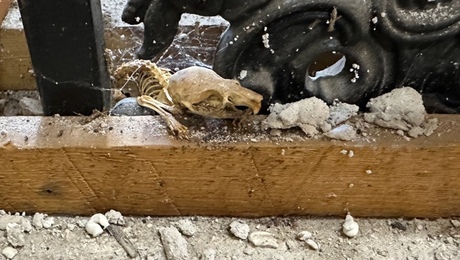
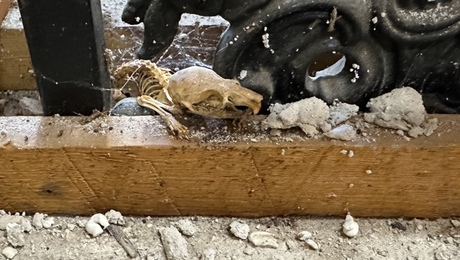
I’ve found three dead rat skeletons in my basement. You can see two of them above and below and the other in this article. One was caught in a rattrap on top of the dropped ceiling; the two shown here died inside walls.
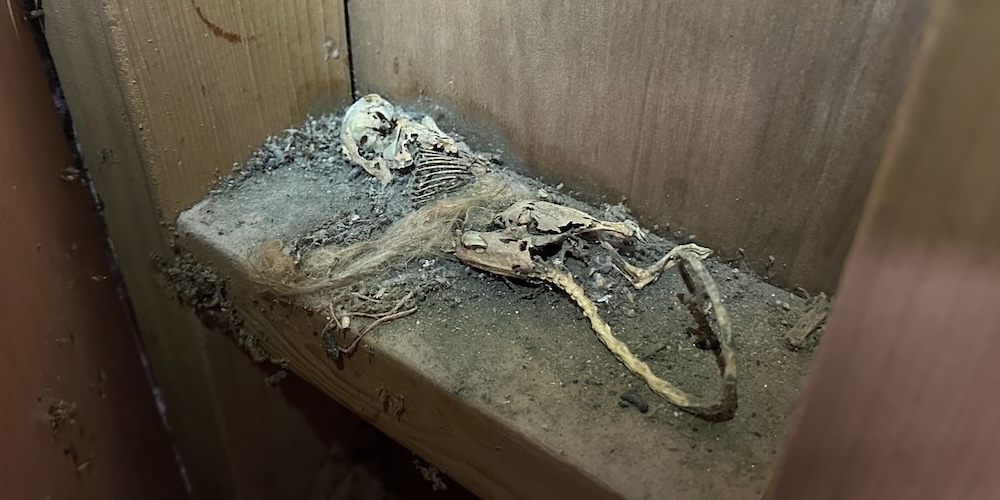 Here’s the second rat skeleton I found in my basement, this one on a piece of 2×4 blocking inside a closet wall.
I had an interesting—read terrifying—encounter with a dead possum in a crawlspace one time. I was squeezing through a tight spot to get to a duct I needed to repair when I saw gray fur. I scooted backward as quickly as I could and then noticed there was no movement. “Ah, it’s just playing dead,” I thought. No, it really was dead. But I was happier to deal with the odor when we removed it rather than having my nose bitten off by a live possum.
Live critters
From ants to raccoons, live animals love finding cozy spots to hang out in your home. Sometimes they stay till they die (see above). Sometimes they’re transient guests (see below). And then there are the ones still living with you, whether you’re aware of them or not.
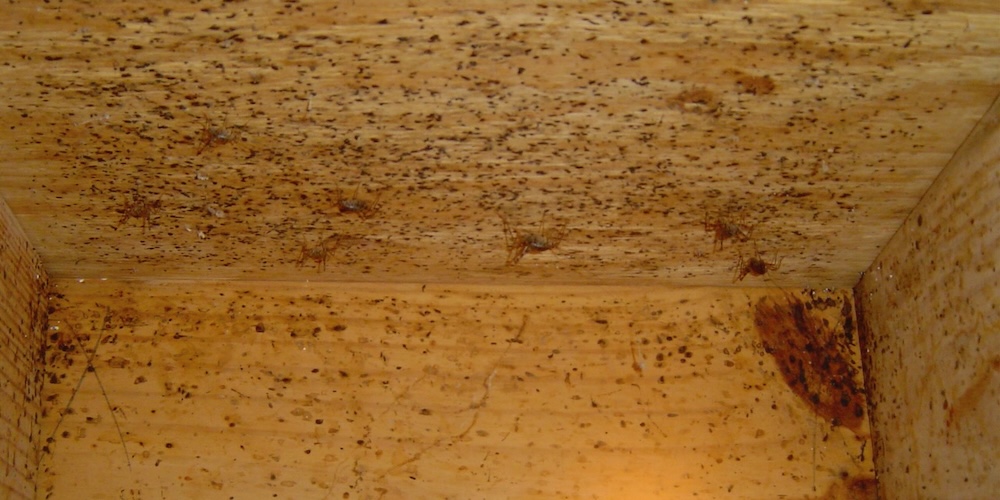 Camel crickets in a nasty vented crawlspace
The photo above shows camel crickets in a crawlspace. There are seven in the photo, plus all the spots they’ve left on their wooden toilet. I’ve seen live snakes (only harmless ones so far), mice, birds, bats, feral cats, and more.
The one that scared me the most was a flying squirrel. I was pressing fiberglass batt insulation down into ceiling joist cavities when one popped up and almost hit me in the face before scurrying to the soffit to escape.
Long-gone critters
Sometimes you see only the evidence of past visits or occupancy of animals. Below you can see the remains of a giant wasp nest inside the wall of Aubrey Gewehr’s house in Portsmouth, New Hampshire. They carved a hole in the blown fiberglass insulation to build their nest.
![An abandoned wasp or hornet nest inside an exterior wall in New Hampshire [photo by Aubrey Gewehr]](https://www.energyvanguard.com/wp-content/uploads/2025/12/wasp-hornet-nest-in-wall-aubrey-gewehr-1000.jpg) An abandoned wasp or hornet nest inside an exterior wall in New Hampshire. Image: Aubrey GewehrReptiles like dark, damp places like the vented crawlspace below. That snakeskin is probably 3 to 4 ft. long.
An abandoned wasp or hornet nest inside an exterior wall in New Hampshire. Image: Aubrey GewehrReptiles like dark, damp places like the vented crawlspace below. That snakeskin is probably 3 to 4 ft. long.
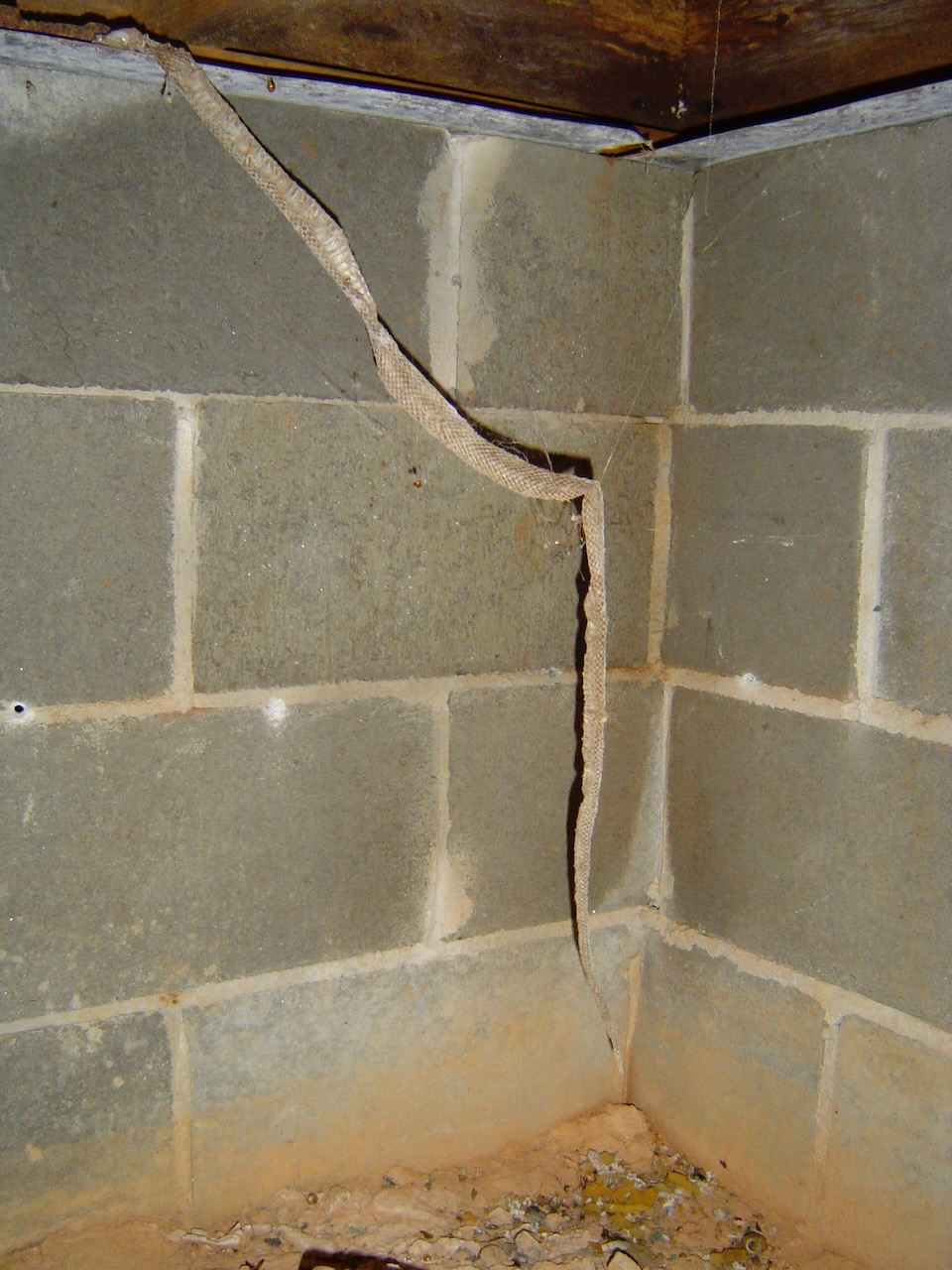 Snake skin in a vented crawlspace
Microbial growth
Microbes of various sorts, including many kinds of mold, love a house with damp conditions. The photo below shows the back side of some wood paneling I removed from my basement. I wonder how many different species of microbes colonized that wood.
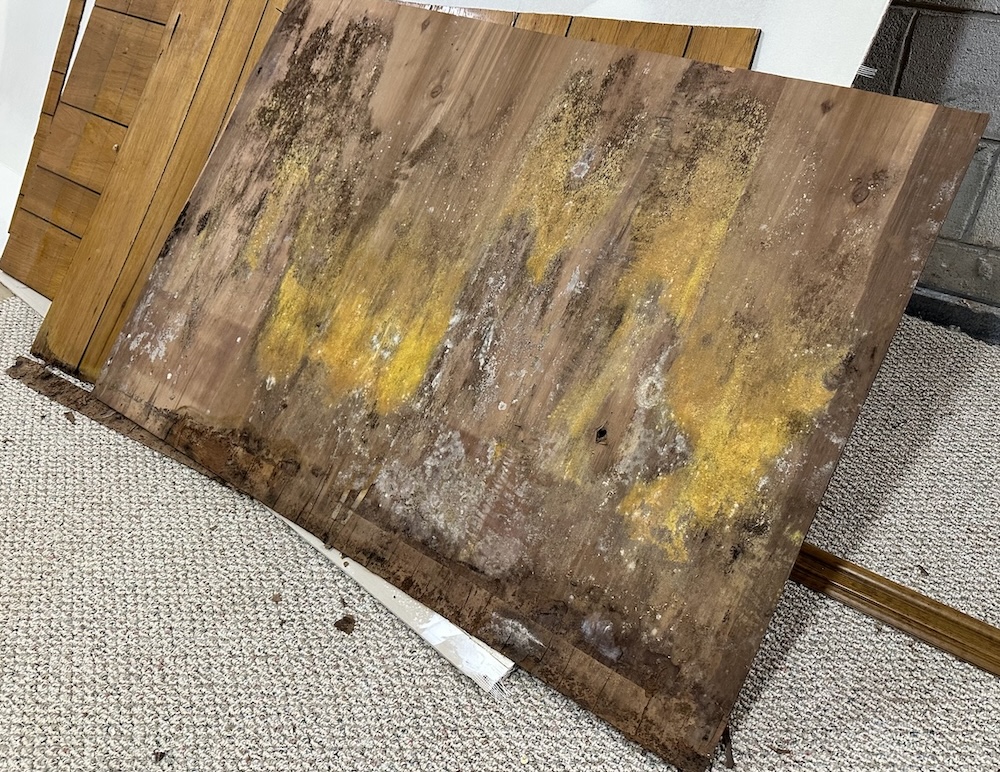 Various colors of microbial growth on the back side of wood paneling in a basement
And you may have seen that paneling before. In the spring of 2020 I began writing my book, A House Needs to Breathe … Or Does It? I used the photo below in one of my updates to those who had pre-ordered the book. At the time, I had no idea how bad the other side of that paneling looked.
 Writing my first book in the basement, unaware of the stuff that had grown on the back of that wood paneling.
Termite damage
Surprisingly, I found little termite damage when I remodeled my basement last year. I did find some, but it was just behind the bathtub on the exterior wall. The photo below shows another house where the baseboard in the basement had been eaten by termites. And they also made a little mud tunnel in the corner to go up the wall.
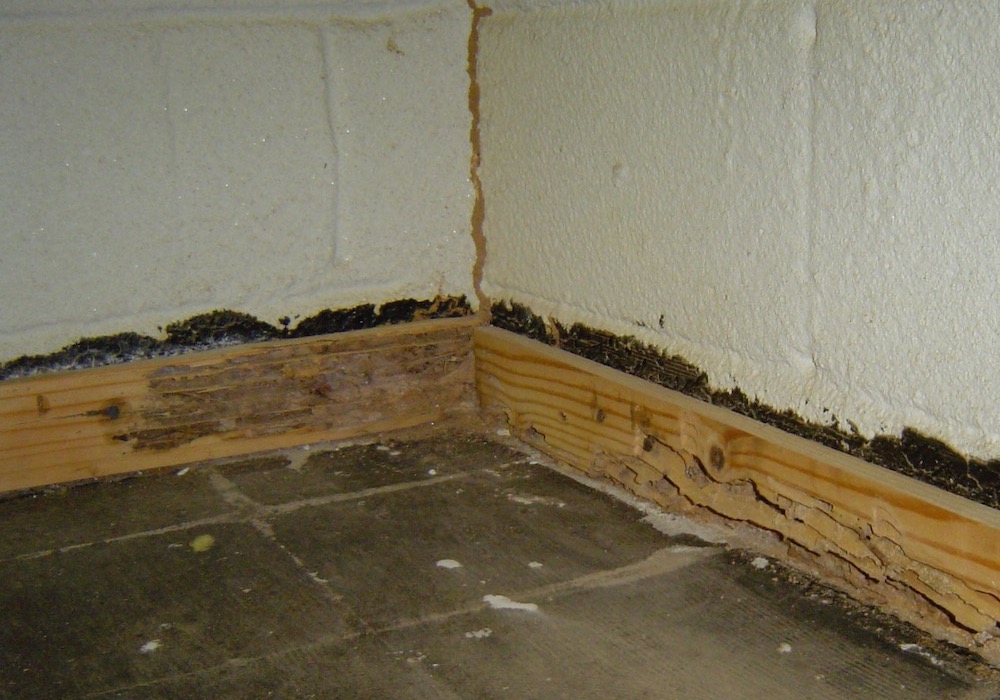 Termite damage in basement. Also note the mud tunnel going up in the corner.
Holes
Oh, the many holes you see when you look beneath the surfaces! Some are there for obvious reasons, like the hole where a duct passed through a concrete block. The reasons for some will always remain a mystery.
And then there are the what-the-heck-were-they-thinking holes. You may have seen this one before, but it’s an absolute classic. The photo below shows what I believe to be a refrigerator vent. It was a huge hole in the kitchen ceiling right above the back of the fridge.
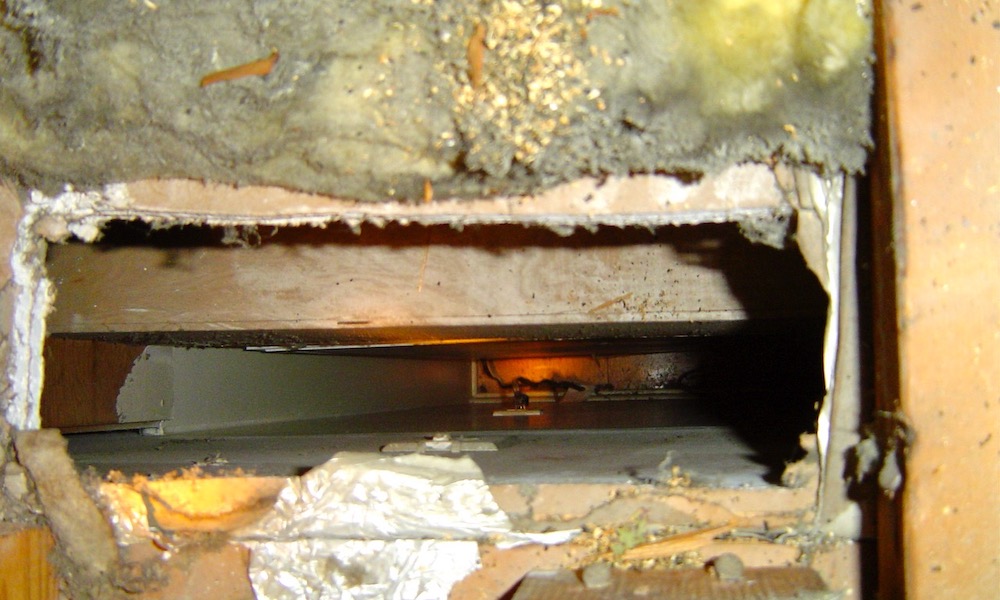 Air-leakage site in an unconditioned attic. This hole was cut to be a vent for the heat from the refrigerator.
Of course, there are also the crawlspace vents open to the space above dropped ceilings in conditioned basements. That one’s pretty common in the Atlanta area—and it provides a great opportunity to make a big improvement in your home’s airtightness. The photo below shows one I found in my house during the basement remodel last year. (You can read more about it here, where you also can see the “after” photo.)
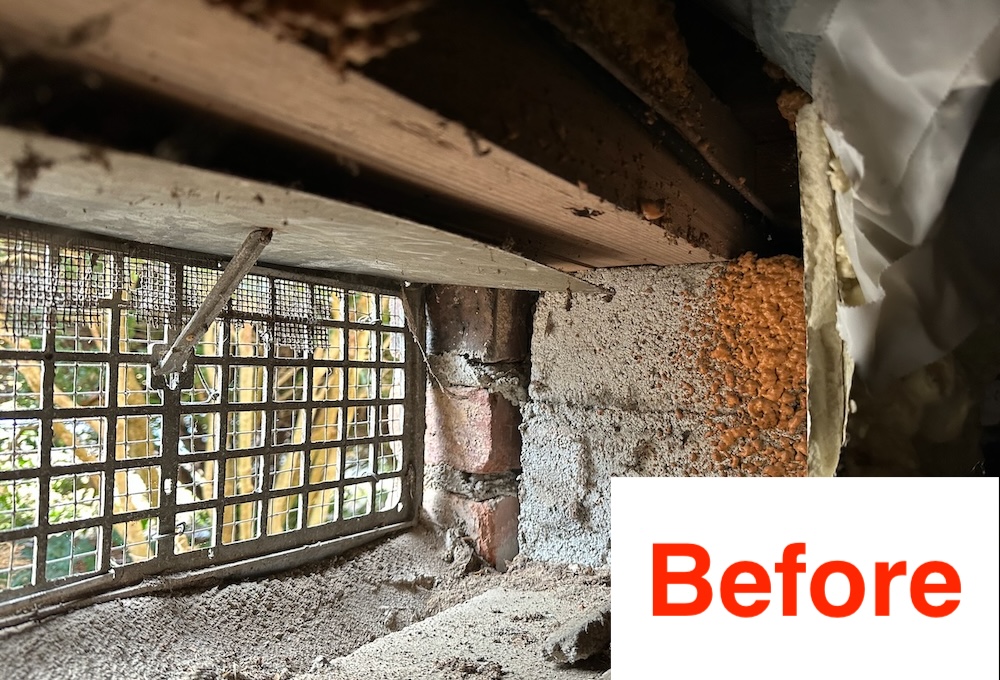 This crawlspace vent was open to the basement for decades.
Rot
Uncontrolled moisture and wood are a recipe for rot (and termites and microbial growth). I think you know what it looks like already, so one nice photo should suffice.
 Rotten floor near plumbing
Toxic and hazardous materials
Asbestos is one of the most common hazardous materials found in older houses. It could be in vermiculite insulation, floor tiles, the black mastic used as adhesive for floor tiles, and drywall joint compound.
The place I’ve seen it the most, though, is in the white cloth tape on HVAC ducts. The photo below shows what it looks like. The problem here is that it has a higher asbestos content than some of the other materials, and it starts falling apart as it ages. When we had the asbestos abatement done at the beginning of our basement remodel, I asked the inspector how often that tape tests positive for asbestos. His answer: 99 percent of the time.
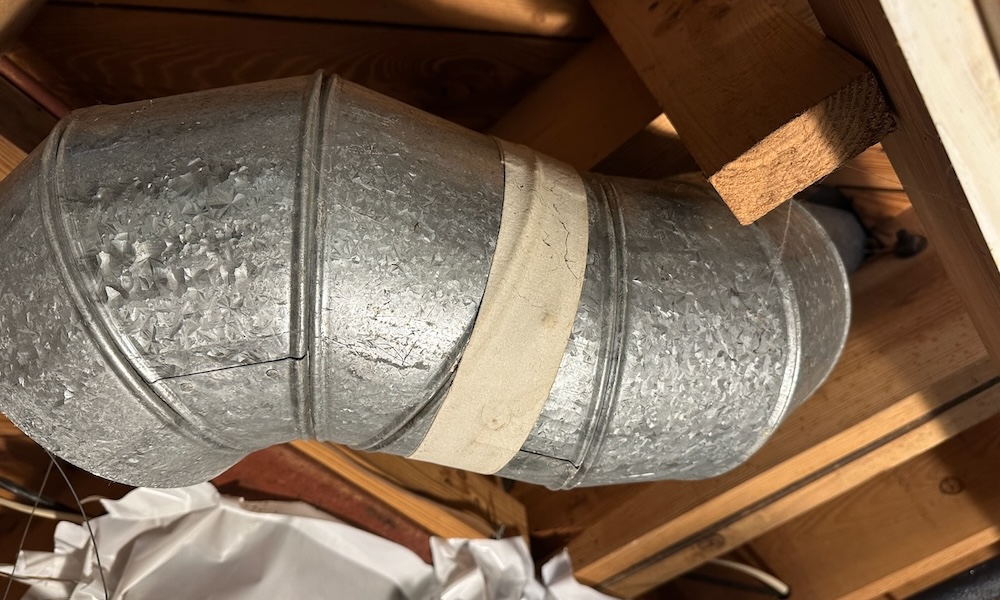 Asbestos tape on old ductwork
The asbestos in drywall joint compound, floor tiles, and black mastic is generally safer—but NOT safe—because of the lower concentration and because it’s less friable than the the asbestos duct tape above. Still, it’s best to encapsulate it with something like PerfectPaint or PerfectPrimer.
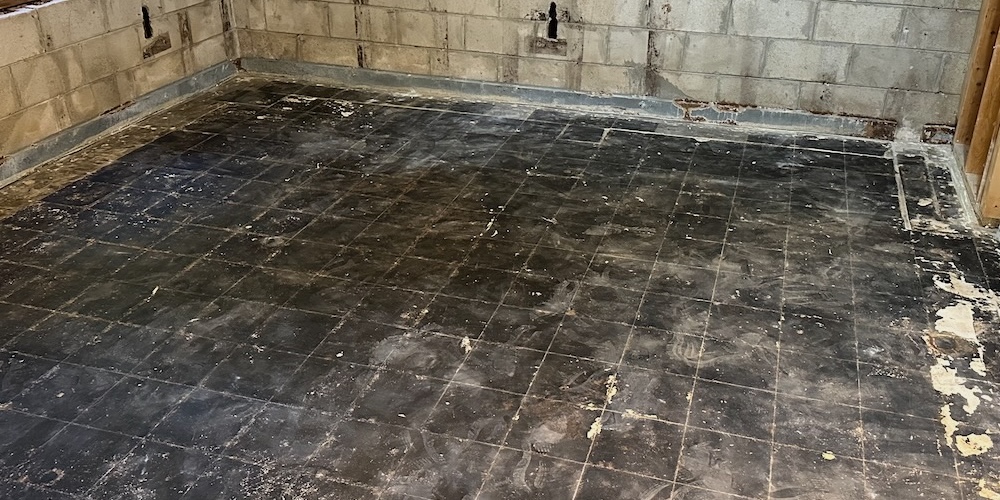 Old houses that had floor tiles may have left you some asbestos even if the tiles are gone.
Structural problems
Then there’s a whole other kind of scary. I found what you see below in my basement. That’s a steel I-beam being supported by a steel pole. Unfortunately, the beam is resting on only about a half inch of the pole. Yikes! If this house were in California, it may not have lasted this long because the only other support for that beam is about 18-ft. away at the other end of the beam. Double yikes!
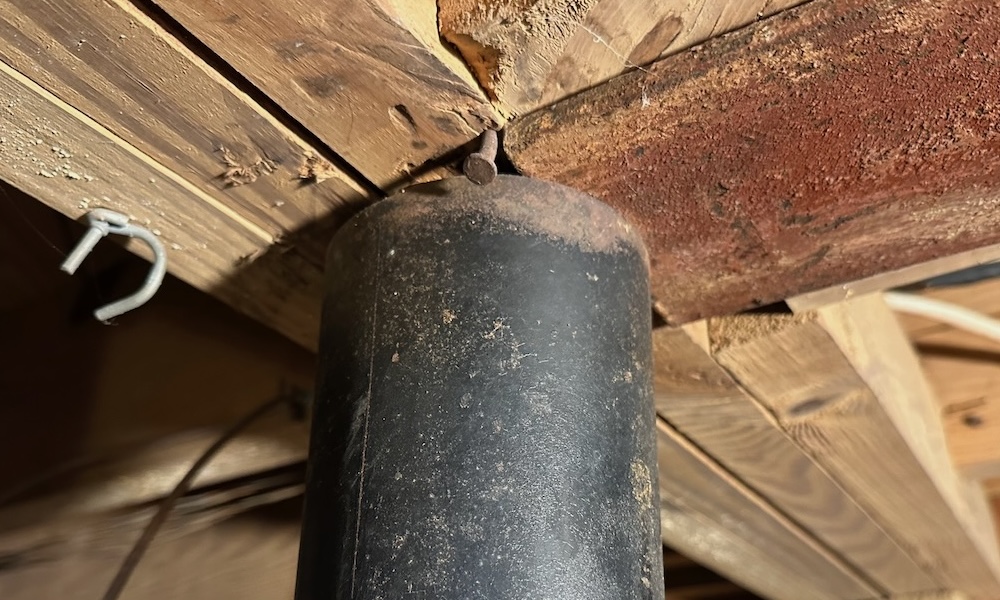 Steel I-beam, barely supported on one end
The stuff left behind
And then there’s the stuff that workers leave behind. Sometimes it’s accidental. I’ve picked up a few perfectly good tools from contractors who forgot them.
Sometimes it’s intentional. I’ve found all kinds of trash but also some more interesting stuff. That empty whiskey bottle was inside one of my foundation walls. I’ve found beer cans in attics too. The worst one I’ve heard about was an open cup of urine inside a garage wall. The owners of the house had to tear open the wall to find out what was making that awful smell.
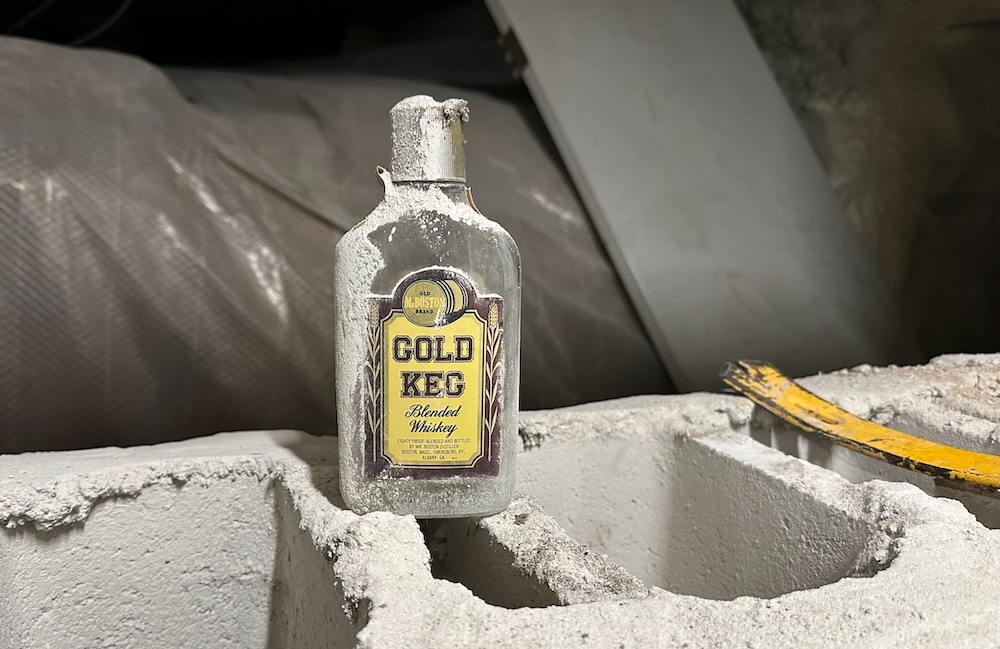 An empty whiskey bottle I found inside a concrete block
Well, there you have a little glimpse behind the curtains . . . or drywall, wood paneling, insulation, or whatever is covering those secrets that may be hiding in your home. Now what are you going to do about it?
Allison A. Bailes III, PhD is a speaker, writer, building science consultant, and the founder of Energy Vanguard in Decatur, Georgia. He has a doctorate in physics and is the author of a bestselling book on building science. He also writes the Energy Vanguard Blog. For more updates, you can follow Allison on LinkedIn and subscribe to Energy Vanguard’s weekly newsletter and YouTube channel.
Weekly Newsletter
Get building science and energy efficiency advice, plus special offers, in your inbox.