
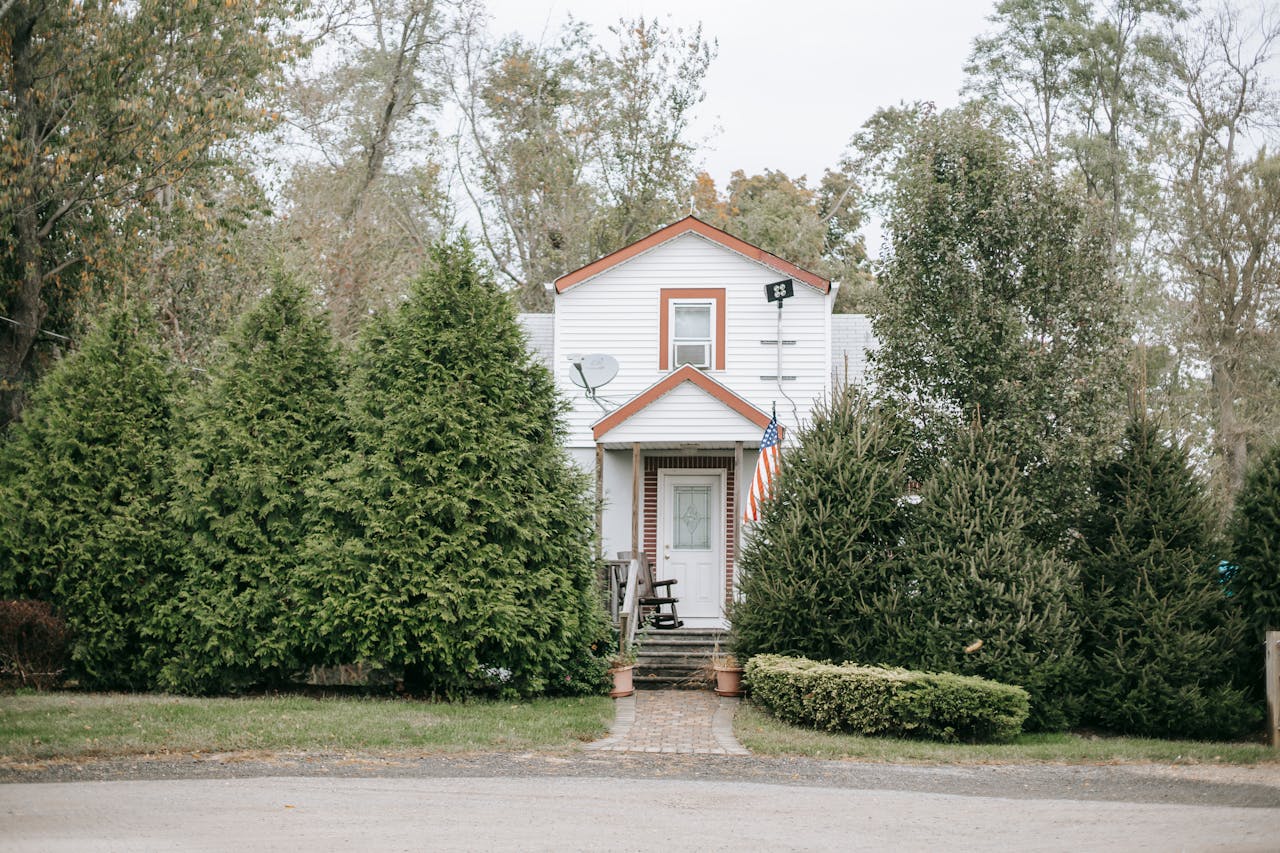

In a newly built subdivision on the outskirts of Redmond, Oregon, the houses sit notably closer together than those from just a few years ago. One development, Cinder Butte Village, even offers homes as small as 400 square feet – essentially tiny one-bedroom cottages with a single bath and maybe a garage tucked in back. The average new house there is around 1,000 square feet, roughly half the size of homes built in that community two years prior. Yet despite the shrinkage in floor space, these compact homes haven’t exactly become cheap. In fact, many buyers are now paying higher monthly mortgage bills for less house than they would have a few years ago.
 New houses built in Cinder Butte Village in Redmond, Oregon, now average roughly 1,000 square feet—nearly 50 percent smaller than the standard home constructed there just two years ago. © Claudia Richardt
What’s driving this counterintuitive trend of more money for less space is the sharp rise in interest rates and the domino effect it’s had on the housing market. Over the past two years, the average 30-year fixed mortgage rate in the U.S. roughly doubled – from around 3% in 2021 to over 7% by late 2023. That surge in borrowing costs has pushed the typical monthly payment far above what it used to be for the same loan amount. As a result, affordability has tanked, and buyers shopping on a budget have been forced to downsize their ambitions. “The monthly payment matters more than anything else,” as housing consultant John Burns puts it, and builders know it. Their solution: build smaller, cheaper homes that can fit a family’s target payment despite the higher interest burden.
Consider the example of Pacific Northwest builder Hayden Homes. In 2021, when mortgage rates were near rock-bottom, Hayden’s typical offering was a three-bedroom house of about 1,900 square feet selling for roughly $500,000, which came out to about a $2,000 monthly payment with a 3% loan. Today, with rates hovering around 6–7%, Hayden Homes has redesigned and trimmed down its floor plans. Their average new house now is only about 1,550 square feet and priced near $400,000, yet the monthly payment ends up around $2,100 even after a larger down payment. “We are reconfiguring our floor plans, our features, and community design all to get to that payment buyers can afford,” said Steve Klingman, Hayden’s president. In other words, the company is cutting size and amenities to keep that all-important mortgage bill within reach of middle-class families. “People want to own if we can make it attainable,” Klingman added.
This drive to shrink the American home isn’t limited to one builder or region – it’s happening nationwide. A recent industry survey found that about half of architects expect the average house size to decline in the coming years, with new developments shifting toward higher-density layouts (think duplexes or tightly packed single-family homes) even in places like Texas, where sprawl used to be the norm. In the past, design compromises such as swapping a backyard for a side yard, or a driveway for a street-facing garage, were mostly confined to pricey urban markets where land was scarce. Now those space-saving tricks are appearing in farther-flung suburbs and small towns as well. Builders are essentially doing whatever they can to squeeze more units onto each acre and trim per-unit costs, since buyers’ budgets haven’t grown enough to keep up with the higher interest rates.
Even before interest rates spiked, U.S. homes had begun a gentle downsizing from their mid-2010s peak. After decades of growth, the median new single-family house size topped out around 2,500 square feet in 2014-2015. It then drifted down by a few hundred feet as construction costs rose and household sizes shrank. The COVID-19 pandemic briefly interrupted that trend – ultra-low rates and remote work needs prompted a short-lived bump in home sizes as some buyers sought extra rooms and bigger yards. But that era is over. Now we’re in what housing economists bluntly call a housing affordability crisis, with overall home affordability at its worst level in at least 15 years. By one metric, buying a median-priced home today (with current rates) is as tough as it was at the peak of the 2006 housing bubble. In response, builders have pivoted back to making houses smaller and more economical, with renewed interest in small home plans.
 Homes in Cinder Butte Village are now being constructed with significantly less space between them than developments from just a few years ago. © Erik Mclean
One telling statistic: the median size of newly sold single-family homes in 2023 was about 2,286 square feet, down from 2,526 square feet at the 2014 peak. And while home prices in many areas have plateaued or even dipped slightly since last year, price-per-square-foot has actually jumped up about 3.4% year-over-year, according to Realtor.com data. In plain English, that means buyers are paying more money for each square foot of house, which is consistent with a greater share of smaller homes being sold (smaller homes tend to cost more per square foot). A study by John Burns Consulting noted that from 1992 to 2021, the price per square foot of new homes usually inched up about 1% a year, but in 2021 it spiked 13%, followed by another 10% jump in 2022. So not only are new houses shrinking, they aren’t exactly cheap on a per-unit basis – a form of “shrinkflation” in real estate where you get less space for the dollar.
If smaller new houses are booming, it’s partly because larger, older houses have virtually vanished from the market. Homeowners who lucked into 3% mortgage rates during the pandemic boom are now reluctant to sell and give up those ultra-low payments. “Mortgage rates were at such historic lows in 2021 and 2022 that buyers are unlikely to trade their homes… for new ones with rates now in the 7% range,” observed Chris Porter, a housing demographer. Indeed, many would-be sellers are effectively “locked in” by their current cheap loans. They’re staying put, which has contributed to a dearth of existing homes for sale. In mid-2023, the inventory of homes on the market hit an all-time low, and the few sellers who do list often insist on high prices to cover their own next purchase. Daryl Fairweather, chief economist at Redfin, noted that the price many sellers want “is unusually high” – they need the buyer to essentially “buy them out” of their great mortgage.
With homeowners sitting on the sidelines, newly built houses have surged to fill the gap. By the summer of 2023, nearly one-third of all single-family homes on the market were new construction – about double the pre-pandemic share. In other words, one out of every three homes a buyer can find for sale now is a brand-new house. That’s an unprecedented situation, and it puts homebuilders in a unique position. Unlike an owner, a builder can’t decide to sell once they’ve built a house – they need to move units to stay in business. So builders have been aggressively adjusting to what buyers can afford: cutting prices where possible, offering incentives like mortgage rate buydowns, and, crucially, redesigning homes to use fewer materials and less land. As one Redfin report put it, “Builders are still building, but homeowners aren’t selling, so new construction is the only option for many buyers”. And to capture those budget-stretched buyers, some builders are literally taking out bedrooms. An Indiana developer, for example, recently shaved 300–500 square feet off its typical house plans – removing spare bedrooms and bathrooms – and trimmed the price by $50,000 to $75,000 to entice cost-conscious buyers.
 With existing homeowners reluctant to sell and inventory at record lows, newly built houses now account for nearly one in three homes for sale—pushing builders to deliver smaller, more affordable designs with fewer bedrooms, tighter layouts, and multipurpose spaces to meet budget-constrained demand. © D Goug
Of course, making a smaller house attractive means rethinking the layout and features. Architects and builders are finding creative ways to pack more functionality into tighter quarters. Hallways are often the first to go – those long interior corridors are now seen as wasted space that can be eliminated to add usable square footage elsewhere. “Essentially, we’re Tetris-ing the functional rooms together, avoiding wasted square footage on non-functional areas like hallways,” one design report noted. Formal dining rooms, once a staple of suburban homes, are disappearing too; in many new designs, the dining area is either absorbed into an expanded kitchen or multipurpose living space. In an industry survey by Burns Consulting, dining rooms and even children’s playrooms were being sacrificed in order to preserve a spacious kitchen and a roomy primary bedroom suite – the areas today’s buyers prioritize. To save space (and money), bathtubs are being replaced with showers in many smaller homes, since a tiled tub/shower combo takes up more room than a simple shower stall. The kitchen is being asked to do double-duty: oversized kitchen islands are common now, designed to function as both prep space and the family dining table. Storage is tucked into every nook – under staircases, in attics, or via built-in cabinetry – because there may be no extra spare room to stash things. And builders are blurring indoor and outdoor spaces to make the home feel larger than it is. It’s now popular to have a big sliding glass door opening onto a covered patio or tiny yard, creating a continuous flow that makes a small living room seem more open and airy. Flexibility is key as well: more than half of new homes now include a “flex space” or bonus room of some sort, which can serve as a home office, guest nook, or play area depending on a family’s needs.
Not everyone is thrilled about the trend toward smaller homes. Some homeowners in upscale markets complain that builders are still catering to the luxury end – tearing down modest houses to build McMansions – rather than addressing affordability. And some empty-nesters and older buyers, having been accustomed to large homes, aren’t eager to downsize their living space. Yet for many first-time buyers and younger families, the choice these days may be between a smaller home or no home at all. The data show that more affordable new constructions (priced in the lower end of the market) have been selling briskly, indicating there is an appetite for these scaled-down houses. “The increase in budget-friendly homes priced in the $200,000 to $350,000 range outpaced all other price categories for the past five months,” noted one Realtor.com analysis, pointing out that buyers now “have way more homes to choose from at a friendly price range” as long as they’re willing to accept less square footage. In many high-cost regions, even a 1,500-square-foot new house is a more affordable price option compared to an older, larger home that might be completely out of budget.
For many first-time buyers and younger families, smaller new homes are becoming the only affordable path to ownership. © Any Lane
Developers like Hayden Homes believe this paradigm shift is not a temporary blip, but a new normal. Having already downsized its catalog of floor plans during the recent rate hikes, Hayden is working on future communities that will pack twice as many homes into the same land area as projects they built a few years ago. “I think this is for the long haul,” Steve Klingman said of the trend toward smaller homes. As long as borrowing money remains expensive and monthly payments weigh heavily on buyers’ minds, builders expect demand to be strongest for these more attainable, efficient homes.
In the broader view, new construction is only a small slice of all housing – builders started about 1.5 million houses and apartments in 2022, versus a total U.S. housing stock of over 140 million units. But new homes are a sort of bellwether for where the market is headed, precisely because they respond most directly to economic pressures like interest rates. Right now, they’re signaling that the era of ever-bigger American homes has hit a wall. The quintessential American single-family house, once synonymous with steady growth in size and comfort, is slimming down in order to fit the financial reality faced by today’s buyers. Whether this “smaller but smarter” home trend proves to be a lasting cultural shift or just a cyclical adjustment, only time will tell. For now, many families are finding that bigger isn’t better when you can’t afford to pay for it – and builders are listening, delivering more compact homes that promise to do more with less space. In an age of high rates and tight budgets, the oversized McMansion is out, and the efficient starter home is very much back in style.
Resources
- Dougherty, Conor. “A higher monthly payment, but less square footage.” The New York Times (via The Seattle Times), Oct. 18, 2023.
- Cunningham, Mary. “New homes will continue to get smaller, according to a new survey.” CBS News, July 16, 2024.
- Pandy, Jordan. “American homes are shrinking, but it isn’t making houses any more affordable.” Business Insider, Aug. 28, 2023.
- Anderson, Dana. “New Builds Make Up One-Third of Houses on the Market, With High Rates Locking Up Existing Inventory.” Redfin News, Aug. 17, 2023.