

Architects: Baumschlager Eberle Architekten
Area: 30,000 m²
Year: 2024
Photography: Trieu Chien
Lead Architects: Dat Thanh Cung
Project Architects: Noi Van Tran, Tuan Quang Nguyen
Chief Design Officer: Garcia Lugo Servando
Client: Huy Hoang Lock Co., Ltd.
City: Hanoi
Country: Vietnam
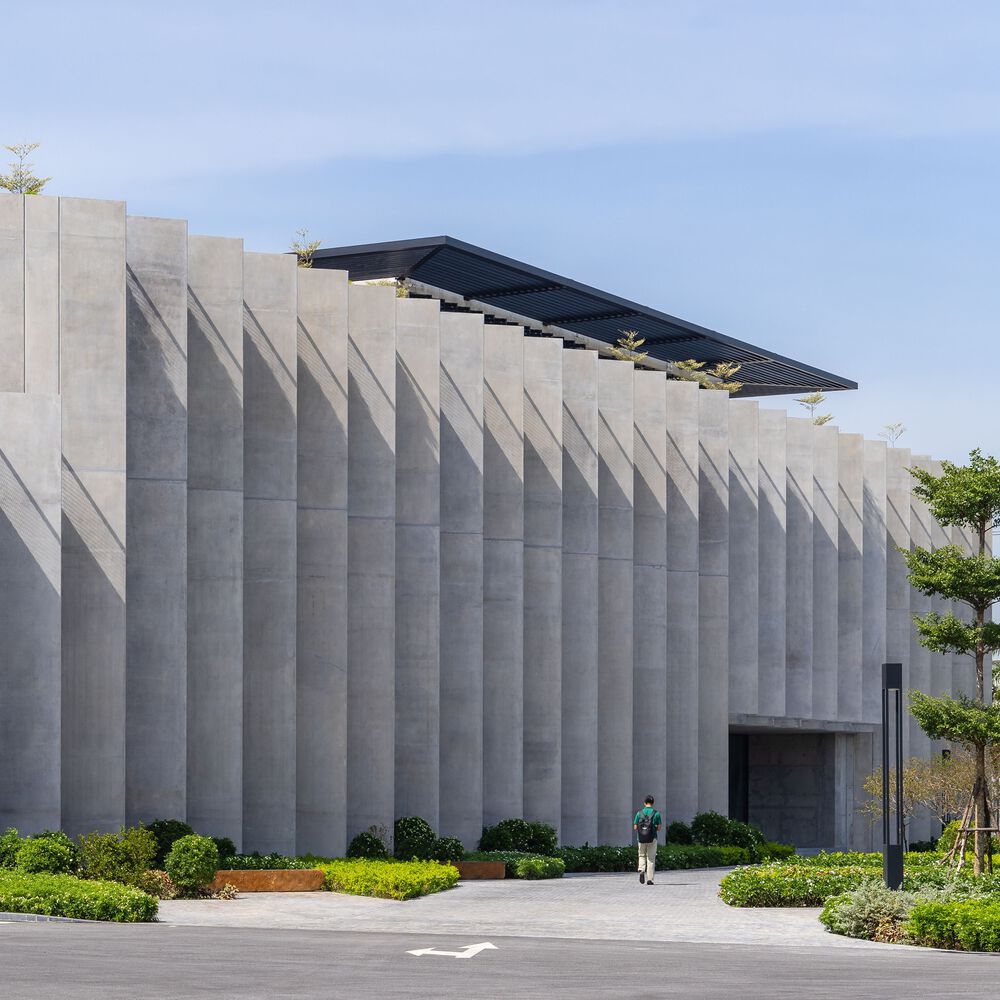
The Huy Hoang Lock Factory in northern Vietnam is a contemporary industrial campus that integrates production, public engagement, and environmental performance within a unified architectural framework. Designed by Baumschlager Eberle Architekten, the project occupies a three-hectare site in the Quang Minh Industrial Zone and brings together three factory buildings connected by a multipurpose front building. Two facilities are dedicated to German manufacturing technology, while the third accommodates Italian production systems, forming a coordinated yet flexible operational layout. Conceived with long-term sustainability in mind, the project achieved LEED Gold certification for both construction and operational phases. Its architectural response is closely aligned with Hanoi’s humid tropical monsoon climate, employing a calibrated concrete lam facade to manage solar exposure, ventilation, and seasonal weather variations. Internally, a core-and-shell structural approach supports open, adaptable spaces, while public-facing functions such as exhibition areas, training facilities, and communal amenities expand the role of the factory beyond production, reflecting the company’s four-decade history and future-oriented vision.

The Huy Hoang Lock Factory departs from conventional industrial models by positioning the manufacturing environment as an open and civic-oriented campus. Rather than isolating production behind closed boundaries, the design emphasizes transparency and accessibility, allowing visitors, workers, and the broader community to engage with the facility. This approach reflects an understanding of the factory not only as a place of output, but as a cultural and educational environment that communicates the identity and values of the company.
 Huy Hoang Lock Factory / Baumschlager Eberle Architekten 52
  Huy Hoang Lock Factory / Baumschlager Eberle Architekten 53
  Huy Hoang Lock Factory / Baumschlager Eberle Architekten 54
Site organization plays a critical role in achieving this openness. The three production buildings are arranged to support efficient workflows while maintaining spatial continuity across the complex. The front multipurpose building functions as a connective element, housing offices, training spaces, and exhibition areas that mediate between industrial operations and public use. Its central hall is conceived as a museum-like space, where artifacts and displays narrate the history of Huy Hoang Lock and offer insight into the manufacturing process, reinforcing the factory’s role as a place of knowledge exchange.
 Huy Hoang Lock Factory / Baumschlager Eberle Architekten 55
  Huy Hoang Lock Factory / Baumschlager Eberle Architekten 56
  Huy Hoang Lock Factory / Baumschlager Eberle Architekten 57
Environmental performance is embedded in the architectural language of the project, most visibly through its concrete lam facade system. Responding to Hanoi’s intense solar radiation, high humidity, and seasonal monsoon patterns, the facade varies in density and opening angle according to orientation. Southern and southeastern elevations are more open to encourage daylight and airflow, while western and northern facades employ tighter configurations to limit thermal gain and protect against prevailing winds. This passive strategy enables the building to generate shade, support natural ventilation, and reduce energy demand throughout the year.
 Huy Hoang Lock Factory / Baumschlager Eberle Architekten 58
  Huy Hoang Lock Factory / Baumschlager Eberle Architekten 59
  Huy Hoang Lock Factory / Baumschlager Eberle Architekten 60
Internally, the core-and-shell structural system provides large, unobstructed floor plates that can accommodate changing production technologies over time. Communal spaces such as the canteen and shared gathering areas are integrated into this flexible framework, benefiting from filtered daylight and moderated indoor climates created by the facade. Through its combination of adaptability, climatic intelligence, and public-oriented spaces, the Huy Hoang Lock Factory demonstrates how industrial architecture can balance efficiency with environmental responsibility and human experience, ensuring relevance and durability well into the future.

Project Gallery
 © Trieu Chien
  © Trieu Chien © Trieu Chien
  © Trieu Chien
  © Trieu Chien
  © Trieu Chien
  © Trieu Chien
  © Trieu Chien
  © Trieu Chien
  © Trieu Chien
  © Trieu Chien
  © Trieu Chien © Trieu Chien
  © Trieu Chien
  © Trieu Chien
  © Trieu Chien
  © Trieu Chien
  © Trieu Chien
  © Trieu Chien
  © Trieu Chien
  © Trieu Chien
  © Trieu Chien
  © Trieu Chien © Trieu Chien
  © Trieu Chien © Trieu Chien
  © Trieu Chien © Trieu Chien
  © Trieu Chien
  © Trieu Chien © Trieu Chien
  © Trieu Chien
  © Trieu Chien © Trieu Chien
  Huy Hoang Lock Factory / Baumschlager Eberle Architekten 61
  Huy Hoang Lock Factory / Baumschlager Eberle Architekten 62 Huy Hoang Lock Factory / Baumschlager Eberle Architekten 63
  Huy Hoang Lock Factory / Baumschlager Eberle Architekten 64 Huy Hoang Lock Factory / Baumschlager Eberle Architekten 65 Huy Hoang Lock Factory / Baumschlager Eberle Architekten 66
  Huy Hoang Lock Factory / Baumschlager Eberle Architekten 67
  Huy Hoang Lock Factory / Baumschlager Eberle Architekten 68
Project Location
Address: Quang Minh Town, Me Linh District, Hanoi, Vietnam
The location specified is intended for general reference and may denote a city or country, but it does not identify a precise address.