
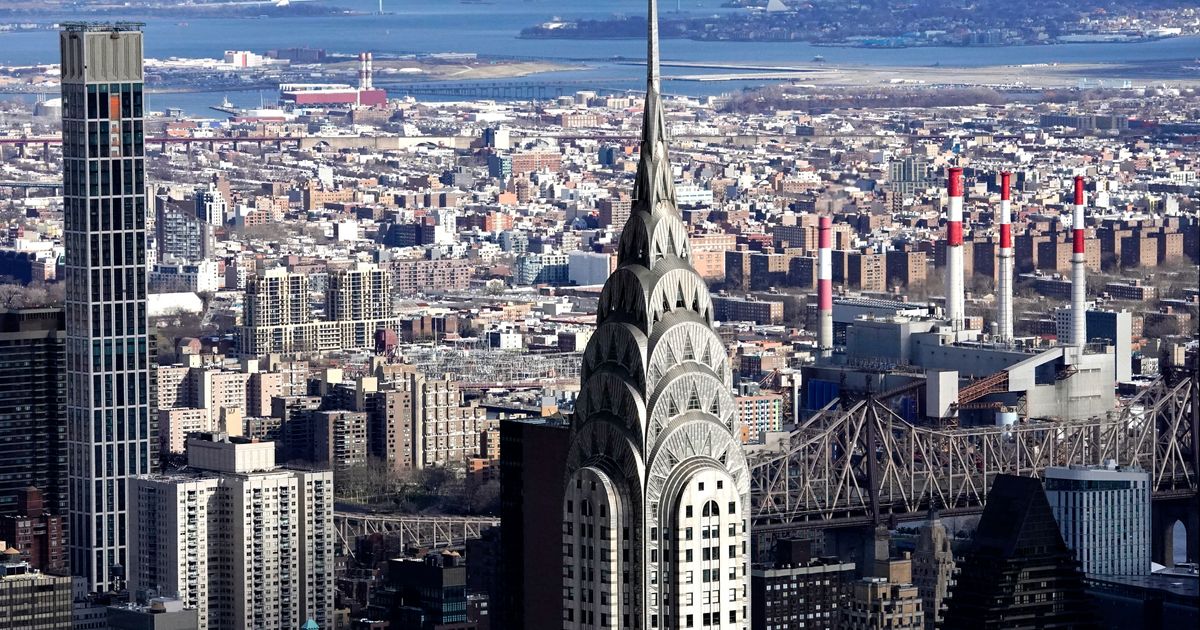
If you lived there, you’d be looking at home right now. Photo: Timothy A. Clark/AFP/Getty Images
In the Chrysler Building’s 96 years of occupancy, exactly two people have managed to pull off the children’s-book fantasy of living there. (Officially, or at least semi.) They couldn’t have been more different; one was an artist, the other a corporate titan. In the mind’s eye, it’s a Fred Astaire movie idea, one that plays out in a glittering, zigzaggy penthouse where the Depression is entirely theoretical, Sky Captain is on a neighboring floor, and your autogiro is parked on the setback terrace outside.
Now, as the building nears what amounts to a foreclosure sale, it seems vaguely possible that a few lucky characters will once again have the chance to move in. In 2025, RFR’s Aby Rosen, who bought the building at what seemed like a bargain price of $150 million six years earlier, fell $21 million behind on the payments and defaulted. Earlier this year, The Real Deal reported that a previous owner, Tishman Speyer, was in talks to buy it, and then this week it broke the news that the front-runner is now Jeffrey Gural, whose GFP Real Estate owns and operates quite a few prewar buildings. Gural’s most recent (and highly visible) move was to gain control of the emptied-out Flatiron Building, in which he had long been a part-owner, and embark, in a joint venture with the Brodsky Organization and the Sorgente Group, on a gut reno of its dilapidated innards. GFP decided to turn it into apartments, and a first look suggests that they’re going to be covetable, particularly the ones with tiny outdoor terraces.
What does Gural’s interest mean for the Chrysler? Apartments in the tower portion, perhaps with offices in the base? Reimagining the building in whole or in part as a residence is a thrilling idea (and Francis Ford Coppola did it most recently, in his bizarre and wildly ambitious film Megalopolis), but the economics of conversion will be trickier than for the Flatiron. It’s much bigger, 77 floors instead of 21. It too needs major work, and it would require heavy modification to go residential: It will need additional plumbing columns, for example, to supply new bathrooms and kitchens. Outside and in the lobby, Landmarks Preservation Commission approval makes everything go slower and cost more. The building’s crown was notoriously leaky in the past, although reportedly that’s been largely dealt with in the past couple of decades.
Then there’s the location, face-to-face with the future behemoth 175 Park Avenue, which will throw a big shadow in its general direction every afternoon. 42nd Street is a noisy, busy artery, significantly more chaotic than 23rd. Perhaps the area can be spun as a positive anyway; it is still on the fringes of residential Murray Hill, and there may be enough pied-à-terre buyers in Darien and Bedford who’d appreciate being right next to Grand Central Terminal. The Pfizer World Headquarters conversion is already underway, and that will drop quite a few residents into the area and give it a less forlorn feeling outside of business hours. One can, albeit hazily, envision a future residential strip stretching from the Chrysler Building at one end to Tudor City at the other, presumably to be called Murray Hill North or the East Deuce or Grand Central East (GraCE?). It’s gray and full of traffic, but that gorgeous atrium at the Ford Foundation would at least offer a little greenery under glass.
The biggest stumbling block, though, is the ground lease. One reason Rosen was able to buy the building so cheaply is that the land beneath it is owned by the Cooper Union for the Advancement of Science and Art, the small unique college on Astor Place. Rent from the Chrysler Building, now $32.5 million a year and set to increase to $41 million in 2028, has for many years helped cover its students’ tuition. (It indirectly led to the writing of this post; both my father and the co-founder of New York attended Cooper on full scholarships.) Rosen had apparently hoped to renegotiate the ground-lease terms after he took over, but instead he just ran up $21 million in unpaid bills. Cooper took possession of the building after the default, and Gural is reportedly speaking with its representatives now. (He’s also a former Cooper Union board member, although his term expired in 2015.) Conventional wisdom holds that buyers of condos are wary of a ground-lease building, because they carry the risk of a future price hike, as the residents of 57th Street’s Carnegie House co-op learned the hard way. Any redeveloper of the building would have to make a sweetheart deal with Cooper — unlikely, since the college is on a track to financial recovery and needs the money — or take another approach, like turning it into super-high-end rentals. The idea of a hotel has been tossed around as well, although that brings a separate set of complications in the form of special permits, further regulation, and a different competitive environment.
That said, it’s a building that (as my colleague Kim Velsey has thoroughly recounted) has at times been a money pit, a place where expensive plans go bust. A previous owner lost it in foreclosure in 1975. Despite some patches of restoration and updating, it is mostly just serviceable space once you move past the public areas. A few people have floated the idea of bringing back the Cloud Club, the spectacular private restaurant in the spire that closed in 1979, and somehow nobody’s been able to carry it off. (Given the success of Manhatta and The View, you’d think there’s plenty of appetite for a way-up-high meal.) Rosen’s plan to rebuild the long-closed observatory, getting in on the tourist game that has been so lucrative at One Vanderbilt, Rockefeller Center, and the Empire State Building, also came to naught.
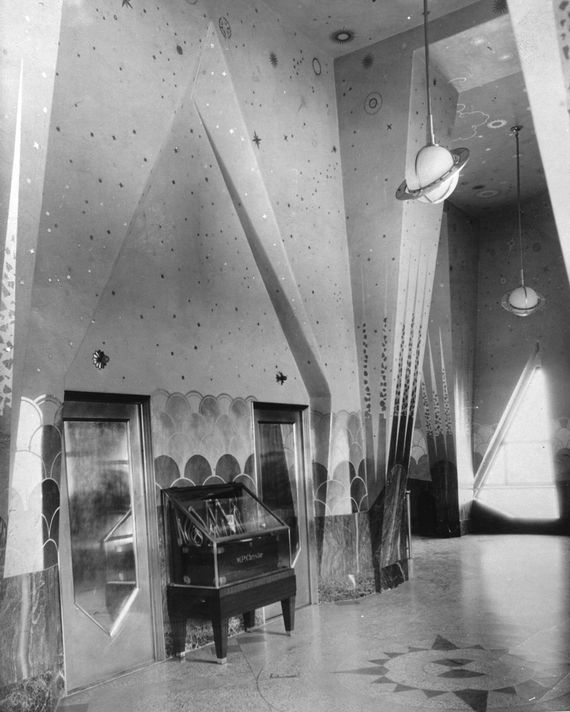
The 71st-floor observatory before it closed in 1945. That is Walter P. Chrysler’s toolbox on display in the glass case by the elevators. Photo: Austrian Archives/Imagno/Getty Images
But back to the apartments. If somehow people did get to live there, what might it be like? The two people who’ve done it had, let’s say, atypical arrangements.
One was Walter P. Chrysler Sr. himself, namesake founder of the automaker and developer of the building. He was the one who called for his tower to be the tallest in the world (which it was for a hot minute, before the Empire State Building overtopped it) and who had his architect, William Van Alen, turn the whole thing into a showcase for the corporation’s product. Faux-chrome hubcaps and brick outlines resembling fenders decorate the building’s skin; those giant gargoyles on the corners are overscale replicas of radiator-cap hood ornaments. And he reserved two of the building’s narrow high floors, 69 and 70, for his own use, decorated not in full-on Art Deco zing but instead fitted out in a sort of baronial-Tudor look. He installed a private gym and used to tell people that he had the highest toilet in town. Up on 71, there was that observatory, and by the elevators a vitrine held Chrysler’s toolbox, evidence of his beginnings as a railroad mechanic. (It still exists, now at the mothership in Michigan.) But he didn’t end up using the apartment all that much, and the company never consolidated its headquarters in New York. He died in 1940, and the company left the building in 1953. The space, somewhat implausibly, became a dentist’s office for many years thereafter.
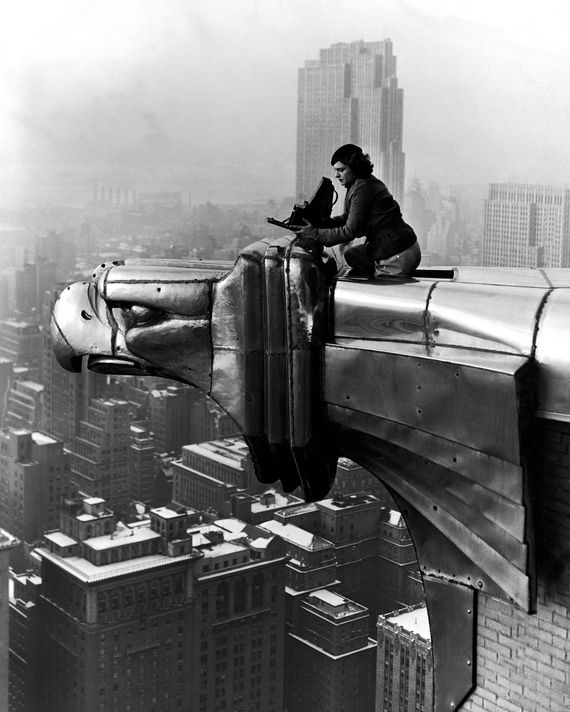
Margaret Bourke-White atop the chrome-steel gargoyles outside her 61st Street studio. She lived there, only slightly extralegally, for about four years when the building was new. Photo: Oscar Graubner/The LIFE Picture Collection/Shutterstock
The other sometime resident was Margaret Bourke-White, the photographer whose epically glamorous life was itself movie-worthy. (Literally: The biopic starred Farrah Fawcett. She also shows up in Gandhi, played by Candice Bergen as she makes this portrait.) In the late 1920s, much of her photo work was about the robust beauty of heavy industry, and that led her to join Henry Luce’s brand-new magazine Fortune. Luce’s Time Inc. soon became one of the first tenants in the Chrysler Building, and Bourke-White — who had been operating from Cleveland — photographed the building’s construction from 800 feet up, leaving her besotted with its futuristic brawn. She wanted to move in, she wanted an apartment overlooking the 61st-floor gargoyles, and she was not a woman who took no for an answer. “There was no place in the world that I would accept as a substitute,” she later wrote, adding that she had been undecided about moving to New York until then. The romance of the building sealed the deal.
Even so, the Chrysler real-estate team didn’t want to rent to her, because she was (in her words) “female, young, and not too plain,” and they expected her to marry any moment and quit her career. So, hilariously, she applied for the job as the building’s janitor, hoping to exploit a legal loophole permitting residency and hand off any jobs involving a mop. That didn’t work either. In the end, she just rented the southeastern part of the 61st floor as a studio — Time Inc. put in a word with the landlord — and she spent her nights there semi-legally, going out for breakfast every day. The great mid-century designer John Vassos did the rooms up for her with a glass desk, a tropical-fish tank built into a wall, a bright raspberry-colored rug, and — out on one of the terraces, at least when it was warm — another tank containing two pet baby alligators. In her telling, her business took off after a few years, and because she needed more space, she and the alligators moved to a larger penthouse in the office building at 521 Fifth Avenue. In real life, according to the curator Stephen Bennett Phillips, she fell behind on her bills and was evicted in 1934, owing six grand in back rent. Even the Chrysler Building’s most celebrated occupant was not immune to its reverse Midas touch.
Sign Up for the Curbed Newsletter
A daily mix of stories about cities, city life, and our always evolving neighborhoods and skylines.
By submitting your email, you agree to our Terms and Privacy Notice and to receive email correspondence from us.