
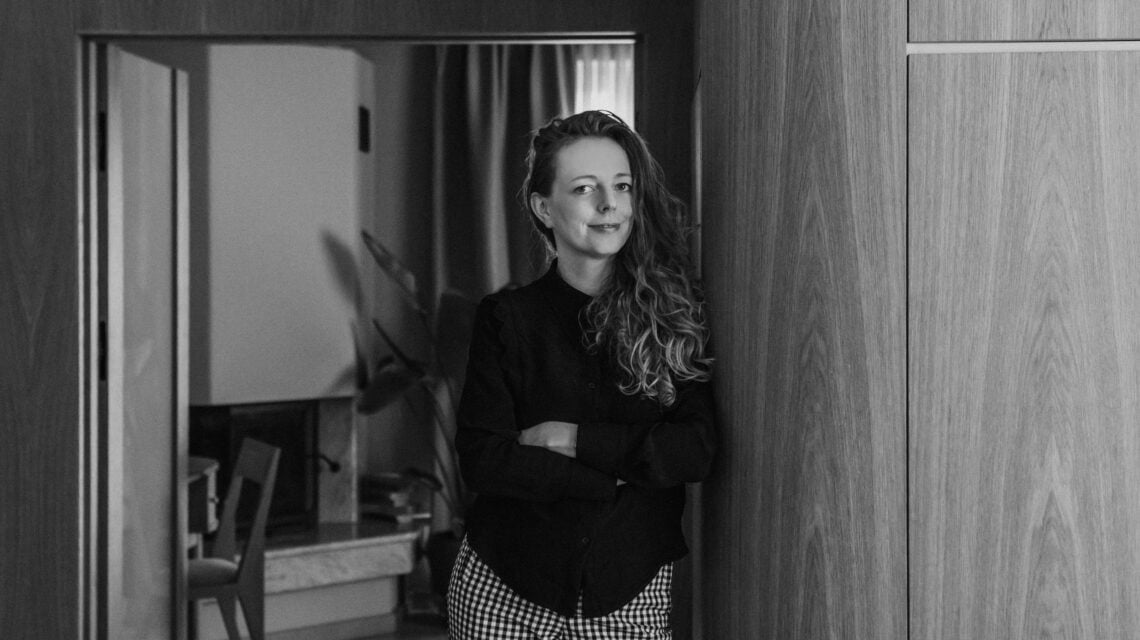

Dorota Terlecka is a Polish architect and founder of Biuro Kreacja, an interdisciplinary design studio based in Poland working across architecture, exhibition design, and cultural projects. Her practice focuses on spatial storytelling, with an emphasis on how people experience, perceive, and emotionally engage with space. Drawing from a background that spans architecture, scenography, and cultural programming, Terlecka approaches design as a narrative medium, often developing exhibitions and public interiors that prioritize atmosphere, movement, and user interaction. Her work includes exhibition projects such as “It’s Not Raining in Gdynia” and installations for institutions, including the World War II Museum in Gdańsk, where spatial design is used to frame reflection, memory, and collective experience. Across her practice, Terlecka consistently explores simplicity, precision, and the role of subtle interventions in shaping meaningful, human-centered environments.
What inspires you?
I feel that inspiration is everywhere-it’s embedded in everyday life. It can come from something as simple as a walk on the beach, a conversation with someone, or even the atmosphere of a social gathering. What matters is being present and open to noticing these moments.
At the same time, I think we are constantly overstimulated, which makes it harder to truly observe. That’s why it’s important to consciously step away from screens-from phones and computers-and allow yourself to experience things more directly. Only then can you really see, hear, and feel what surrounds you.
In my work, inspiration often comes from unexpected connections. When designing exhibitions, even something like cooking can become the starting point for an interactive installation. I’m particularly interested in creating experiences that surprise people-something that interrupts their routine way of perceiving reality. Sometimes that surprise can be very subtle, like introducing silence into a space. It’s something we rarely experience today, yet it can be incredibly powerful.
What inspired you to become an architect?
My interest in architecture grew quite naturally out of my early passion for drawing. As a child, I was always sketching, and this led me to attend art school. It was there that I began to understand that what fascinated me most was not just creating images, but thinking about space-how it works, how it influences people, and how it can be shaped.
At the same time, I realized I had a strong technical inclination, which made architecture feel like a natural combination of creativity and structure. However, my path wasn’t entirely straightforward. After graduating, I explored different areas-I worked on set design for television and film, created event spaces, and organized cultural projects.
Looking back, I see how important that period was. It allowed me to experiment, to understand different scales of design, and to develop a more narrative approach to space. I believe that trying different things is essential, especially at the beginning of a career. All of those experiences shaped the way I think today.
What I value most now is the possibility to immerse myself in a project, whether it’s an exhibition or a public space, and to explore completely new themes each time. It gives me a sense of constant discovery and allows me to step outside everyday routines.
 Kulinarna Kamienica / Biuro Kreacja + M19 Architekci © Alka Murat
How would you describe your design philosophy?
For me, design always begins with people. I try to understand what a space should offer them-how it can support their perception, their comfort, and their overall experience.
When I design an exhibition or a restaurant, I think not only about the visual aspect but also about how the space will be used, how people will move through it, and what kind of emotions it might evoke. In that sense, my approach is often connected to service design and user experience thinking.
At the same time, I’m interested in simplicity and precision. Sometimes a single element-a color, a texture, or a carefully framed view-can have a stronger impact than a complex composition. There are also moments when the best decision is to introduce emptiness, to create space for reflection.
This can be challenging, because as designers we often feel the need to “add” something. Choosing to do less, or even nothing, requires a different kind of confidence. But I believe that this restraint can lead to more meaningful and authentic spaces.
What is your favorite project?
I don’t think I have one favorite project, because each one represents a different moment, a different challenge, and a different set of ideas. However, there are definitely projects that I feel particularly connected to, especially those where we managed to go beyond the initial framework.
I’m most satisfied when a project evolves into something unexpected, when it starts to create its own logic rather than simply following a brief. Those are the moments when design becomes more exploratory and less predictable.
One example is the exhibition “It’s Not Raining in Gdynia.” In this project, we used relatively simple means to build a strong atmosphere inspired by a seaside town. Through a sequence of installations, visitors could engage physically and emotionally, sliding down a symbolic cliff, “fishing” in the depths, or touching seaweed. It was less about presenting information and more about creating a sensory experience.
 Interview with Dorota Terlecka of Biuro Kreacja 29
  Interview with Dorota Terlecka of Biuro Kreacja 30
  Interview with Dorota Terlecka of Biuro Kreacja 31
  Interview with Dorota Terlecka of Biuro Kreacja 32 It’s Not Raining in Gdynia / Dorota Terlecka © Maja Tybel
Another project that is very important to me was an installation concluding the visit to the World War II Museum in Gdańsk. The intention was to create a moment of pause, a space for reflection after an intense and emotional exhibition.
We designed a sculptural form of a bird, whose metaphorical feathers were composed of cards carrying visitors’ thoughts and reflections. The form was intentionally open to interpretation-it could be seen as a dove, a universal symbol of peace, or perhaps a crane, suggesting transcendence and a movement upwards.
Rather than offering a literal message, the installation invited visitors to project their own meanings onto it, transforming personal reflection into a collective, evolving form.
 Interview with Dorota Terlecka of Biuro Kreacja 33
  Interview with Dorota Terlecka of Biuro Kreacja 34
  Interview with Dorota Terlecka of Biuro Kreacja 35
  Interview with Dorota Terlecka of Biuro Kreacja 36
  Interview with Dorota Terlecka of Biuro Kreacja 37
  Interview with Dorota Terlecka of Biuro Kreacja 38
  Interview with Dorota Terlecka of Biuro Kreacja 39
  Interview with Dorota Terlecka of Biuro Kreacja 40
  Interview with Dorota Terlecka of Biuro Kreacja 41
  Interview with Dorota Terlecka of Biuro Kreacja 42
  Interview with Dorota Terlecka of Biuro Kreacja 43
  Interview with Dorota Terlecka of Biuro Kreacja 44 World War II Museum Installation in Gdańsk / Dorota Terlecka © Maja Tybel
What is your favorite detail?
I find a lot of satisfaction in working on details, because they are what ultimately define the quality of a space. Even very small elements can have a strong impact on how something is perceived.
Sometimes it’s about a subtle gesture-a slightly rounded edge that feels softer to the touch, or a polished surface that reflects light in a particular way. These details might not be immediately noticeable, but they contribute to the overall atmosphere.
When working in historical buildings, I’m especially inspired by the richness of detail from different periods. Styles like Modernism or Art Nouveau offer a vast range of decorative possibilities, and I enjoy exploring them and finding ways to reinterpret them in a contemporary context.
I wouldn’t say I have one favorite detail, but I do enjoy the process of discovering and refining them in each project.
Do you have a favorite material?
I try not to approach projects with a predefined idea of materials. For me, the choice of material should always be closely connected to the concept and context of the project.
Having a “signature” material could easily turn into a stylistic habit, something that doesn’t necessarily respond to the actual needs of the space. Instead, I prefer to treat materials as tools that help express a specific idea.
That said, I do feel a natural affinity for materials that are honest and tactile, often natural in character. At the same time, I think it’s increasingly important to consider materials in terms of sustainability.
Depending on the project, different aspects become important. In public spaces, durability is often key, while in temporary exhibitions, recyclability and the possibility of reuse play a bigger role. These decisions are becoming an integral part of the design process.
What is your process for starting a new project?
The beginning of a project is a very special phase for me. It’s the moment when everything is still open, and the main focus is on searching for the right idea.
I usually try to create conditions that allow me to fully concentrate, often by stepping away from the office and everyday distractions. I need a certain level of calm and isolation to think clearly and to explore different directions without interruption.
This phase often involves collecting references, observing, reading, and making loose associations. Even when the project is developed within a larger team, I find it important to have time alone at the beginning. It helps me build a strong conceptual foundation that can later be shared and developed collaboratively.
How do you fuel your creativity?
Creativity, for me, is both an individual and a collective process. On larger projects, we work as a team, often using methods inspired by design thinking.
Our team is quite diverse, which creates interesting dynamics and allows for unexpected ideas to emerge. At the beginning, we focus on generating as many thoughts and associations as possible, without judging them too quickly. These can be small ideas, fragments, or even abstract connections.
We often look beyond the obvious context, exploring local history, biological references, or cultural layers. Sometimes this involves research, sometimes conversations with experts.
The process can feel chaotic at first, but over time, certain patterns begin to appear. Usually, one key idea emerges from this complexity and becomes the guiding principle for the entire project.
What advice would you give to young architects?
I think it’s important not to rush the process of defining your path. At the beginning, it’s valuable to explore different directions, to test yourself in various roles, and to remain open to unexpected opportunities.
Failure is also an important part of this process. It helps you understand what doesn’t work for you and brings you closer to what does.
From my experience, diversity-both in terms of skills and perspectives-can be a great strength, especially when working in a team. At the same time, developing self-awareness is crucial: understanding what you are good at and what you still need to improve.
Over time, this combination allows you to shape your own approach and build a practice that feels both meaningful and personal.
What inspired The Woman Question 1550–2025?
The exhibition design was developed in close collaboration with curator Alison Gingeras. The show itself brings together works spanning five centuries, creating a broad and thought-provoking overview of women’s artistic expression across time.
From the curatorial perspective, it was a bold and, in some ways, controversial decision to place historical objects within the context of a contemporary art museum in Warsaw. The new building, designed by Thomas Phifer and Partners, is defined by its minimalist, highly controlled interior-an environment typically associated with modern and contemporary art.
What I found particularly inspiring was Alison Gingeras’s narrative approach. She created a dialogue between works by women artists from different periods, geographies, and stylistic backgrounds. The exhibition was not chronological, but relational-it focused on connections, tensions, and continuities across time.
Our role as designers was to support this narrative without overpowering it. On one hand, we introduced a very restrained, contemporary language, simple display cases, benches, and platforms that provide clarity and structure. On the other hand, we deliberately incorporated strong, saturated colors into the space.
These colors reference historical exhibition traditions, where color was often used more boldly, and they create a bridge between the past and the present. They also help unify the diverse works on display, giving the exhibition a cohesive visual rhythm.
The process itself was very intensive. I spent a lot of time working closely with Alison, discussing and refining even the smallest details. Interestingly, the final result is almost invisible as a design gesture. What visitors primarily see is the art and the relationships between the works.
For me, that is actually the greatest success of this project-the fact that the design steps back and allows the narrative and the artworks to fully emerge.
 Interview with Dorota Terlecka of Biuro Kreacja 45
  Interview with Dorota Terlecka of Biuro Kreacja 46
  Interview with Dorota Terlecka of Biuro Kreacja 47
  Interview with Dorota Terlecka of Biuro Kreacja 48
  Interview with Dorota Terlecka of Biuro Kreacja 49
  Interview with Dorota Terlecka of Biuro Kreacja 50
  Interview with Dorota Terlecka of Biuro Kreacja 51
  Interview with Dorota Terlecka of Biuro Kreacja 52
  Interview with Dorota Terlecka of Biuro Kreacja 53
  Interview with Dorota Terlecka of Biuro Kreacja 54
  Interview with Dorota Terlecka of Biuro Kreacja 55
  Interview with Dorota Terlecka of Biuro Kreacja 56 The Woman Question 1550–2025 / Alison Gingeras, Dorota Terlecka
How did the public embrace The Woman Question 1550–2025?
The exhibition has been very well received, both by the public and by critics. It has attracted a great deal of interest, which I think reflects not only the strength of the curatorial concept but also the relevance of the topic today.
Visitors seem to engage deeply with the exhibition-it invites reflection, but also creates space for dialogue. The diversity of works and perspectives resonates strongly, and it’s been very rewarding to see how people respond to these connections across time.
Working with Alison Gingeras was an incredibly valuable experience for me. Her way of thinking about art and building narratives is very inspiring, and the collaboration itself was both intense and enriching.
In many ways, this project reminded me of what I value most in my work: that every project is an opportunity to learn something new. Each collaboration, each theme, and each challenge pushes me to rethink my approach and expand my perspective.