
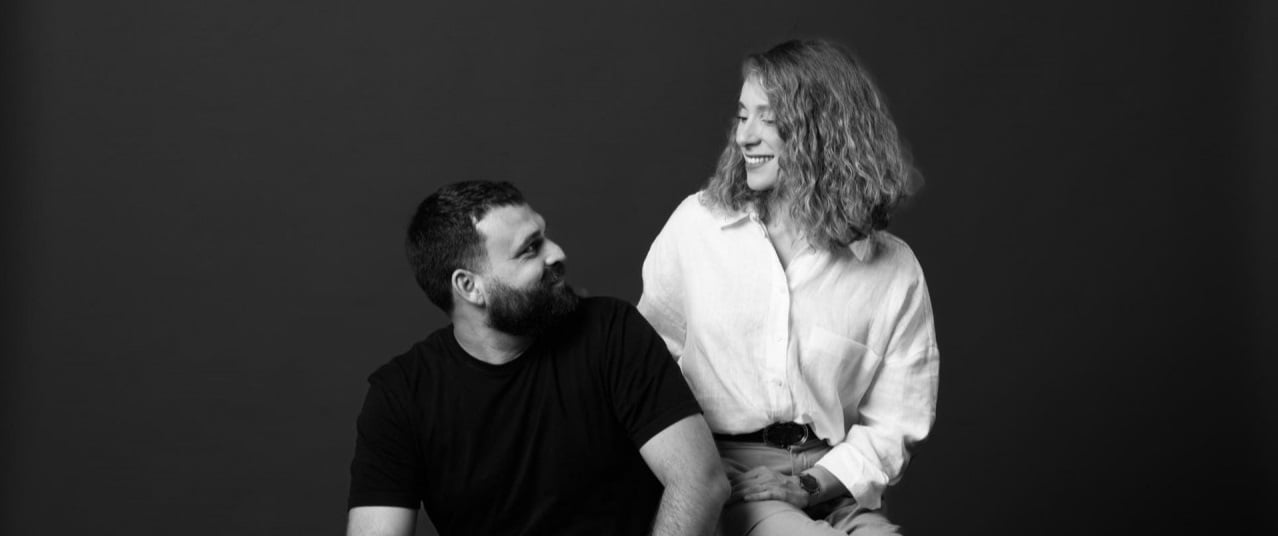

Luka Cvitan and Antonia Cvitan Vuletić are Croatian architects and co-founders of Prostorne Taktike, a Zagreb-based practice working across architecture, research, and participatory spatial strategies. Their work operates at the intersection of design, community engagement, and spatial experimentation, often extending beyond conventional architectural boundaries into long-term processes and collective initiatives. Educated in Croatia, both architects developed their approach through academic work, independent research, and hands-on projects engaging with local contexts and cultural landscapes. Among their most recognized works is Logorun – Donkey Island, a long-term transformation of a former military site into a protected landscape and community-driven project, alongside experimental interventions such as the Bridge over Foša. Their work has been discussed on regional and international platforms alike, including Architecture Lab, ArchDaily, and Dezeen, reflecting an ongoing interest in redefining architecture as an open, evolving system shaped by people, place, and time.
 Bridge Over Foša / Prostorne Taktike © Darko Škrobonja
What inspires you?
It is inspiring to create in every sense of the word. In architecture, you create all the time, from the very pragmatic point of view, where you create final plans, etc., to the abstract point of view, where, by thinking about space, you create life cycles, processes, new customs, and possibilities to interact, change, act, and play. Giving options to enhance spaces, you open new perspectives for people, sharing and creating a vision they are usually not even aware of.
What inspired you to become an architect?
Antonia
I’m not sure at all. Today, I have no idea why I decided to follow that road back when choosing a faculty, because it is not something that I wanted to be my whole life. It just came to the table at a certain point. I loved the idea and went for it. Even during the first year, I was not sure if this was the right road; I was faced with too much abstraction that I was not ready for. But once I learned how to work with it, it became such a nice way for me to express myself—to start from the abstract and conceptual and be able to find a way to make it real, while still keeping the same main thought along the way. This love for the abstract and experimenting eventually led me to explore performance-based art projects that, much like my architecture, are centered around the exploration of space.
Luka
For me, it was a fairly logical continuation of vocational secondary school in construction, which I chose for a very pragmatic reason – the belief that there will always be work in the building industry. What I couldn’t anticipate at the time was how vast the scope of architecture actually is. It spans from abstract concepts and ways of thinking about space to very concrete, everyday details that directly influence how people live and use their environment.
How would you describe your design philosophy?
It is always about how to be able to keep things on track, and how to design and bring a project to life while always keeping in mind the main thought, the essence of the project. And one more important thing, always to have something more in the design, more than expected. A ‘program plus,’ an extra perspective, always to have that one underlying sentence you can go back to that gives extra value to what we are trying to create.
What is your favorite project?
It’s difficult to single out a favorite project. There are many that have shaped the way we think about architecture. One that I often return to is the Nordic Pavilion at the Venice Biennale by Sverre Fehn—an extraordinary example of how architecture can frame light, nature, and structure with remarkable clarity.
We are also great admirers of the work of Lateral Office, whose projects consistently explore how architecture can engage with landscape, climate, and infrastructure in inventive ways.
At the same time, I feel it’s important to highlight projects closer to home. Croatian architecture has produced some outstanding works, such as the Museum of Apoxyomenos on Lošinj or the Vučedol Culture Museum, which show how contemporary architecture can sensitively engage with history and context. I would also mention the Medo Brundo kindergarten, a project that demonstrates how thoughtful design can shape everyday spaces for the youngest users.
When it comes to a favorite project from our office, Louis Kahn famously said, “the next one.”
That really is true—each new project brings another opportunity for innovation and that “a-ha” moment.
If we had to single out one of our works, it would be Logorun – the Donkey Island. This project is deeply personal; it began during our student days, fueled by a raw enthusiasm we never imagined would span over a decade. What started as an ambitious idea to transform an abandoned military complex into a donkey reserve has since evolved into a thirteen-year journey of discovery.
It pushed us far beyond the limits of traditional architecture and into participatory work, leading us to develop the ‘Island Tactics’ community workshops. Looking back, we couldn’t have foreseen how this would grow alongside us, shifting from a student concept into the reality we are shaping today as we finalize the official construction documentation.
What is your favorite detail?
One detail I often think about is the use of reflective road studs on the façade of the Baumax store in Slovenia by Hrvoje Njirić. What makes it remarkable is that the entire architectural effect is achieved with extremely simple, inexpensive, and readily available elements.
By using these everyday road reflectors, the façade becomes almost responsive—constantly changing with light and movement. It transforms a very ordinary material into something unexpected, turning the building envelope into a kind of kinetic artwork. For me, it’s a perfect example of how strong architectural engagement can emerge from the most modest means.
 Interview with Luka Cvitan and Antonia Cvitan Vuletić of Prostorne Taktike 10
  Interview with Luka Cvitan and Antonia Cvitan Vuletić of Prostorne Taktike 11
  Interview with Luka Cvitan and Antonia Cvitan Vuletić of Prostorne Taktike 12 Baumax Store / Hrvoje Njirić
If we had to single out a favorite detail from one of our projects, it would probably be a subtle variation in the softness of the surface on a pedestrian bridge.
This was achieved by embedding stone into the rubber base of the main walking path, while the surrounding areas remain rubber. As a result, the primary walking surface feels firm and stable underfoot, avoiding that uncomfortable sense of flex. At the same time, the softer zones outside the path naturally invite people to sit or lie down, encouraging a more relaxed and informal use of the space.
Do you have a favorite material?
We don’t have a favorite material typology or anything favorite so far in our work. We love to explore and learn new things, which is both great and not so great. It is great for professional progress since you are always learning, but it is also hard for the workflow because you don’t have things you usually repeat, so you can’t always work fast.
What is your process for starting a new project?
It always involves a lot of references and many variations. We love to create a lot of options – just work, work, and make many of them – and then we filter. We also keep asking questions; we constantly ask many questions during the project in order to see where the answers take us, and if that is the right direction we want to take.
How do you fuel your creativity?
We are completely different in how we fuel our creativity. Luka loves reading and finding deep references in books and specialized magazines, focusing on the theoretical side. On the other hand, Antonia loves traveling above everything else; she feels like a new person after every trip, and today we try to travel as much as possible to gain new perspectives. Antonia is also heavily involved in performative and cultural work, specifically in the field of contemporary circus, collaborating with various multidisciplinary artists. She loves working with people and exploring creative processes across different practices, and she truly enjoys being challenged in every aspect of her work.
Actually, we both love to be challenged. Whether it is through a complex project, a new culture, or an artistic collaboration, the challenge itself is perhaps the best answer to what keeps us inspired. It is that constant push to step out of our comfort zone that keeps our design process alive and evolving for both of us.
What inspired the Bridge over Foša?
There wasn’t a single moment of inspiration. We approached the project more as problem-solvers, asking a simple question: how can a bridge—normally just infrastructure—become something more than a utilitarian structure for crossing from one side to the other.
The final form was strongly shaped by its context, particularly the long presence of the shipbuilding industry in the area. Local craftsmanship and shipbuilding know-how became our point of departure. In that sense, the bridge is less a conventional piece of infrastructure and more a small fragment of maritime culture translated into public space.
 Interview with Luka Cvitan and Antonia Cvitan Vuletić of Prostorne Taktike 13
  Interview with Luka Cvitan and Antonia Cvitan Vuletić of Prostorne Taktike 14
  Interview with Luka Cvitan and Antonia Cvitan Vuletić of Prostorne Taktike 15 Bridge Over Foša / Prostorne Taktike © Darko Škrobonja
How did materiality shape the Bridge over Foša?
Materiality followed geometry quite naturally in the Bridge Over Foša. The form we developed as the most capable of accommodating the bridge’s additional uses—such as the lounging net and seating elements—was best realized in steel due to its structural flexibility and precision. Steel allowed us to achieve the slenderness and curvature that the concept required.
The next step was refining the project together with experts from the shipbuilding industry. As architects, the form initially seemed almost impossible to construct, but for the craftsmen in the shipyard, it was practically routine. In many ways, the bridge behaves more like a small vessel or the rudder of a larger ship than a conventional bridge, so their knowledge and fabrication techniques were essential in bringing the design to life
 Interview with Luka Cvitan and Antonia Cvitan Vuletić of Prostorne Taktike 16
  Interview with Luka Cvitan and Antonia Cvitan Vuletić of Prostorne Taktike 17 Bridge Over Foša / Prostorne Taktike © Darko Škrobonja
What advice would you give to young architects?
Like the recent rovers humanity sent to Mars, young architects should carry—and continually cultivate—the same essential instruments: perseverance, ingenuity, and curiosity.
But there is also a fourth element—patience. Architecture is a slow-burning profession. We’ve learned that the ‘a-ha’ moment and the final result can take a decade to arrive. You have to be comfortable playing the long game.
 Luka Cvitan and Antonia Cvitan Vuletić of Prostorne Taktike © Tom Dubravec/Cropix