
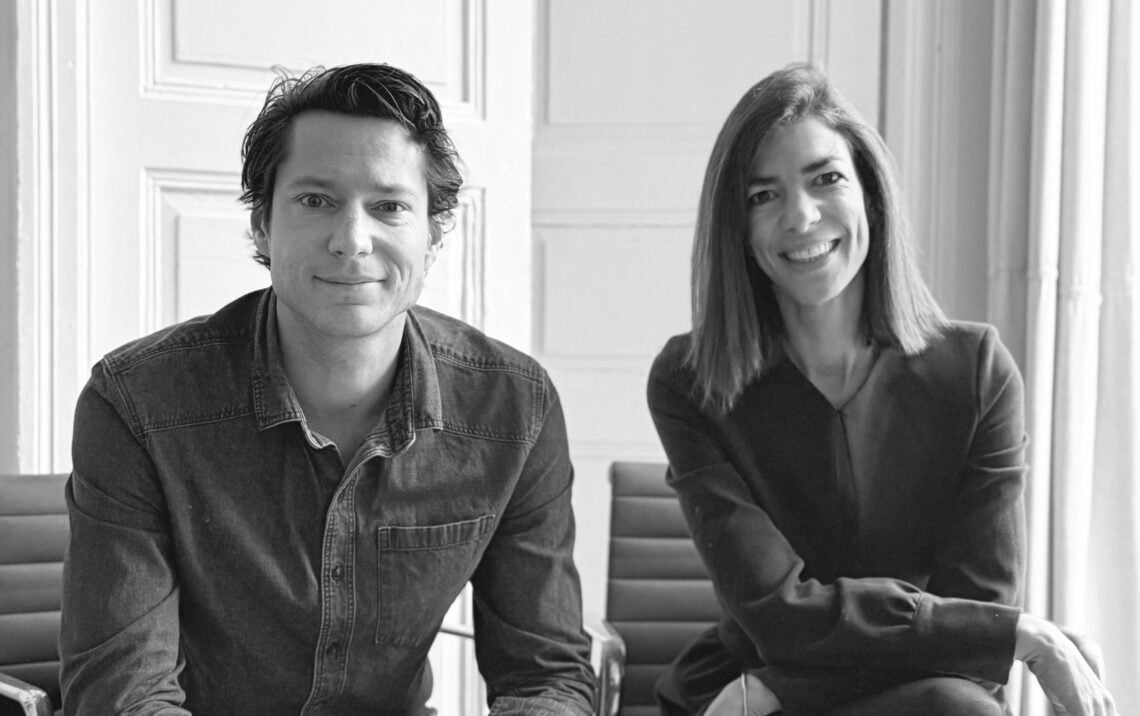

Pierre-Louis Filippi and Céline Filippi are French architects and the founders of Studio Pia, an architecture practice based in Corsica that works across architecture, rehabilitation, and landscape-sensitive design. Rooted in the Mediterranean context of the island, their work is guided by careful observation of place—its light, topography, materials, and the traces of historic construction that shape the territory. Through Studio Pia, the duo explores architecture as a precise and restrained intervention, often building as little as possible while emphasizing continuity between existing structures, landscape, and new spatial programs. Their projects frequently reinterpret vernacular typologies and regional architectural archetypes, drawing inspiration from convent plans, vaulted village churches, and the rhythms of traditional façades. Notable works include the rehabilitation of the Granaggiolo church complex and the Galeria Emergency Center, projects that demonstrate their commitment to material clarity, contextual sensitivity, and the creation of architecture that quietly extends the memory and character of the site.
 Galeria Emergency Center / Studio Pia @ 11h45
What inspires you?
The landscape, Mediterranean light, and the materials we find around us—sometimes reinterpreted or reused—strongly influence the way we design, as do the traces of historic buildings. There is also something that inspires us in a very direct way: the architectural forms and archetypes that surround us. The organization and plans of convents, the semicircular vaults of the churches in our villages, the rhythm of a façade, or the hand-crafted stucco decorations.
What inspired you to become an architect?
When we talk about it together, despite our different backgrounds, we find the same founding impulses that led us to this profession. First, there is the transversal nature of the discipline, which allows us to touch sculpture, engage with painting, and rely on the rigor of geometry. In practice, the architect’s work leads us to explore the full complexity of human personality: one day very concrete, the next more dreamlike, at once logical and artistic, both in service of others and responsible for making decisions. In many ways, we were drawn to the freedom of expression that this profession offers.
There is also a more intimate aspiration: the desire to transmit an emotion. To allow others to experience what one can feel in front of a beautiful building, the pleasure of its harmony, the quiet presence of a material. We hope to offer users the quality of space, sometimes in places where they no longer expect it.
How would you describe your design philosophy?
We try to approach every project with a simple idea: build as little as possible, but build with precision. A large part of our work consists of observing what is already there, looking at a landscape, analyzing it, and understanding it, in order to insert the project as simply and as accurately as possible.
Our starting point is almost always the place itself. The landscape, the topography, the light, the available materials, or the traces of existing buildings already contain a large part of the project. Rather than imposing a form, we try to reveal what is already there and place the architecture within a sense of continuity.
This search for continuity and extension often leads us to question the limits between interior and exterior, creating intermediate spaces that are very characteristic of Mediterranean architecture. We aim to extend this shared heritage. It is reflected in our use of typologies and architectural archetypes—volumes and spatial arrangements inspired by vernacular or monumental architecture that always resonate with the program or the site.
What is your favorite project?
The Granaggiolo project holds a special place for us. It is particularly meaningful because it reflects quite well the way we work: starting from what already exists, intervening with restraint, and searching for a form of poetic evidence in architecture.
In the 1960s, the vault of the nave of this monumental church collapsed over the first bays. Since then, trees have grown inside the building, benefiting from the light and shelter from the wind, giving the place a romantic atmosphere that the project seeks to preserve.
Our intervention proposes a geometric restitution of the semicircular barrel vault with lunettes, in the form of a light wooden structure that allows the remaining masonry to remain visible. An oculus treated as an impluvium allows rain and light to enter, maintaining this spontaneous vegetation, while the ground design organizes the flow and infiltration of rainwater.
 Interview with Pierre-Louis Filippi and Céline Filippi of Studio Pia 15
  Interview with Pierre-Louis Filippi and Céline Filippi of Studio Pia 16
  Interview with Pierre-Louis Filippi and Céline Filippi of Studio Pia 17
  Interview with Pierre-Louis Filippi and Céline Filippi of Studio Pia 18 Eglise Sant-André de Granaggiolo / Studio Pia @ 11h45
Rather than imposing a gesture, we tried to extend the existing condition, using simple materials and working very precisely on proportions and openings. We also sought to preserve the particular atmosphere of this timeless place and to transmit the emotion it carries—something that resonates strongly with visitors to the church, which is still under restoration.
We also appreciated the idea that the program could adapt to the existing structure, as this is often an issue in rehabilitation projects, where there is sometimes a temptation to overload a building. Here, space and ruin fully retain their place.
The workshop and the dwelling are installed in the former presbytery. The rooms have retained their original character; we restored the wooden log lintels and the rubble stone walls covered with lime plaster. There is an immersive experience and a resonance between different periods, between mineral and vegetal elements, and between ornament and structure.
What is your favorite detail?
Our favorite detail is the thin void line beneath the pedestrian walkway of the Galeria Emergency Center. It is the detail that reveals the hidden complexity of the building, exposing the care and underlying tension within an architecture that is otherwise purely functional.
 Interview with Pierre-Louis Filippi and Céline Filippi of Studio Pia 19
  Interview with Pierre-Louis Filippi and Céline Filippi of Studio Pia 20
  Interview with Pierre-Louis Filippi and Céline Filippi of Studio Pia 21 Galeria Emergency Center / Studio Pia @ 11h45
Do you have a favorite material?
I don’t think we have a single favorite material. Rather, materials tend to impose themselves depending on the project. What interests us most about materiality is the possibility of appropriating it, of reinterpreting or even diverting it from its usual use.
For example, lime is a material we often use in heritage projects, but it can also be applied in contemporary finishes or incorporated into concrete. Concrete itself is a material we appreciate a great deal. It can be approached almost like a craft: mixed with local stone or soil, tinted, bush-hammered. It offers a great deal of flexibility, its main limitation today being its carbon footprint.
Wood is also a material we enjoy working with, as is stone, which we would like to use even more often.
What is your process for starting a new project?
When starting a new project, we usually move through two seemingly contradictory phases that we try to bring into balance. On one side, we explore as widely as possible. We gather and absorb everything the site can offer: its colors, materials, history, and atmosphere. All these elements are essential. We do the same with the program—we discuss, listen, and try to understand how the functions will take shape. At this stage, we aim to be as open and exhaustive as possible.
Then comes the opposite movement: we synthesize, rationalize, and establish a hierarchy. Almost instinctively, connections begin to appear, relationships between elements emerge, and a kind of alchemy takes place. From that moment, the project begins to take form.
How do you fuel your creativity?
We look at everything that is being made around us, whether old or new. Of course, exhibitions, magazines, travel, and social media are sources of inspiration. But we also talk a lot together, or with people who are not architects. Talking about architecture, explaining why a particular building or detail moved us, allows us to confront our perceptions and to retain the idea, the emotion behind it.
What inspired the Galeria Emergency Center?
The region’s military heritage—massive and mineral—strongly influenced the design of the Galeria Emergency Center. These defensive architectures that punctuate the coastline inspired the idea of a small fort, where operational efficiency and integration with the landscape combine to overlook the valley. The red rocks of the Scandola nature reserve and the stone found on the site itself inspired the ochre-red tone of the building.
 Interview with Pierre-Louis Filippi and Céline Filippi of Studio Pia 22
  Interview with Pierre-Louis Filippi and Céline Filippi of Studio Pia 23
  Interview with Pierre-Louis Filippi and Céline Filippi of Studio Pia 24
  Interview with Pierre-Louis Filippi and Céline Filippi of Studio Pia 25
  Interview with Pierre-Louis Filippi and Céline Filippi of Studio Pia 26
  Interview with Pierre-Louis Filippi and Céline Filippi of Studio Pia 27 Galeria Emergency Center / Studio Pia @ 11h45
How did materiality shape the Galeria Emergency Center?
Materiality quickly emerged as a mineral element inspired by the rocks of the site, whose tone, as mentioned earlier, seemed quite evident. For budgetary reasons, we were unable to reuse the stone directly within the concrete mix, but the presence of a quarry less than 12 kilometers from the site allowed us to develop a low-carbon tinted concrete that closely echoes the color of the surrounding rock.
What advice would you give to young architects?
Know how to surround yourself well. Within the office, of course, with the right collaborators and the right partners. But also with engineers, contractors, and clients. Surrounding yourself well means combining human qualities with strong professional skills. For us, this is essential in order to create the connections that architecture requires.
