
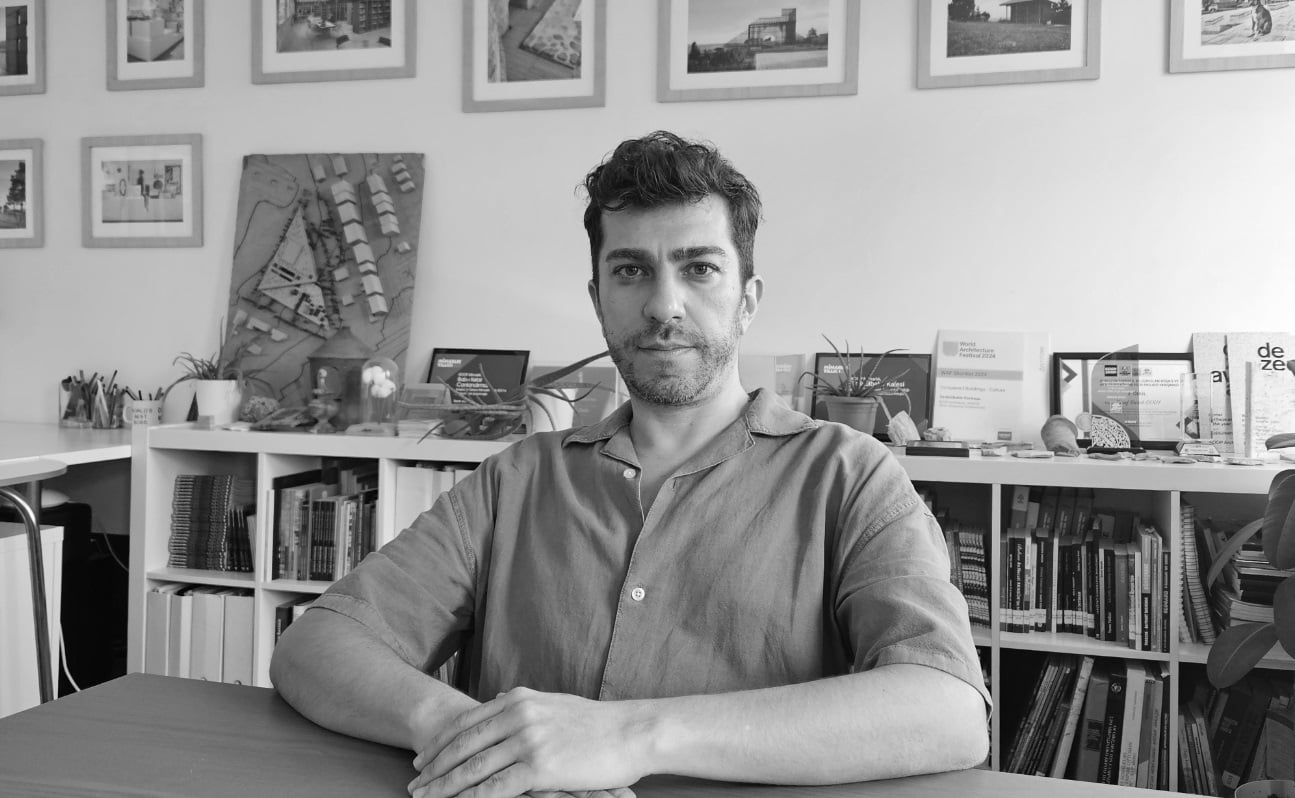

Yusuf Burak Dolu is a Turkish architect and co-founder of KOOP Architects, an architecture practice based in Turkey working across cultural heritage, restoration, and contemporary architectural design. The studio operates through a cooperative model that brings together architects, historians, engineers, and researchers to address projects with strong historical and social contexts. Dolu’s work focuses on the relationship between architecture, memory, and place, often engaging historic structures and landscapes through careful research, material honesty, and contemporary interventions that respect existing cultural layers. Projects such as the Seddülbahir Fortress Conservation and Visitor Center, the Gümüşhane Greek School Memory Center, and the Akçakoca Bey Masjid demonstrate this approach, where architecture acts as a medium for revealing historical narratives while integrating new spatial programs. Across KOOP Architects’s work, design is understood as a process of understanding place first—through archival research, field investigation, and dialogue with multiple disciplines—before translating those insights into clear and context-responsive architectural interventions.
 Seddülbahir Fortress / KOOP Architects + AOMTD © Egemen Karakaya
What inspires you?
What inspires me most is the “place” itself and the layered memory it holds. As a designer, when I sit at my desk, I do not look for inspiration in distant places, but in the land, climate, and history of the place where the project will be realized. Before asking “What can I do here?”, asking “What can I learn from here?” is what sets me in motion. Additionally, the collective production process, formed by people from different disciplines coming together, is an inexhaustible resource for me.
What inspired you to become an architect?
This was a desire that had been growing inside me since childhood, rather than an instant decision or a single event. I think growing up in a historic environment also increased my interest in architecture. As a child, during the summers we spent at my grandmother’s house, I would explore the historic buildings and ruins in the area. I actually wanted to become an aeronautical engineer when I was in primary school. I used to build model airplanes. Then I realized I needed to design an airport for them — and that’s how I ended up getting into architecture. During my high school years, I would observe architectural offices and imagine what that environment was like and how people produced there. And in the last year of high school, I started going to the architecture faculty and sitting in on classes from the back row. I found it fascinating.

How would you describe your design philosophy?
I can define our design philosophy through “honesty,” “simplicity,” and “relationship with context.” As KOOP, we strive to establish an honest relationship with the material and the place. Instead of trying to make a structure look “as if it were old” or engaging in trendy formal games, we prefer to produce simple and clear solutions that are true to the nature of the material and free from unnecessary noise. I believe that design should be a “companion” that respects the memory of its location but also boldly speaks the language of today.
What is your favorite project?
Undoubtedly, the Seddülbahir Fortress. This project is the work that best summarizes our office’s “cooperative” structure and architectural approach. It is the product of a research process spanning approximately 26 years, the effort of hundreds of experts, and a multi-layered history. It is not just a reuse project; it is a “space of memory” where we enable the spatial experience of war’s destruction, the value of peace, and the memory of the geography. It holds a very distinct place for me due to both its scale and the significance of the meaning it carries.


What is your favorite detail?
My favorite detail is the roof and façade intersection detail we developed for the Gümüşhane Greek School Memory Center project. This detail is a contemporary interpretation of “hartama” (timber shingles), a traditional construction technique. It is a hybrid solution that combines traditional construction techniques with today’s building physics requirements (insulation, air barrier, breathability, etc.). While the oak beams resting on the traditional stone wall and the carcass system continue the traditional texture in a contemporary interpretation with cedar cladding at the finishing element, the layers in between contain stone wool insulation, vapor stabilizer, and air gaps. This is the technical drawing of our philosophy of “sustaining without imitating.” It is the effort to keep the aesthetics of the past alive with the technology of today.
In addition to this, it is necessary to emphasize that the use of timber in roof finishing elements is not a mistaken choice, contrary to general assumptions. This detail stands as a critical stance to reprove to society how reliable and applicable the ancient knowledge and local construction techniques of the region are, even today.

Do you have a favorite material?
Timber and stone. Because these are materials that live, age, and integrate with their surroundings over time. There is a difference between “wearing out” and “aging”; while concrete or composite materials wear out and deteriorate, timber and stone gain character and “age” over time. This is why the timber turning gray and blending into the forest at the Akçakoca Bey Masjid, or the stone façade of the museum building integrating with the fortress at Seddülbahir, is so valuable to me.
 Interview with Yusuf Burak Dolu of KOOP Architects 14
  Interview with Yusuf Burak Dolu of KOOP Architects 15 Seddülbahir Fortress / KOOP Architects + AOMTD © Egemen Karakaya
What is your process for starting a new project?
Our process always starts with “understanding.” We spend a long research period before picking up the pen. Archival research, oral history studies, and reading the traces in the field are the first steps of design for us. We do not draw a line without hearing what that place whispers to us. The information-gathering process sometimes takes longer than the design itself, because asking the right question is half of finding the right answer.
How do you fuel your creativity?
Through diversity. In our office, on the same day, we might discuss the content curation of a museum project, the mortar analysis of a restoration project, or the details of a modern residence. These transitions between scales and subjects keep the mind sharp. Furthermore, working with non-architect experts—historians, archaeologists, engineers—allows us to push the boundaries of our own discipline and feeds creativity.
 Interview with Yusuf Burak Dolu of KOOP Architects 16
  Interview with Yusuf Burak Dolu of KOOP Architects 17
What inspired Seddülbahir Fortress?
Our source of inspiration was the dramatic history of the site itself and the concept of “the importance of peace.” The fortress was a structure ruined under heavy bombardment during World War I. We did not want to hide this destruction or rebuild the fortress “brand new” as if it had never been destroyed. Our inspiration was to make the traces of war visible and to make the visitor feel the weight of this destruction. We curated a space of life and commemoration rising from the ruins.
 Interview with Yusuf Burak Dolu of KOOP Architects 18
  Interview with Yusuf Burak Dolu of KOOP Architects 19
  Interview with Yusuf Burak Dolu of KOOP Architects 20
  Interview with Yusuf Burak Dolu of KOOP Architects 21
  Interview with Yusuf Burak Dolu of KOOP Architects 22
  Interview with Yusuf Burak Dolu of KOOP Architects 23 Seddülbahir Fortress / KOOP Architects + AOMTD © Egemen Karakaya
How did materiality shape Seddülbahir Fortress?
Material usage allowed us to code the time layers in the project. We preserved the existing historic walls. In the contemporary sections we designed (Info Kiosk, Museum), we used stones that reference the material of the fortress but are clearly modern in terms of their cut and size. For the sections of the building that we ‘reconstructed’, we wanted to give a temporary feeling; we preferred timber. Thus, when a visitor touches a wall, they can read from the material what belongs to the 17th century, what belongs to the 20th century, and what belongs to 2023.

How did the public embrace Seddülbahir Fortress?
The reactions were far more impressive than we expected. This place has become not just a tourist sightseeing spot, but a “space of memory” with high emotional intensity. When visitors see the spatial effects of war and the destruction, they grasp the value of peace much better. Both the local people and visitors state that they feel the area has been handled respectfully and sincerely regarding its history, rather than like a “fake stage decor”; this is the greatest reward for us. We have also been honoured to receive numerous national and international awards, which have made this journey even more meaningful for us.
What advice would you give to young architects?
I am not really in a position to give advice, but if I had to name the core qualities that have allowed me to sustain this work until today, I would say patience and perseverance. Architecture is not a quickly consumed visual show, but a long-term marathon. Instead of chasing popular trends or purely visual-focused approaches, we should focus on understanding material, detail, and context. And most importantly, we should make a habit of collaborating with other disciplines and constantly learning, without falling into the “I know best” ego.