

Architects: Eero Saarinen
Year: 1955
Photography: Eero Saarinen and Associates, Iñaki Bergera, Gunnar Klack, Trevor Patt, Wikimedia Commons, Madcoverboy, NateBergin, archjourney.org, j.czliao, caribbeanfreephoto, isabelle, kathia shieh
City: Cambridge
Country: United States
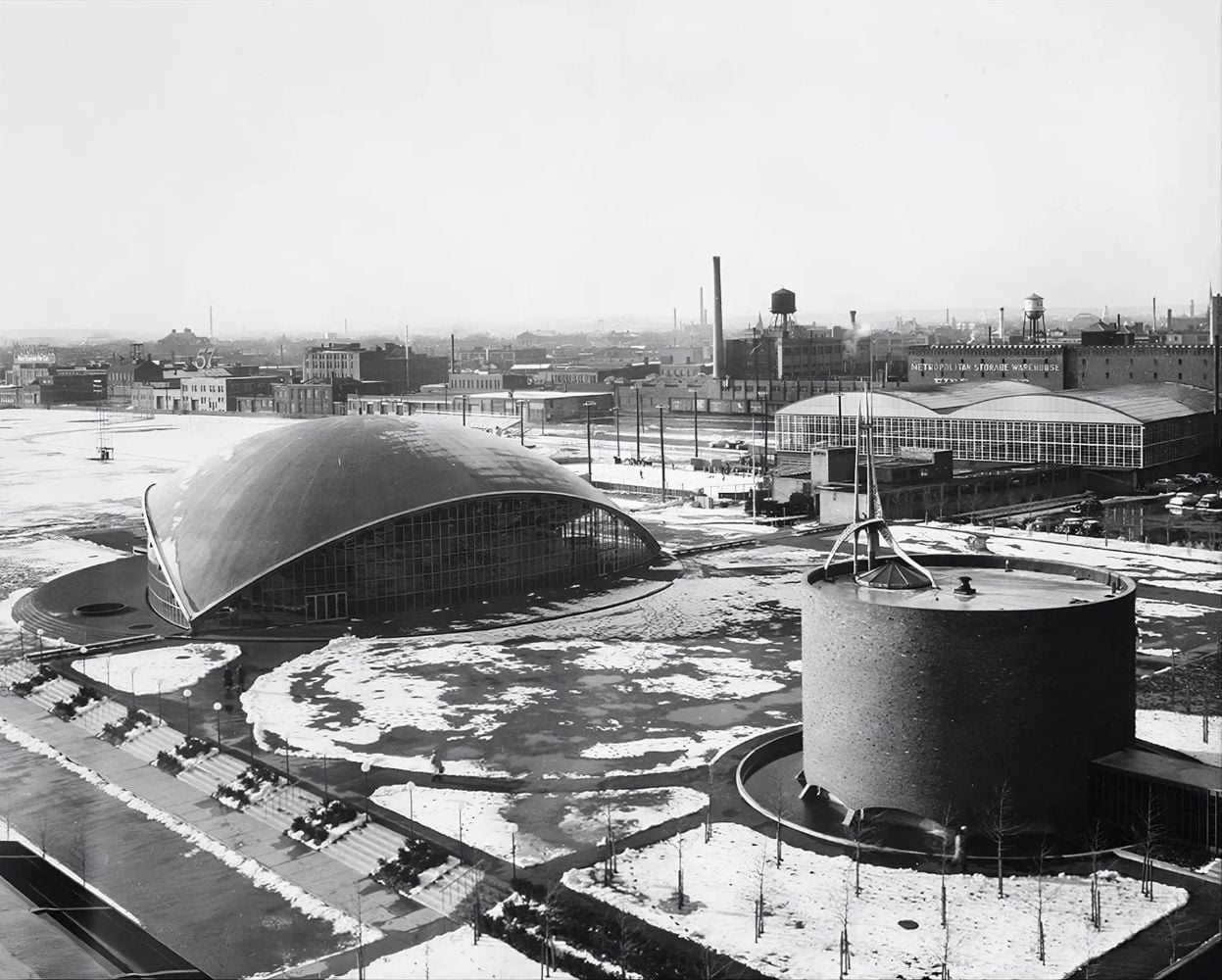
MIT Chapel, a religious building designed by Eero Saarinen in Cambridge, has redefined non-denominational sacred space through controlled light, material restraint, and spatial introspection, completed in 1955. MIT Chapel operates as a compact cylindrical volume within the MIT campus, establishing a contrast to the surrounding orthogonal grid while forming a compositional relationship with Kresge Auditorium. MIT Chapel uses a windowless brick enclosure and a surrounding shallow water moat to isolate the interior from external noise and visual distraction. MIT Chapel organizes light through a circular skylight above the altar, where a suspended metal sculpture by Harry Bertoia reflects and distributes daylight within the space. MIT Chapel introduces secondary illumination through reflected light from the surrounding moat, creating a gradient across undulating brick walls. MIT Chapel establishes a centralized interior that supports multiple forms of worship, emphasizing spatial unity, acoustic control, and contemplative use. MIT Chapel demonstrates how minimal form and precise environmental control construct a focused spiritual environment.

MIT Chapel, designed by Eero Saarinen, was conceived as a non-denominational space for reflection within the Massachusetts Institute of Technology campus. The project departs from Saarinen’s expressive formal language, adopting a compact cylindrical geometry that suppresses external expression in favor of interior experience. The chapel establishes a place of retreat within the academic environment, positioned near Kresge Auditorium as part of a coordinated campus composition.
 MIT Chapel / Eero Saarinen | Classics on Architecture Lab 72
  MIT Chapel / Eero Saarinen | Classics on Architecture Lab 73
The building presents a windowless brick cylinder set within a shallow concrete moat. The exterior maintains a restrained presence, using rough-textured brick and low arches to support the enclosure. A grove of trees and a long perimeter wall define the immediate landscape, reducing noise and reinforcing separation from surrounding circulation. The cylindrical form interrupts the campus grid, introducing a centralized figure within a predominantly orthogonal context.
 MIT Chapel / Eero Saarinen | Classics on Architecture Lab 74
  MIT Chapel / Eero Saarinen | Classics on Architecture Lab 75
  MIT Chapel / Eero Saarinen | Classics on Architecture Lab 76
  MIT Chapel / Eero Saarinen | Classics on Architecture Lab 77
The approach sequence structures a gradual transition from exterior to interior. A narrow entry and low vestibule compress movement before releasing into the main volume. The moat extends visually and spatially into the building through low openings, introducing reflected light and reinforcing the boundary between inside and outside.
 MIT Chapel / Eero Saarinen | Classics on Architecture Lab 78
  MIT Chapel / Eero Saarinen | Classics on Architecture Lab 79
  MIT Chapel / Eero Saarinen | Classics on Architecture Lab 80
  MIT Chapel / Eero Saarinen | Classics on Architecture Lab 81
  MIT Chapel / Eero Saarinen | Classics on Architecture Lab 82
  MIT Chapel / Eero Saarinen | Classics on Architecture Lab 83
The interior volume is defined by undulating brick walls that modify the perception of the circular plan. The textured surface captures and diffuses light, producing variation across the enclosure. A circular skylight above the altar introduces a focused vertical light source. Suspended beneath it, a metal sculpture by Harry Bertoia reflects and disperses light, forming a continuous luminous field that extends from ceiling to altar.
 MIT Chapel / Eero Saarinen | Classics on Architecture Lab 84
  MIT Chapel / Eero Saarinen | Classics on Architecture Lab 85
  MIT Chapel / Eero Saarinen | Classics on Architecture Lab 86
  MIT Chapel / Eero Saarinen | Classics on Architecture Lab 87
  MIT Chapel / Eero Saarinen | Classics on Architecture Lab 88
  MIT Chapel / Eero Saarinen | Classics on Architecture Lab 89
  MIT Chapel / Eero Saarinen | Classics on Architecture Lab 90
  MIT Chapel / Eero Saarinen | Classics on Architecture Lab 91
Light enters indirectly at the base of the walls through reflections from the surrounding water, producing a low ambient glow that shifts throughout the day. The combination of top light and reflected light establishes a gradient from center to perimeter.

The plan remains centralized, with seating arranged around the altar to maintain proximity and visual clarity. The absence of windows and lateral openings concentrates attention inward, supporting acoustic control and spatial cohesion. The chapel accommodates multiple forms of use, including worship, music, and individual reflection, without imposing a fixed symbolic language.
 MIT Chapel / Eero Saarinen | Classics on Architecture Lab 92
  MIT Chapel / Eero Saarinen | Classics on Architecture Lab 93
  MIT Chapel / Eero Saarinen | Classics on Architecture Lab 94
  MIT Chapel / Eero Saarinen | Classics on Architecture Lab 95
  MIT Chapel / Eero Saarinen | Classics on Architecture Lab 96
The project integrates architecture, landscape, and light into a unified system. The moat operates as both a physical boundary and an optical device, while the material palette remains limited to brick, concrete, metal, and marble. The result is a controlled environment where light defines space and minimal form supports a focused spiritual condition.

Project Gallery
© Eero Saarinen and Associates © Eero Saarinen and Associates © Flickr User: isabelle © archjourney.org  © Trevor Patt © Trevor Patt © Trevor Patt © Trevor Patt © Trevor Patt © archjourney.org
  © NateBergin
  © Eero Saarinen and Associates © Trevor Patt © Trevor Patt © Trevor Patt © Trevor Patt
  © Trevor Patt
  © Iñaki Bergera
  © Flickr User: j.czliao
  © Iñaki Bergera
  © Iñaki Bergera © Trevor Patt © archjourney.org © Madcoverboy / Wikimedia Commons
  © Flickr User: caribbeanfreephoto
  © Gunnar Klack © Eero Saarinen and Associates
  © Trevor Patt © Eero Saarinen and Associates
  © Iñaki Bergera © Flickr User: j.czliao © Iñaki Bergera © Iñaki Bergera © Flickr User: caribbeanfreephoto © Iñaki Bergera
  © Iñaki Bergera
  © Trevor Patt © archjourney.org
  © Trevor Patt
  © Trevor Patt
  © Flickr User: j.czliao
  © Flickr User: kathia shieh © Trevor Patt © Flickr User: kathia shieh © Eero Saarinen and Associates © Eero Saarinen and Associates
Project Location
Address: 48 Massachusetts Avenue, Cambridge, MA 02139, United States
Location is for general reference and may represent a city or country, not necessarily a precise address.