

Architect: Sverre Fehn
Year: 1962
Photography: Sverre Fehn, Åke E:son Lindman, Jean-Pierre Dalbéra, Teigens Fotoatelier, The National Museum of Art, seier+seier, Thom Mckenzie
Structural System: Reinforced concrete beam lattice with concrete walls and column
Program: Exhibition pavilion for the Venice Biennale
City: Venice
Country: Italy
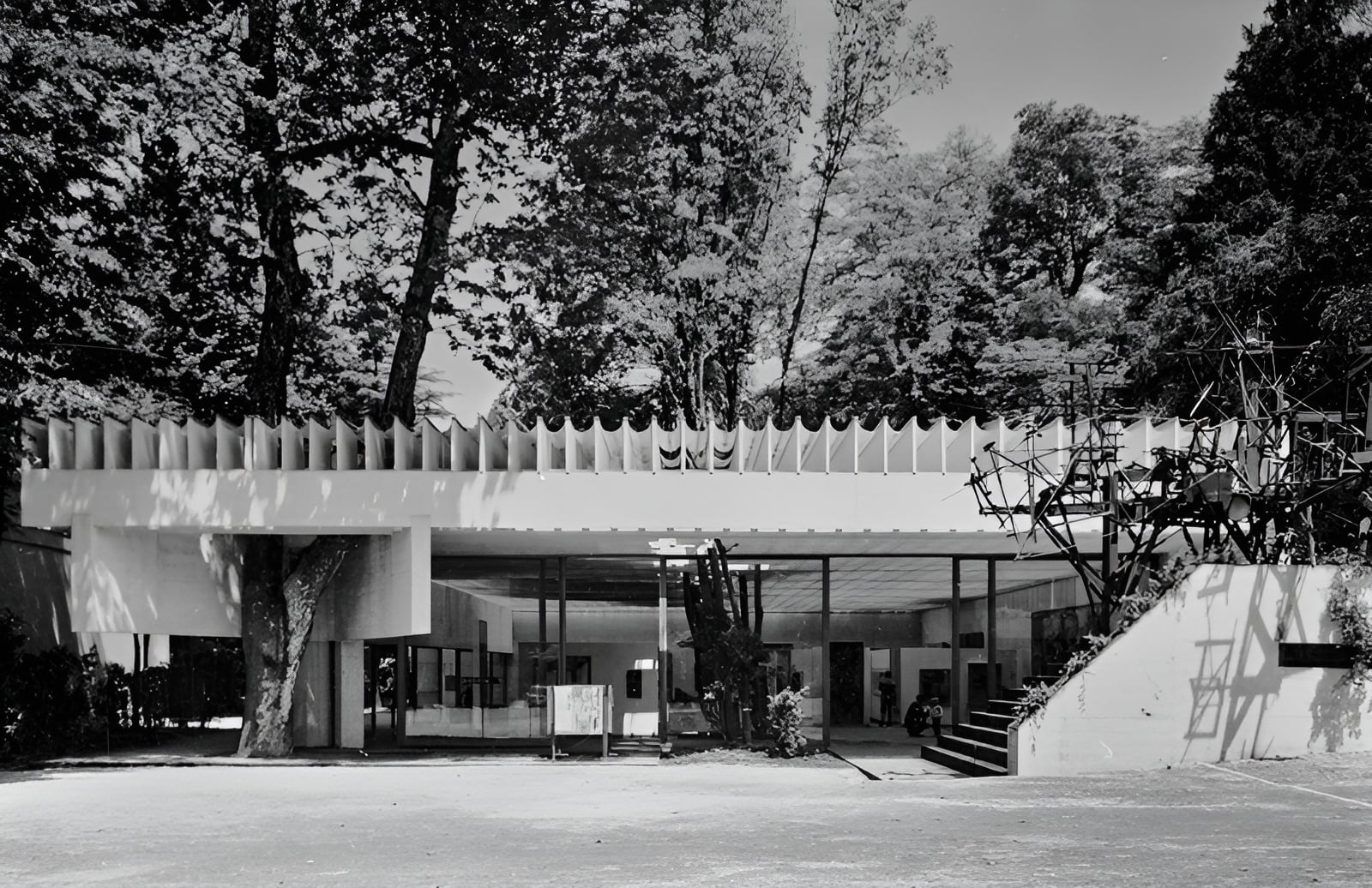
The Nordic Pavilion at the Venice Biennale in Venice, Italy, designed by Sverre Fehn and completed in 1962, serves as the shared exhibition space for Sweden, Norway, and Finland. Selected through an invited competition in 1958, the project is located within the Giardini di Castello between the Danish and U.S. pavilions, where existing plane trees and a sloping site shaped the design. Fehn integrated the trees directly into the architecture while creating a flexible exhibition hall of approximately 400 square meters capable of accommodating different curatorial arrangements. The pavilion is organized as an open rectangular space supported primarily by two L-shaped concrete walls and a single column, allowing uninterrupted exhibition surfaces and visual continuity with the surrounding park. Natural light is controlled through a distinctive roof composed of layered reinforced concrete beams forming a deep brise-soleil that diffuses Venetian daylight while preventing direct sun. Transparent roof panels admit filtered light, producing a uniform illumination suited to displaying artworks. Constructed primarily from white concrete, glass, and slate, the pavilion creates a restrained material palette that enhances the luminous interior atmosphere. By integrating trees, filtered daylight, and open circulation, the Nordic Pavilion establishes a continuous relationship between architecture, landscape, and exhibition space, becoming one of the most influential examples of Scandinavian modern architecture.

The Nordic Pavilion at the Venice Biennale, designed by Norwegian architect Sverre Fehn and completed in 1962, serves as the shared exhibition space for Sweden, Norway, and Finland. The project emerged from an invited competition held in 1958 in which Fehn participated alongside Swedish architect Klas Anshelm and Finnish architects Reima and Raili Pietilä. Conceived as a flexible exhibition environment capable of accommodating either independent or collaborative exhibitions by the three Nordic countries, the pavilion became one of Fehn’s most important works and a landmark of Scandinavian modern architecture.

The pavilion is located within the Giardini di Castello, the historic park that has hosted the Venice Biennale since 1895. Positioned between the Danish Pavilion and the U.S. Pavilion along Viale Trento, the site presented several constraints, including a sloping terrain and a number of mature plane trees that were required to remain. Fehn embraced these conditions by integrating the trees directly into the architectural composition, allowing them to pass through the pavilion’s structure and become essential spatial elements.
 Nordic Pavilion, Venice / Sverre Fehn | Classics on Architecture Lab 62
  Nordic Pavilion, Venice / Sverre Fehn | Classics on Architecture Lab 63
  Nordic Pavilion, Venice / Sverre Fehn | Classics on Architecture Lab 64
  Nordic Pavilion, Venice / Sverre Fehn | Classics on Architecture Lab 65
  Nordic Pavilion, Venice / Sverre Fehn | Classics on Architecture Lab 66
  Nordic Pavilion, Venice / Sverre Fehn | Classics on Architecture Lab 67
The competition brief required approximately 400 square meters of exhibition space for paintings, sculptures, and graphic works, along with a smaller service area for storage and maintenance. A key requirement was spatial flexibility, allowing Sweden, Norway, and Finland to organize exhibitions either individually or collectively. Fehn responded with an open and unobstructed floor plan capable of accommodating a wide range of exhibition configurations.

The building is organized as a single rectangular exhibition hall defined by minimal structural elements. Structural support is concentrated in two L-shaped reinforced concrete walls and a single supporting column positioned diagonally across the space. This arrangement eliminates the need for internal columns and produces a continuous exhibition area of roughly 400 square meters. Large sliding glass panels open the pavilion toward the surrounding park, dissolving the boundary between interior exhibition space and the landscape of the Giardini.
 Nordic Pavilion, Venice / Sverre Fehn | Classics on Architecture Lab 68
  Nordic Pavilion, Venice / Sverre Fehn | Classics on Architecture Lab 69
  Nordic Pavilion, Venice / Sverre Fehn | Classics on Architecture Lab 70
Natural light plays a central role in the architectural concept. Venice’s atmospheric conditions—shaped by surrounding water and high humidity—produce a diffuse daylight that Fehn sought to harness for exhibition purposes. At the same time, the pavilion had to prevent direct sunlight from entering the interior in order to protect artworks and maintain consistent viewing conditions. To achieve this balance, Fehn developed a distinctive roof composed of two orthogonal layers of reinforced concrete beams forming a deep beam lattice. Each beam measures approximately one meter in height, and together they create a roof structure roughly two meters thick. Transparent plastic panels inserted between the upper beams allow filtered daylight to enter the space while the depth and spacing of the beams block the steep summer sun typical of Venice. The system functions as a brise-soleil, producing soft and evenly distributed illumination across the exhibition hall.
 Nordic Pavilion, Venice / Sverre Fehn | Classics on Architecture Lab 71
  Nordic Pavilion, Venice / Sverre Fehn | Classics on Architecture Lab 72
  Nordic Pavilion, Venice / Sverre Fehn | Classics on Architecture Lab 73
  Nordic Pavilion, Venice / Sverre Fehn | Classics on Architecture Lab 74
The interior space beneath the roof reaches a height of approximately 4.3 meters, reinforcing the pavilion’s strong horizontal character. From within the hall, the canopy of the surrounding trees remains largely invisible, emphasizing the continuity of the roof plane while allowing the tree trunks to appear as vertical elements within the space. This subtle interplay between structure, vegetation, and filtered daylight creates a calm and atmospheric environment for viewing artworks.
 Nordic Pavilion, Venice / Sverre Fehn | Classics on Architecture Lab 75
  Nordic Pavilion, Venice / Sverre Fehn | Classics on Architecture Lab 76
Material selection reinforces the pavilion’s restrained architectural expression. The structure is cast in reinforced concrete made with white cement and light aggregates, allowing surfaces to reflect and diffuse natural light throughout the interior. Glass enclosure panels provide transparency toward the surrounding park, while slate stone flooring introduces a darker, tactile surface that anchors the space. Fehn avoided applied finishes, allowing each material to express its natural color and texture.

Through its careful orchestration of light, structure, and landscape, the Nordic Pavilion establishes a delicate balance between enclosure and openness. Rather than functioning as an isolated exhibition hall, the building operates as a spatial extension of the Giardini itself. Trees, filtered daylight, and open circulation merge with the architecture to create an environment in which art is experienced within a continuous dialogue between nature and built form.

The Nordic Pavilion remains one of the most celebrated works of twentieth-century Scandinavian architecture. Its integration of natural elements, structural clarity, and atmospheric light reflects Sverre Fehn’s broader architectural philosophy, in which construction and landscape form a unified spatial experience.

Project Gallery
 © Teigens Fotoatelier © Sverre Fehn © Teigens Fotoatelier
  © Sverre Fehn
  © Teigens Fotoatelier
  © The National Museum of Art © Teigens Fotoatelier © Sverre Fehn © Åke E:son Lindman
  © Sverre Fehn
  © Åke E:son Lindman
  © Åke E:son Lindman © Jean-Pierre Dalbéra © Åke E:son Lindman
  © Åke E:son Lindman
  © Åke E:son Lindman
  © Åke E:son Lindman
  © Åke E:son Lindman
  © Åke E:son Lindman © Åke E:son Lindman
  © Åke E:son Lindman © Åke E:son Lindman
  © Åke E:son Lindman © Åke E:son Lindman
  © Åke E:son Lindman © Åke E:son Lindman
  © Åke E:son Lindman © Åke E:son Lindman © Åke E:son Lindman © Åke E:son Lindman
  © Åke E:son Lindman © Åke E:son Lindman
  © seier+seier
  © Sverre Fehn © Thom Mckenzie © Sverre Fehn
  © Nasjonalmuseet Digital Archive
  © Nasjonalmuseet Digital Archive
  © Nasjonalmuseet Digital Archive
  © Fri ikke-kommersiell bruk
  © Fri ikke-kommersiell bruk
  © Fri ikke-kommersiell bruk
  © Fri ikke-kommersiell bruk
  © Fri ikke-kommersiell bruk
  © Fri ikke-kommersiell bruk
  © Sverre Fehn
Project Location
Address: Giardini della Biennale, Castello, 30122 Venice, Italy
Location is for general reference and may represent a city or country, not necessarily a precise address.