
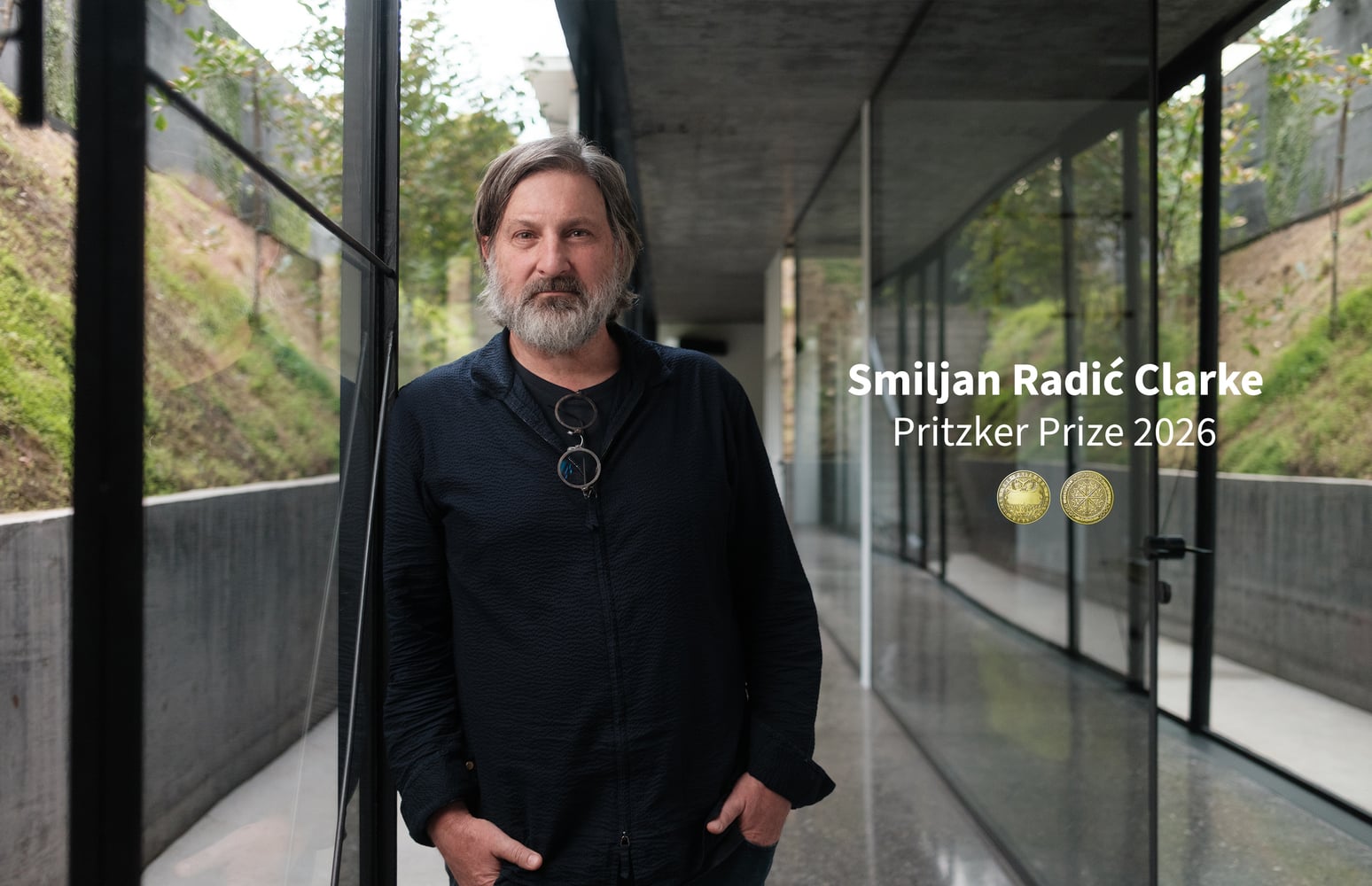

Smiljan Radić Clarke, born in Santiago, Chile, in 1965, is a Chilean architect known for his experimental approach to architecture and for buildings that explore the relationship between landscape, material weight, and fragile enclosure. He studied architecture at the Pontificia Universidad Católica de Chile, graduating in 1989, and later continued his education at the Istituto Universitario di Architettura di Venezia in Venice. Radić established his independent architectural practice in Santiago in 1995, developing work that combines primitive construction logic with contemporary spatial investigation. His architecture is associated with experimental contemporary architecture that integrates craft traditions, sculptural thinking, and anthropological references. Radić’s greatest accomplishment is receiving the 2026 Pritzker Architecture Prize, recognizing his body of work produced through a deliberately small studio practice. Notable works by Radić include the Serpentine Gallery Pavilion in London, Teatro Regional del Biobío in Concepción, NAVE Performing Arts Center in Santiago, Restaurant Mestizo in Santiago, and Pite House in Papudo, demonstrating his approach to material contrast, landscape integration, and atmospheric spatial experience. Radić’s contributions have influenced contemporary architecture by demonstrating that significant architectural ideas can emerge from modest commissions, experimental materials, and close engagement with site conditions. While some of his unconventional architectural forms have generated debate regarding visual legibility and material expression, Radić has avoided major personal controversy and remains widely respected. Radić’s portfolio consists primarily of cultural institutions, residential architecture, installations, and temporary structures. Educated in Santiago and Venice, Radić has collaborated extensively with sculptor Marcela Correa, integrating artistic thinking into architectural production. Radić belongs to a generation of contemporary architects who operate outside major architectural centers while producing work that has achieved international recognition through its focus on material experimentation, landscape integration, and experiential spatial design. Students can learn from Radić’s work by studying his treatment of structure, material contrast, and landscape, as well as his ability to construct architecture that prioritizes spatial experience over formal spectacle.
 “Architecture is thought through what is built or constructed.” Smiljan Radić Clarke © Hisao Suzuki
Who is Smiljan Radić Clarke?
Smiljan Radić Clarke is a Chilean architect born in Santiago in 1965 and recognized for his experimental and site-sensitive approach to contemporary architecture. Radić grew up in Santiago and developed an early interest in art, landscape, and construction. His family background includes connections to the Croatian island of Brač, from which his paternal grandfather emigrated to Chile in 1919, and to British heritage on his maternal side. Radić studied architecture at the Pontificia Universidad Católica de Chile and graduated in 1989. His education emphasized modernist design principles and Chile’s tradition of material experimentation. Radić later continued his studies at the Istituto Universitario di Architettura di Venezia (IUAV) in Venice, where he studied history and aesthetics while traveling across Europe. These experiences deepened his interest in architecture as a cultural and spatial discipline. After returning to Chile, Radić founded his architectural practice in Santiago in 1995. The studio developed through residential commissions, installations, and experimental projects that explored the boundaries between architecture, sculpture, and landscape. Radić maintained a small studio structure rather than expanding into a large international practice. Radić has collaborated closely with sculptor Marcela Correa, whose work has influenced the sculptural qualities and material experimentation present in many projects. This interdisciplinary collaboration contributed to Radić’s reputation for producing architecture that appears both primitive and contemporary. Smiljan Radić Clarke built an international reputation through projects across Chile and abroad. His work has been exhibited in cultural institutions and widely published in architectural journals. In recognition of his contributions to contemporary architecture, Radić received the 2026 Pritzker Architecture Prize, confirming his position among the most influential architects of his generation.
 “In Chile, it’s better to do it really brut rather than perfectly.” Smiljan Radić Clarke © The Pritzker Architecture Prize
What type of architecture does Smiljan Radić Clarke represent?
Smiljan Radić Clarke represents contemporary architecture characterized by material experimentation, landscape integration, and the construction of atmospheric spatial experiences. His work does not follow a fixed stylistic language but instead develops through responses to site conditions, material behavior, and cultural context. Radić’s architecture frequently combines primitive structural elements with fragile or translucent enclosures, producing buildings that appear both archaic and experimental. Radić’s projects often blur the boundary between architecture and landscape. Stone, concrete, timber, membranes, and glass are assembled to emphasize weight, gravity, and tactile presence while allowing light and environmental conditions to shape spatial experience. This approach places Radić within a broader tradition of Latin American architecture that values material authenticity and environmental responsiveness. Many of Radić’s buildings use partial enclosure rather than complete separation between interior and exterior. Walls, platforms, and roof structures create spaces that mediate between shelter and exposure. His work frequently draws inspiration from vernacular construction methods, archaeological structures, and temporary installations, producing architecture that appears both ancient and contemporary. Radić’s architecture represents a strand of contemporary architecture that prioritizes spatial experience and material presence over visual signature. His buildings are designed to be understood through movement, light, sound, and bodily perception rather than through a single photographic viewpoint.
 “Architecture is more about atmosphere, not just the visual.” Smiljan Radić Clarke © Smiljan Radić Clarke
What is Smiljan Radić Clarke’s great accomplishment?
Smiljan Radić Clarke’s great accomplishment is a distinctive architectural body of work recognized internationally for its originality and cultural depth. His most significant professional recognition came when he was awarded the 2026 Pritzker Architecture Prize. The Pritzker Prize acknowledged Radić’s ability to produce influential architecture through a relatively small practice based in Santiago. Radić demonstrated that a studio operating outside the major architectural capitals of Europe and North America could achieve global impact through material research and conceptual thinking. Radić’s projects have expanded contemporary architectural discourse by emphasizing atmosphere, construction logic, and landscape relationships rather than formal spectacle. Buildings such as Teatro Regional del Biobío, Restaurant Mestizo, and the Serpentine Gallery Pavilion illustrate how architecture can create spatial experiences through simple structural ideas and carefully selected materials. Radić’s accomplishment lies in the consistency of a body of work that explores architecture as a cultural and physical encounter with place. Through this approach, Radić has influenced architects and students worldwide to reconsider how buildings engage with landscape, materials, and human perception.
 © AFP/File
  © Marcela Correa
What are Smiljan Radić Clarke’s most important works?
Smiljan Radić Clarke’s most important works span residential architecture, cultural institutions, installations, and experimental structures, epitomised by the Serpentine Gallery Pavilion in London, a translucent fiberglass pavilion resting on quarry stones; Teatro Regional del Biobío in Concepción, a civic theater wrapped in a glowing PTFE membrane; NAVE Performing Arts Center in Santiago, an adaptive-reuse performance venue combining historic masonry and temporary structures; Restaurant Mestizo in Santiago, a park pavilion supported by massive quarry stones beneath a concrete roof; and Pite House in Papudo, a coastal residence embedded into rocky terrain through concrete terraces and retaining walls.
01. Serpentine Gallery Pavilion, London
The Serpentine Gallery Pavilion is a temporary architectural structure commissioned by the Serpentine Galleries for the 2014 summer season in Kensington Gardens, London. The pavilion functioned as a public gathering space hosting cultural events, lectures, and a café program. Radić’s design consists of a translucent fiberglass shell resting on large quarry stones that act as structural supports. The structure forms a partially enclosed circular room surrounding an open central courtyard. The pavilion evokes ancient shelters and primitive constructions while employing contemporary materials and fabrication techniques. The building type is a temporary cultural pavilion, and the design explores architecture as a fragile membrane suspended above heavy structural elements. The contrast between lightweight fiberglass and massive stone creates spatial tension. The pavilion operated between June and October 2014 and became one of the most widely discussed temporary architectural structures of the decade.
 © Iwan Baan
  © Iwan Baan
  © Gonzalo Puga
  © Iwan Baan
  © Iwan Baan
  © Iwan Baan
  © Iwan Baan
  © Iwan Baan
02. Teatro Regional del Biobío, Concepción
The Teatro Regional del Biobío is a performing arts complex located in Concepción, Chile. The project was first proposed in 2011 and constructed between 2015 and 2018. The building contains a large concert hall, smaller performance venues, rehearsal spaces, and public circulation areas. Radić designed the structure as a large rectangular volume wrapped in a translucent membrane. The envelope consists of PTFE fabric panels stretched over a steel frame, creating a glowing surface that changes appearance depending on light conditions. The design treats the theater as a container in which interior circulation and structural elements remain visible behind the thin outer skin. Reinforced concrete forms the structural base of the building, while steel framing supports the membrane façade. The project has become an architectural landmark within the city.
 © Iwan Baan
  © Hisao Suzuki
  © Iwan Baan
  © Iwan Baan
  © Hisao Suzuki
  © Hisao Suzuki
  © Hisao Suzuki
  © Iwan Baan
  © Cristobal Palma
  © Iwan Baan
03. NAVE Performing Arts Center, Santiago
NAVE Performing Arts Center is a cultural facility located in Santiago, Chile, completed in 2015. The project transformed an early twentieth-century house into a contemporary performing arts venue. The building serves as a performance, rehearsal, and workshop space for experimental theater and dance. Radić’s design retained portions of the existing structure while inserting new volumes and spatial voids to accommodate performance programs. A circus-style tent installed on the rooftop terrace provides additional performance space and symbolizes the temporary nature of cultural production. The architecture combines heavy masonry walls from the original building with lightweight structural insertions and fabric elements. The result is a layered architectural composition that reflects preservation and transformation.
 © Cristobal Palma
  © Cristobal Palma
  © Cristobal Palma
  © Cristobal Palma
  © Cristobal Palma
  © Cristobal Palma
  © Cristobal Palma
  © Smiljan Radic
  © Smiljan Radic
04. Restaurant Mestizo, Santiago
Restaurant Mestizo, completed in 2006, is located within Parque Bicentenario in Santiago, Chile. The building functions as a public restaurant integrated into the landscape of the park. Radić designed the structure as a large horizontal roof supported by stone elements. The roof is formed by a reinforced concrete slab system that spans across irregular granite boulders sourced from nearby quarries. The interior space remains open, allowing views across the park and toward the Andes Mountains. The building type is a commercial restaurant, though the architectural concept resembles a civic pavilion. The design dissolves the boundary between interior and exterior by extending the roof plane across the surrounding landscape. Stone, concrete, glass, and timber are the primary materials used in the building, creating a structure that is both monumental and minimal.
 © Gonzalo Puga
  © Gonzalo Puga
  © Gonzalo Puga
  © Gonzalo Puga
  © Gonzalo Puga
  © Smiljan Radic
  © Smiljan Radic
  © Smiljan Radic
  © Smiljan Radic
05. Pite House, Papudo
Pite House is a private residence located in Papudo on Chile’s central coast, completed in 2005. The project occupies a rocky hillside overlooking the Pacific Ocean. Radić designed the house as a sequence of terraces and platforms embedded within the terrain. Thick concrete retaining walls anchor the structure to the rocky site while framing views toward the sea. The architecture uses horizontal surfaces and controlled openings that mediate between the interior shelter and the surrounding landscape. The building type is a private residential house, and the design explores the relationship between architecture and topography. Reinforced concrete, stone, and timber are the primary construction materials. The project exemplifies Radić’s interest in integrating architecture with geological formations.
 © Cristobal Palma
  © Cristobal Palma
  © Cristobal Palma
  © Cristobal Palma
  © Cristobal Palma
  © Cristobal Palma
  © Hisao Suzuki
  © Cristobal Palma
  © Erieta Attali
How did Smiljan Radić Clarke contribute to architecture?
Smiljan Radić Clarke contributed to architecture through an experimental approach that emphasizes material presence, landscape relationships, and spatial perception. His work demonstrates that architecture can develop cultural relevance through modest programs and carefully developed construction strategies. Radić’s buildings often challenge conventional architectural hierarchies by treating houses, restaurants, installations, and cultural venues with equal conceptual rigor. This approach expands architectural practice by showing that small-scale projects can generate ideas with international influence. Radić has contributed to architectural discourse through exhibitions, lectures, and collaborations with artists and cultural institutions. He founded the Fundación de Arquitectura Frágil in 2017, an initiative dedicated to experimental architectural research and cultural exchange. Through this work, Radić contributes to architectural discussion beyond his built projects.
What awards and honors has Smiljan Radić Clarke received?
Smiljan Radić Clarke has received several international awards for his work in contemporary architecture. His distinctions include:
- Pritzker Architecture Prize (2026) – Awarded for his body of work in architecture.
- Arnold W. Brunner Memorial Prize (2018) – Awarded by the American Academy of Arts and Letters.
- Oris Award (2015) – Awarded by the Oris House of Architecture for contributions to contemporary architecture.
- Design Vanguard Award (2008) – Presented by Architectural Record.
- Best Architect Under 35 (2001) – Awarded by the Colegio de Arquitectos de Chile.
Radić has received institutional recognitions, including Honorary Membership in the American Institute of Architects (AIA) in 2009 and appointment as Corresponding Member of the Croatian Academy of Sciences and Arts in 2020.
Smiljan Radić Clarke, recipient of the 2026 Pritzker Architecture Prize. © Tom Welsh for The Pritzker Architecture Prize
Did Smiljan Radić Clarke change the architecture industry?
Yes, Smiljan Radić Clarke changed contemporary architectural practice by demonstrating that influential architecture does not require a large global office or a consistent visual brand. His work showed that a small studio operating outside major architectural centers could produce internationally significant architecture. Radić’s buildings emphasize atmosphere, material logic, and spatial experience rather than iconic form. This approach has prompted architects and critics to reconsider the role of perception, landscape, and construction in architectural design. His work contributes to a shift away from image-driven architecture toward more experiential forms of spatial design.
Was Smiljan Radić Clarke ever controversial in any way?
Smiljan Radić Clarke has maintained a strong professional reputation with few personal controversies. Debate has surrounded specific projects, particularly those that employ unusual materials or unconventional spatial arrangements. The Teatro Regional del Biobío, for instance, generated discussion among local audiences due to its translucent membrane façade and unconventional appearance for a civic building. Critics questioned the visual legibility of the structure, while supporters praised its experimental character and atmospheric qualities. These debates reflect discussions within architecture regarding innovation and public expectation rather than controversies related to Radić himself.
Who are the most famous architects in modern history besides Smiljan Radić Clarke?
Aside from Smiljan Radić Clarke, Frank Lloyd Wright, Le Corbusier, Ludwig Mies van der Rohe, Walter Gropius, Frank Gehry, Zaha Hadid, and Norman Foster are among the most influential architects in modern architectural history. Frank Lloyd Wright (American, 1867–1959) developed organic architecture, designing buildings such as Fallingwater and the Guggenheim Museum in New York that integrated structure with landscape and spatial continuity. Le Corbusier (Swiss-French, 1887–1965) helped define modern architecture through theoretical works and buildings such as Villa Savoye and the Unité d’Habitation, establishing principles of modernist urban planning and architectural form. Ludwig Mies van der Rohe (German-American, 1886–1969), a leading figure of the International Style, developed a minimalist architectural language based on structural clarity and open space, exemplified by the Barcelona Pavilion and the Seagram Building in New York. Walter Gropius (German-American, 1883–1969) founded the Bauhaus school, shaping twentieth-century architectural education and promoting the integration of art, craft, and industrial production in modern design. Frank Gehry (Canadian-American, born 1929) advanced deconstructivist architecture through sculptural buildings such as the Guggenheim Museum Bilbao and Walt Disney Concert Hall in Los Angeles. Zaha Hadid (Iraqi-British, 1950–2016), the first woman to win the Pritzker Architecture Prize in 2004, developed fluid architectural forms through projects such as the MAXXI Museum in Rome and the Heydar Aliyev Center in Baku. Norman Foster (British, born 1935) pioneered high-tech architecture, designing technologically expressive buildings including 30 St Mary Axe in London, the Reichstag Dome in Berlin, and Apple Park in California. Chile has also produced influential contemporary architects, including Alejandro Aravena, winner of the 2016 Pritzker Architecture Prize, known for incremental social housing projects such as Quinta Monroy, and Mathias Klotz, whose residential architecture helped define contemporary Chilean modernism through minimal structures and strong landscape relationships.
What did Smiljan Radić Clarke mostly design?
Smiljan Radić Clarke mostly designed cultural buildings, residential houses, installations, and small public structures. His projects frequently address the relationship between architectural structure, landscape conditions, and material construction.
- Cultural and Civic Buildings: Radić designed theaters and performance venues, including Teatro Regional del Biobío in Concepción and the NAVE Performing Arts Center in Santiago. These buildings provide spaces for concerts, theater, rehearsals, and cultural events.
- Residential Architecture: Radić designed private houses, including Pite House in Papudo and Copper House 2 in Chile. These projects explore how residential architecture can be integrated with terrain, structure, and material enclosure.
- Temporary Pavilions and Installations: Radić designed temporary architectural structures such as the Serpentine Gallery Pavilion in London, a seasonal pavilion used for public events and exhibitions.
- Commercial and Public Projects: Radić designed commercial and public buildings, including Restaurant Mestizo in Santiago, a restaurant located in Parque Bicentenario that combines a reinforced-concrete roof structure with stone supports.
Across these categories, Radić’s work frequently combines structural systems, landscape context, and material construction to define spatial experience.
Where did Smiljan Radić Clarke study?
Smiljan Radić Clarke studied architecture at the Pontificia Universidad Católica de Chile, graduating in 1989. The university is one of the major architecture schools in Latin America and has produced several prominent Chilean architects. Radić later pursued additional study at the Istituto Universitario di Architettura di Venezia (IUAV) in Venice, Italy. His experience in Venice exposed him to European architectural theory and historic urban environments, expanding his perspective and influencing his approach to architectural design.
Did Smiljan Radić Clarke have any famous teachers or students?
Smiljan Radić Clarke’s career has not been defined by a single well-known teacher or formal academic lineage. His biographies emphasize intellectual independence and interdisciplinary collaboration rather than direct mentorship from famous architects. Radić has collaborated extensively with sculptor Marcela Correa, whose artistic practice has influenced many architectural projects. Through his architectural studio and teaching activities, Radić has influenced younger architects who have worked within his office or studied his projects.
How can students learn from Smiljan Radić Clarke’s work?
Students can learn from Smiljan Radić Clarke’s work by studying how architecture can emerge from attention to materials, landscape, and human perception. Radić’s projects demonstrate that architecture does not require complex technology or monumental scale to produce strong spatial experiences. Architecture students can analyze buildings such as Pite House and Restaurant Mestizo to understand how structural systems and natural topography interact. Projects such as the Serpentine Pavilion illustrate how temporary architecture can achieve cultural impact through simple and carefully constructed ideas. Radić’s work encourages students to experiment with materials, study site conditions closely, and design architecture that engages the senses. His buildings show how modest forms and limited materials can generate architecture that is intellectually rigorous and connected to place.