
It was during a July drive down Interstate 25 through Denver that I noticed new midrise residences and bulky multifamilies beginning to color the city. By “color” I mean taupify: All shades of brown, beige, and sandstone blurred together, with some grays and burnt siennas to provide visual interest—like a sunburn might add depth to a bare thigh. My partner joked that all these new apartments look like Swedish prisons; I’d never seen a Swedish prison before, but I got what he was saying. The buildings appear desiccated in the high desert sunshine, but they are humane enough for residents seeking an apartment to occupy during a national housing shortage. From a distance, each looks like a comfortable punishment.
Though the view is grim from the freeway, driving and walking through the city paints a different picture—literally. Denver has become a mecca for muralists, with government initiatives for capital improvement projects yielding funding for public art. As the city has grown in population, new tax revenues have helped fund infrastructure improvements, new and renovated libraries and shelters, and expanded transit lines. A municipal program requires that 1 percent of city-funded capital projects with budgets greater than $1 million go toward public art. But developers, too, have taken to the idea. As multifamily buildings are constructed or renovated, massive murals are adorning what would otherwise be blank walls or eyesore parking garages. It’s a many-pronged strategy—marketing, branding, ornamentation, real estate returns, and public art rolled into one.
This isn’t just happening in Denver. Around the country, murals have been proliferating at new housing developments. The trend has caused a debate among communities that see new development as a threat to their property taxes, a way of “artwashing”—the use of cultural projects like public art to obfuscate gentrification. But some artists and arts organizations disagree. As developers add much-needed housing to urban areas, commissioning a piece of public art has become a way to add visual interest to a boring extruded box. In the age of value-engineered development that has flattened not just architecture but local culture, public art has become an avenue for civic identity-making that has been diminished by a sea of brown boxes.
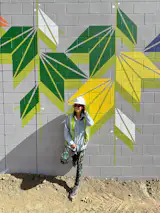
Artist Sandra Fettingis installing a mural at Sprouts Market in Aurora, Colorado.
Artist Sandra Fettingis resides in Denver. Unlike much of her newly built bland surroundings, her murals feature brightly colored patterns that, while angular and sharp, seem to embody a natural geometry. I’ve admired Fettingis’s work since 2011, when we both worked at the front desk of the Museum of Contemporary Art Denver, a job that sustained her until her reputation took off after she won a commission to create a massive installation in the Colorado Convention Center’s atrium as a part of the city’s public arts program.
Since then, Fettingis’s work has appeared everywhere: windscreens for railway stations, a suspended installation in a college atrium, and murals in private homes. She’s completed more than 90 murals and installations at sites across the Denver area, including 22 new rental apartment and condo projects. One of her most recent projects was a commission by Mill Creek, a major U.S. developer known for upscale apartments. Mill Creek approached her in 2024, she says, to design a mural on a new building near the University of Denver. It’s a normal “developer special”: studios and one- and two-bedroom units in a five-story structure located in an otherwise single-family neighborhood; a charcoal gray amenity tower with a deck meets burnt sienna and tan cladding the exterior. Fettingis’s mural is on a wall near the entryway, visible from the amenity deck and some balconies.
She wasn’t given any art direction—a great relief for a creative person who sometimes gets commissions based on work she completed years prior—and created a 60-by-25-foot mural whose umber tones complement the building’s muted color schemes. It also features her signature geometric botanicals cascading down the wall, transforming an otherwise ordinary building into a landmark for residents and passersby.
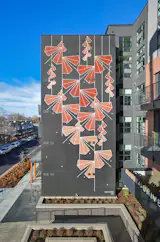
In 2025, Fettingis installed a mural of her characteristic geometric botanicals down the side of the Modera University Park building built by developer Mill Creek in Denver. She says residents talk to her while she’s working on her pieces and have shared “how much life and joy” they bring.
“I think there’s a lot of things that take place even on a subconscious level,” she says of the experience of being a resident. “I think there’s a level of pride if your building has something rad on it.” On a community level, she continues, it shows that a developer actually cares about the neighborhood it’s building in. “They are offering this unique character to a place that’s thoughtful, versus just dumping a building and leaving and going on to the next one.” Gina Harris, regional design manager at Mill Creek (who hired Fettingis for the project) agrees and says the company has worked with local artists on projects across a national portfolio. “We believe art adds lasting value by giving a building personality and emotional resonance. It helps residents feel proud of where they live and signals that we care deeply about the communities we develop,” she told Dwell via email. “Those details matter.”
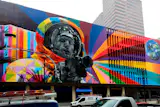
Eduardo Kobra’s “Armstrong” mural in Cincinnati, Ohio.
“Care” is a tricky word in the context of new development. Though murals like these have roots in 1930s New Deal commissions that helped adorn public buildings and stimulate the economy, over the years, that reputation has shifted. Graffiti and street art had negative connotations in the 20th century—linked to illicit activity and blight—but in recent decades have become tools for beautification as many cities like Denver have adopted programs to support them. They’ve inched their way into the private sphere: In 2015, the Washington Post profiled D.C.-area developer and property owner JBG Cos as it launched a massive mural campaign to decorate parking garages, blank walls, and other features in its expansive portfolio.
The roughly 30 murals wrought mixed feelings, according to the Post. Some believed them to be a genuine way to give back to the community, while others saw a marketing ploy or, as one “divided” muralist hired by JBG told the Post, a way to make urban areas “sexy” to “millennials who want to buy into a growing real estate neighborhood that is predominantly poor, or inner city, or minority or whatever term you want to use.”
Anxiety rules over neighborhood change when a developer rolls into town, potentially bringing rising rents, noise, traffic, and displacement. As such, commissioning a mural for a new development has become a fraught topic, the concern being that street art is being co-opted to make those changes more palatable. A 2025 study led by Hyesun Jeong, assistant professor of urban design in the University of Cincinnati’s School of Planning at the College of Design, Architecture, Art, and Planning, geo-located murals across the city using a database by ArtWorks, a community-based public art nonprofit in Cincinnati. By analyzing various public data at each site, it found that those neighborhood blocks with murals show “significant increases in pedestrian activity, household income, rents, and housing values,” indicating both neighborhood revitalization as well as gentrification. Here, murals have become signifiers of both improvement and displacement.
Critics who draw boundaries around what is considered street art and what is seen as selling out are simply making claims about language; perhaps these murals should be considered something else entirely.
But the benefits to developers appear quite clear. Jordan Giha, CEO and founder of WXLLSPACE, an organization that has connected developers with artists on more than 140 mural projects, has conducted his own studies into the relationship between property development and public art. A former real estate professional, he analyzed thousands of real estate transactions over a five-year period, he says, and, working with data scientists, found that properties with murals had an increase of more than 30 percent in value over those without. WXLLSPACE also surveyed leasing offices and property management companies and found that murals “have added a huge attraction to renters.”
They could also make existing residents feel that displacement is on the way. It’s perhaps unsurprising, considering that artists have frequently played a role in gentrification—once artists begin moving into distressed or disinvested neighborhoods seeking cheaper rents, they become a key driver of new development and “improvement.” But city governments have, in recent history, actively sought the presence of creatives; in urbanist Richard Florida’s 2002 book The Rise of the Creative Class, he argues for cities to attract creative workers—tech workers, but also artists, designers, writers, and more—in order to spur economic development. A working paper published by the National Endowment for the Arts from 2014 speaks to how some city governments and developers have targeted “arts industries to generate place-based redevelopment.” Interestingly, the paper finds that those “commercial” industries (film, design, and music) are more closely associated with indicators of gentrification, while the “fine arts” (visual art, museums, etc.) are more associated with revitalization. Developer-led murals, straddling both fine art and business industries, have been subsumed into this commercial process, operating simultaneously as art, branding, “placemaking,” and even, as author Martha Rosler suggests in her book Culture Class, a “minor government apparatus.” The notion of “artwashing,” then, isn’t only about distracting from displacement occurring after “neighborhood improvement” but the unintended consequences of neighborhood betterment desired by city leaders themselves.
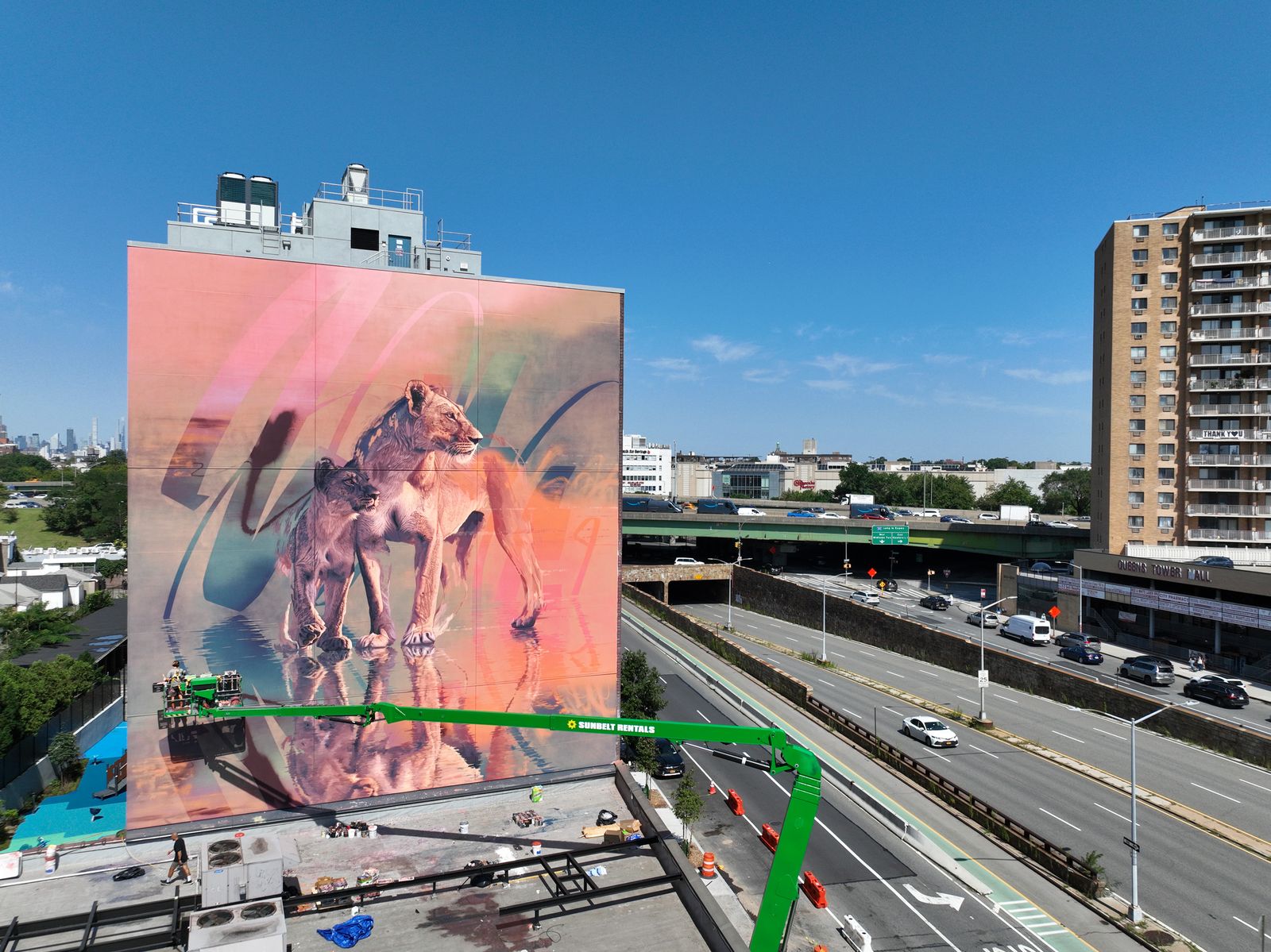
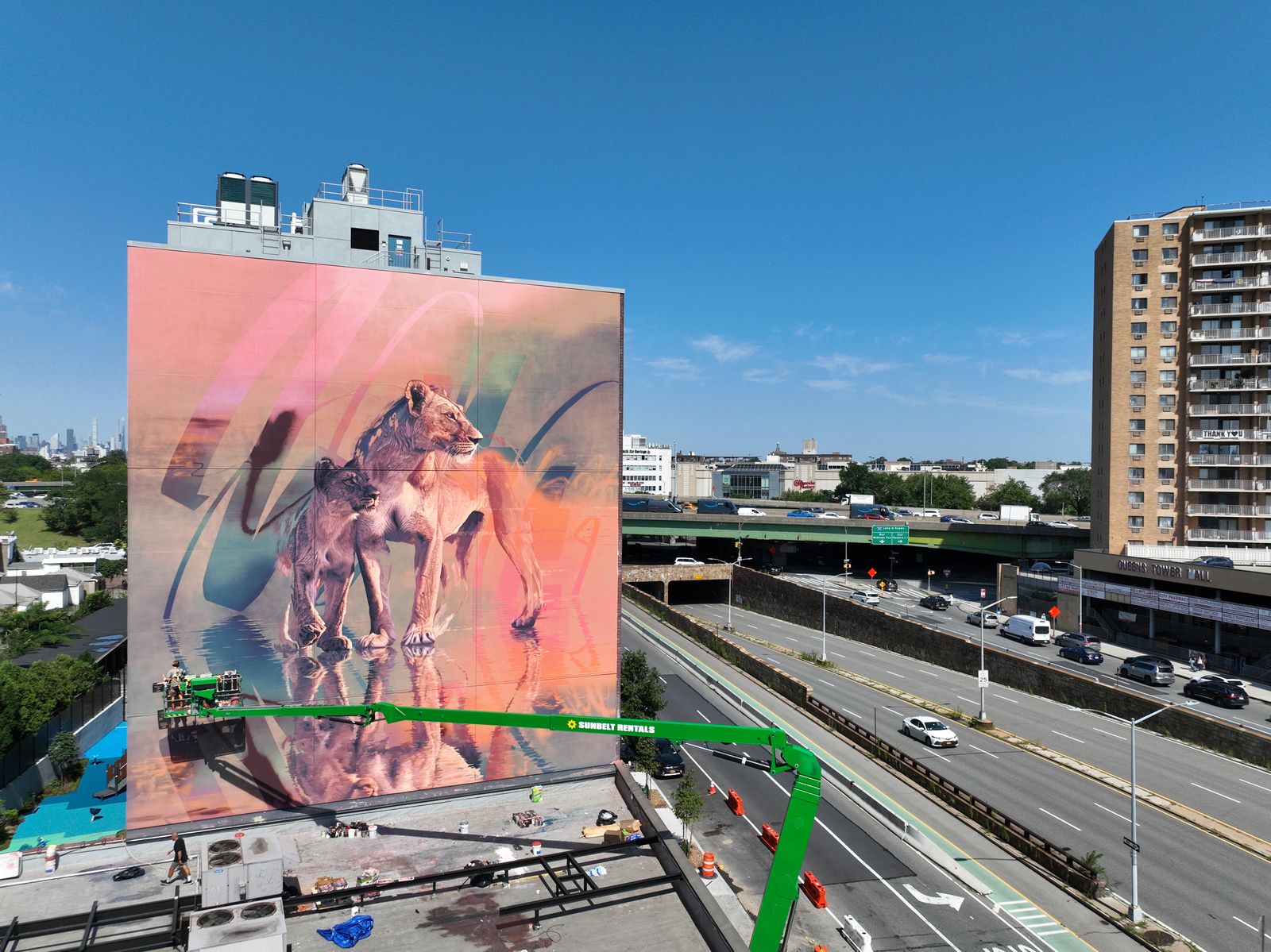
To counteract those potential negative effects, the University of Cincinnati researchers recommend in their study that policymakers “link mural initiatives with affordable housing and long-term employment strategies to support inclusive growth and community stability.” In Rego Park, Queens, one such developer took that advice to heart. In 2024, Slate Property Group was developing an eight-story, 88-unit affordable development for people transitioning from being unhoused. “The developers were looking for something that symbolized hope and care,” says Giha, who helped pair Slate with South Africa–raised artist Sonny Sundancer, who designed an image of a lioness and a cub. “It is a great representation of care—they’re the hunters, they’re also the gatherers and the caretakers of their prides.” Installing the 65-foot-tall, multicolored pastel mural wasn’t simple, he continues: With a mosque next door, the art team’s work hours were limited to those when prayers were not being held; they had to “boom” (install a boom lift) 150 feet over the mosque and cover the entryways and exits. But it was worth it, he says.
“It has been shared a bunch of times on the internet. We get so much love,” says Giha. It was so successful that the owners ended up naming the building after the mural, calling it the Lionheart.
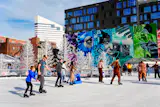
A mural by Tristan Eaton at the Cincinnati Convention Center looks over a seasonal skating rink.
It might be easy to dismiss these works as corporate art, but critics who draw boundaries around what is considered street art and what is seen as selling out are simply making claims about language; perhaps these murals should be considered something else entirely. As an art form, architecture is beholden to developer clients, but does that reality limit the “artfulness” of their industry? Certainly, it places limitations on what can be accomplished in terms of materials and ornaments that are cost prohibitive to getting new homes built, but this is precisely where artists contribute. Public art, especially murals, can add the visual interest that is value engineered out of contemporary residential boxes, while also providing something that communities in the midst of transformation truly need: financial support for artists.

Artist Sonny Sundancer works on his mural for The Lionheart, designed by Aufgang
Architects and developed by Slate Property Group in Rego Park, Queens.
The pieces Fettingis has seen aren’t just mass-produced giclée stick-ons but “cool, interesting, sculptural work” being supported. “New development has opened up the gates for new opportunities for work, which has definitely helped my field,” she says, adding that the combination of city-led public art initiatives and private development have enabled her to become a full-time artist. It’s especially important in cities where skyrocketing housing costs over the past decade have pushed working artists out—including those who hail from those “redeveloped” communities who have survived third-, fourth-, or fifth-wave gentrification. As local artists have helped build on a city’s cultural sphere, providing them with paid work can ensure that culture still flourishes.
Though she notes that, in the past, she struggled with the possibility that public art on housing projects might be contributing to gentrification, she’s found peace with it, knowing full well that she resides in the land of brown boxes. “While I was grappling with that, I was also starting to think about, Okay, well, there were buildings being built prior in all sorts of neighborhoods that did not have any art, and how do we feel about that?” she asks. “You know, we still see them, and they’re just blasé—gray, beige, meh, no life, no soul.” It’s a lesson that planners, architects, and even developers seem to be taking to heart: We can build quickly, affordably, and abundantly without leaving the soul of our cities behind.
—
Top photo by Ben Lau, courtesy of Sonny Sundancer/WXLLSPACE. Sonny Sundancer completed the Queens Pride mural in 2024 on the side of a building in Rego Park, Queens. Sundancer says it “transforms the urban landscape…and speaks to the power of protection, bravery, and unity.”
—
Head back to the March/April 2026 issue homepage