
Photo: Courtesy of the subjects
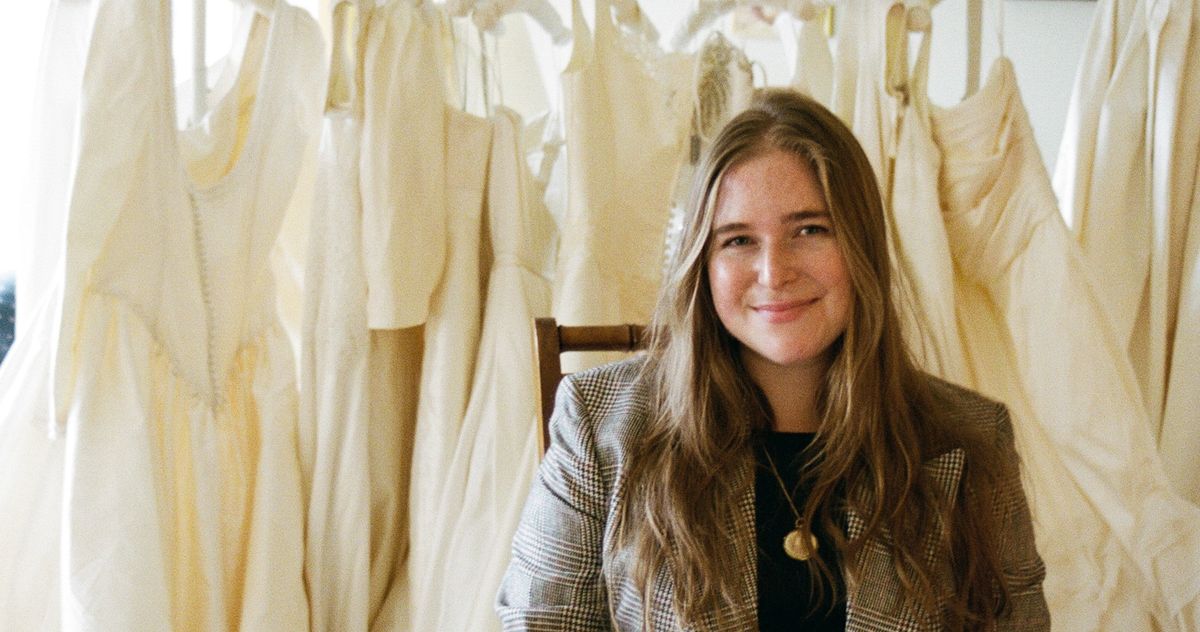
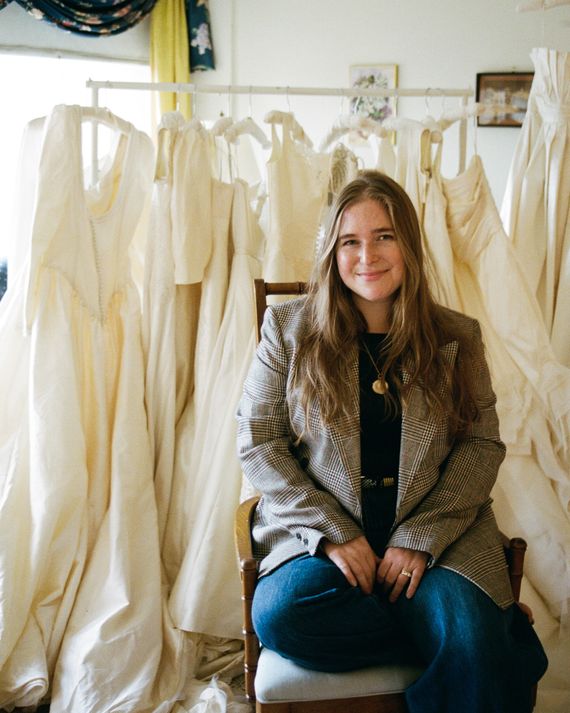
When Lizzie Wheeler lists appointments for Studio Dorothy, her vintage bridal boutique, she has to check her family’s Google Calendar first. It shows her who’s staying in 10D and 11D, two studio apartments stacked on top of each other in a giant East Side building. Apartment 11D belongs to her aunt and uncle, and her parents own 10D. If her father, Scott, a composer and musician based in Boston, is using 10D to draft music or to host a cocktail party ahead of a performance, or if any of her cousins, aunts, or uncles have already booked it, then Lizzie waits until the next free day. It’s a 12-person negotiation.
It’s been this way since she launched her business in 2024. But Lizzie doesn’t mind. “People shop this kind of business for the personal touch. They want to say, ‘I got my wedding dress at this lovely old apartment,’” she says. “The little inconveniences are worth it for the story.”
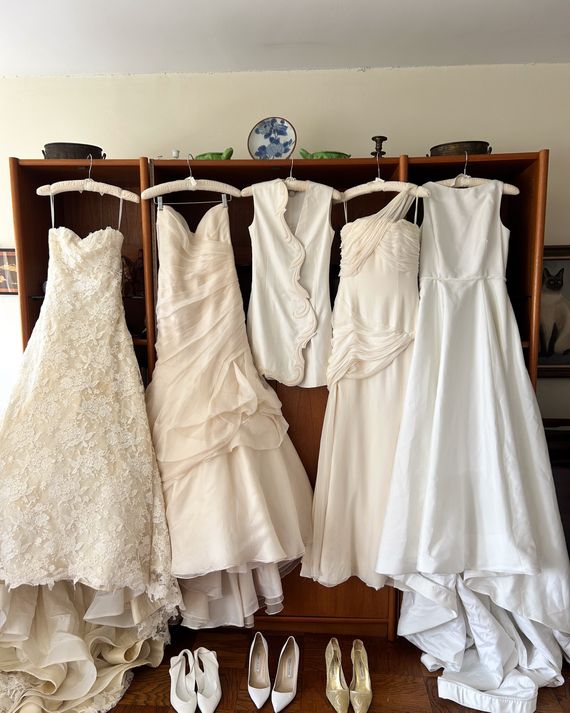
Photo: Courtesy of the subjects
But before there was a bridal atelier or a composing studio or even an 11th-floor unit, there was just 10D. It belonged to Mac and Dorothy Wheeler, Scott’s parents. The couple, who met and married in Manhattan, raised their four kids in Connecticut and moved to Rhode Island in their 60s once the children had grown up. But they wanted to stay connected to the city, so they purchased the 10th-floor studio as a pied-à-terre in 1983 and the 11th-floor unit the following year for about $85,000 each. The couple had a vague aspiration of combining the two apartments into a single duplex, but because 11D was occupied by a tenant until 2011 (at which point the Wheelers were in their late 80s), it never happened.
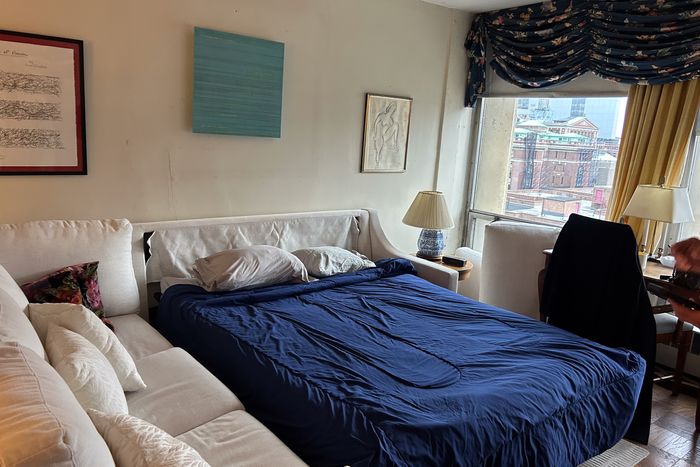
Photo: Courtesy of the subjects
Scott — who was working as a composer and professor in Boston when his parents bought the apartment — remembers them coming into the city monthly to see Broadway shows and visit museums, but mostly they spent time with friends. Dorothy, the family matriarch whom Lizzie’s bridal studio is named after, loved to host, and she would find a way to have groups of up to 30 over for cocktails and snacks. (To make room in the 550-square-foot studio, she opted for a pull-out couch instead of a bed.) “My musician and artist friends in New York loved to go to events in this elegant little apartment, which looked more like a designer place than their functional apartments,” he says.
Most of Dorothy’s design choices are still in place, unchanged. Stepping into the vestibule, the walls are covered in a blue-and-gold-striped wallpaper, which is peeling a bit at the edges. The tiny galley kitchen around the corner still has the original range and analog clock. Most of the apartment walls are decorated with ornate metal wall sconces and mirrors, along with a mix of modern prints and realistic paintings. The living room is furnished with vintage armchairs and dark wooden furniture, and the wall of windows is covered by yellow drapes with floral valances. “The curtains are such a vibe, but they’re totally falling apart. We’re going to have to replace them, but we’re all depressed about it and keep kicking it down the line,” says Lizzie.
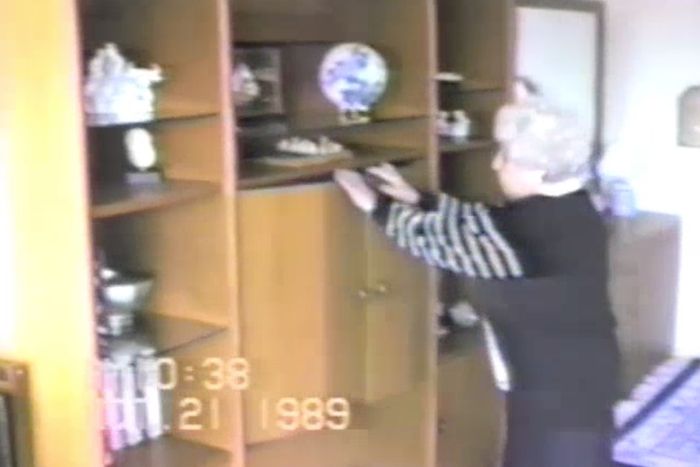

From left: Stills from a 1980s home video of the studio apartments as Dorothy and Mac Wheeler used them. Photo: Courtesy of the subjectsPhoto: Courtesy of the subjects
From top: Stills from a 1980s home video of the studio apartments as Dorothy and Mac Wheeler used them. Photo: Courtesy of the subjectsPhoto: Courtesy… From top: Stills from a 1980s home video of the studio apartments as Dorothy and Mac Wheeler used them. Photo: Courtesy of the subjectsPhoto: Courtesy of the subjects
When they weren’t using the studios, Mac and Dorothy had a first-come, first-served policy for their four kids, who would reserve nights over email. Lizzie remembers staying over when they attended her dad’s shows in the city or spending the night with a handful of cousins and friends during a bat mitzvah. Once the four grandkids were old enough to use the apartment alone, they joined the group email chain — among them, only Lizzie and her sister live in the city. In rare instances when all of the families came into the city for an event, like Mac and Dorothy’s 50th-anniversary vow renewal or when Scott had a piece performed at Carnegie Hall, the siblings would sort it out among themselves. (For the latter, everyone agreed Scott should get the apartment for his big night.)
It went on like this for decades, with all of the family members splitting the pied-à-terre among themselves — the only change was that Wendy, Scott’s sister, eventually created a Google Calendar to manage reservations. Then, in 2010, the senior Wheelers moved to a Connecticut retirement community, and Scott began spending more time in 10D because his work required him to be in the city for weeks at a time, and he became the de facto gatekeeper for the residence.
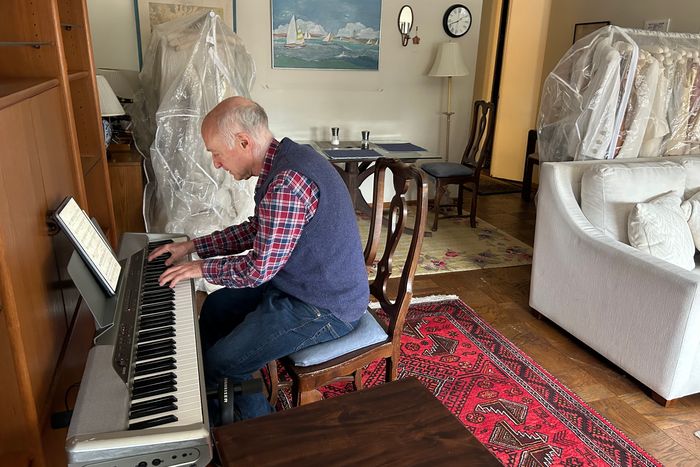
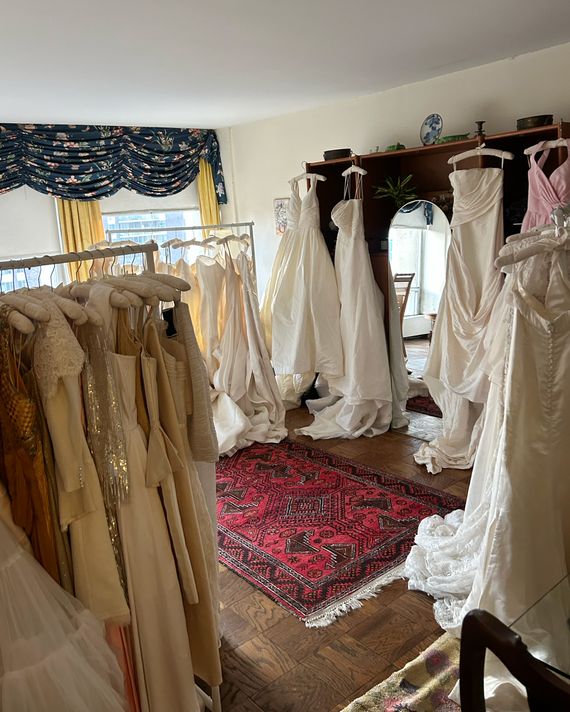
From left: Scott Wheeler composing at his keyboard in front of the wooden console that his daughter Lizzie uses for her bridal salon. Photo: Courtesy of the subjectsThe apartment with all the racks set up for Studio Dorothy. Photo: Courtesy of the subjects
From top: Scott Wheeler composing at his keyboard in front of the wooden console that his daughter Lizzie uses for her bridal salon. Photo: Courtesy o… From top: Scott Wheeler composing at his keyboard in front of the wooden console that his daughter Lizzie uses for her bridal salon. Photo: Courtesy of the subjectsThe apartment with all the racks set up for Studio Dorothy. Photo: Courtesy of the subjects
When Mac died in 2022, six years after Dorothy, the apartment was left equally to the four children. But Scott had already told his siblings that he wanted to buy out their shares, and that year he and his wife became the official owners of 10D. Later that year, Wendy and her husband, who also live in Boston, decided to buy the upstairs unit with the money they’d gotten from the 10D payout. Apartment 11D has the exact same layout as the unit below (though Wendy removed part of the kitchen wall to make it an open-floor plan), and it’s set up almost identically — just with more modern furniture.
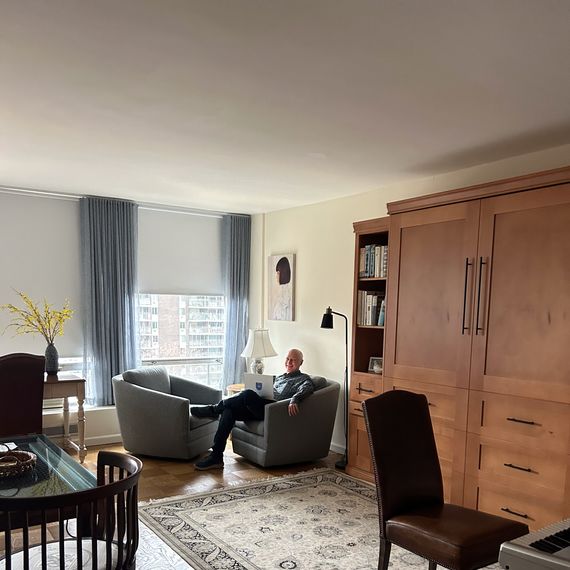
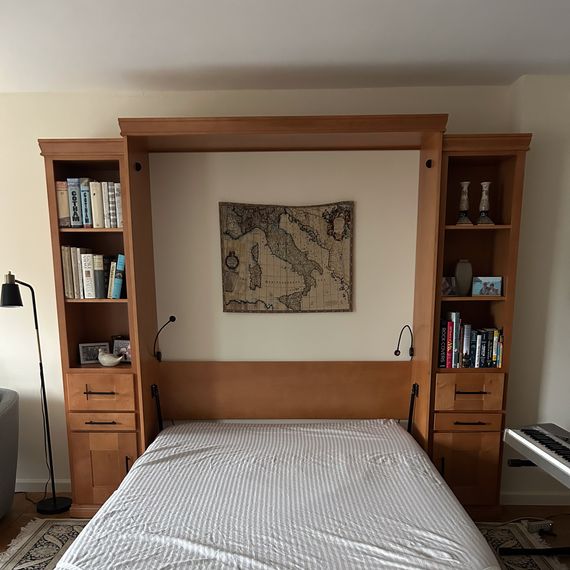
From left: Apartment 11D’s living room and setup feature more modern furniture. Photo: Courtesy of the subjectsPhoto: Courtesy of the subjects
From top: Apartment 11D’s living room and setup feature more modern furniture. Photo: Courtesy of the subjectsPhoto: Courtesy of the subjects
Now the Wheeler family says the studios operate almost like a two-bedroom; both apartments are on the shared calendar and up for grabs. Each apartment has a set of keys for the other, so if Wendy’s daughter Emily visits the city with one of her partners and they both have meetings, she can let herself into 10D for a Zoom call, if it’s free. If Scott is in New York for a show and wants to offer another musician a place to stay (which he often does), he can ask his sister and book 11D for them. If one of their other siblings is in town, but both units are occupied, Scott might decide to spend the night in Brooklyn with one of his daughters to free up 10D. “My brother was here last month and I thought it was more important that he get to use the place, since he doesn’t often have the chance,” Scott says. The only other tacit rule, first instituted by Mac and Dorothy, is that parents always get prioritized over the kids, Wendy said.
As the official owners, the costs of keeping up the apartments are still mostly up to Scott and Wendy; they each chip in $150 for a monthly house cleaner and each pay the monthly maintenance fees for their apartments, which are less than $600, and the annual $360 membership fee for the building’s gym (guests can’t use it). In return for a place to stay, Scott’s guests often cover his portion of the monthly house-cleaning fee (a price that they say pales in comparison to a stay at a hotel), and Wendy asks that people wash the sheets and towels in the building’s laundry room before they go.
The most complex negotiations are between Lizzie and Scott. Most months Lizzie schedules up to 60 bridal appointments in the apartment, and Scott is there for a week or two composing music and hosting parties between performances. To avoid encroaching on her dad, Lizzie books appointments a month in advance and tries to schedule as many as six per day. “My parents came here for Thanksgiving, so that was a bit limiting, but I just built up the showroom right when they left on Black Friday and worked the following day,” she says. If a family friend is staying at the apartment, she’ll ask to know exactly when their train is so she can set up as soon as they’re gone. Most of the time, Lizzie stores 40 to 50 bridal outfits in the closet (there are more in her storage unit in Gowanus), and if it’s just family using the unit she might keep out a clothing rack or two so that the garments don’t have to be rehung and steamed. By now, a lot of the other family members are used to having to make their way around racks of dresses and shoes. Most of the time this works. “Once there was a big Dior gown in the closet for a couple months, and at one point my dad was like, Get this thing out, so I brought it to my apartment,” she says.
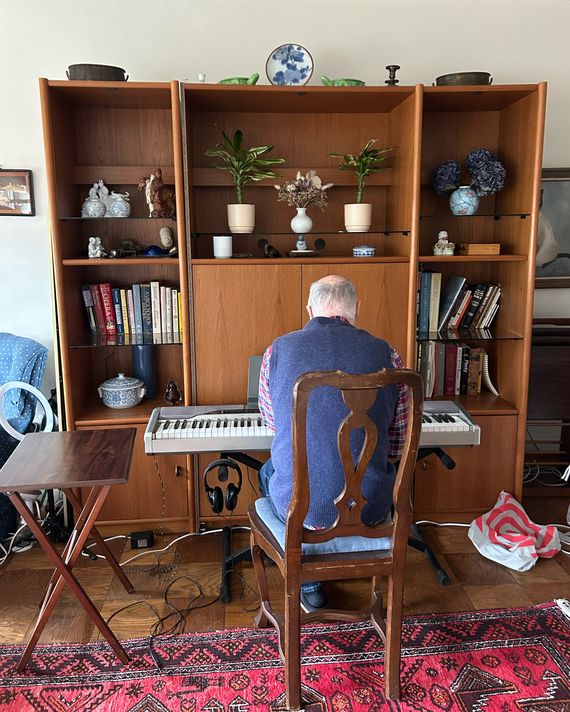
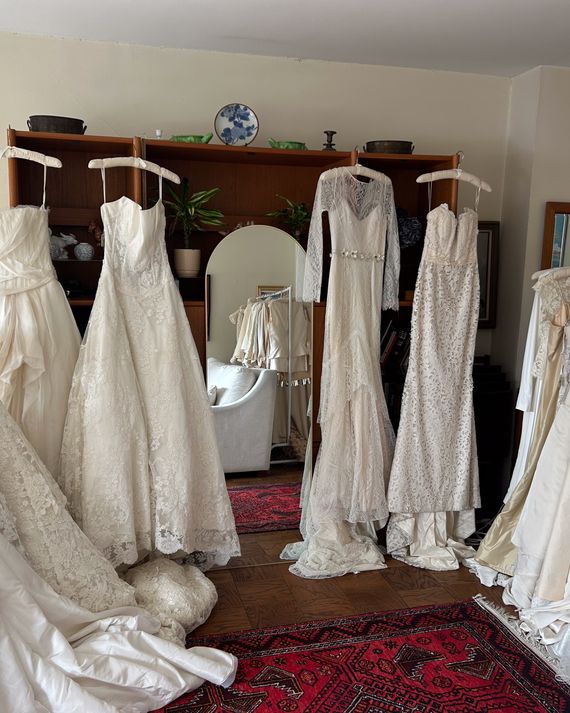
From left: The wooden console where Scott works and Lizzie sets up a mirror for her bridal appointments. Photo: Courtesy of the subjectsPhoto: Courtesy of the subjects
From top: The wooden console where Scott works and Lizzie sets up a mirror for her bridal appointments. Photo: Courtesy of the subjectsPhoto: Courtesy… From top: The wooden console where Scott works and Lizzie sets up a mirror for her bridal appointments. Photo: Courtesy of the subjectsPhoto: Courtesy of the subjects
A large wooden mid-century console in the main room does a lot of the work of switching the space from bridal atelier to music studio. It has shelves to hold Scott’s opera books and a cabinet for his external monitor, and Lizzie hides ring lights and a full-length mirror behind it. When he’s there, Scott takes his keyboard and music stands out of the closet, removes a printer from behind one of the armchairs, and pulls up a chair in front of the monitor tucked into the console. The next day, Lizzie can just as easily cover the middle of the console with the mirror and set up three clothing racks on either side (these are usually hidden under the sofa). Once the racks are filled with bridal outfits, much of the apartment’s furniture and knickknacks are obscured by tulle and silk. What’s still visible, like the many table lamps and the vintage wallpaper, charms the brides. “It’s 100 percent my grandma, and it would be a big project to bring this sense of her elsewhere,” says Lizzie. “For now, I’m really just white-knuckling it and holding on for dear life to this arrangement as long as I can.”
See All