

Architects: Michael Graves
Area: 33,910 m² (365,000 ft²)
Year: 1982, Renovation in 2020
Photography: Michael Graves, Steve Morgan, James Ewing, JBSA, Meredith L. Clausen, Peter Meijer & Patience Stuart, misfitsarchitecture.com, camknows, sacred_destinations
Associate Architect: Emery Roth & Sons
Project Type: Government office building
Client: City of Portland
Structural Engineer: Desimone Consulting Engineers
Main Contractor: Hoffman Construction, Pavarini McGovern Construction
Renovation Architect: DLR Group
City: Portland
Country: United States
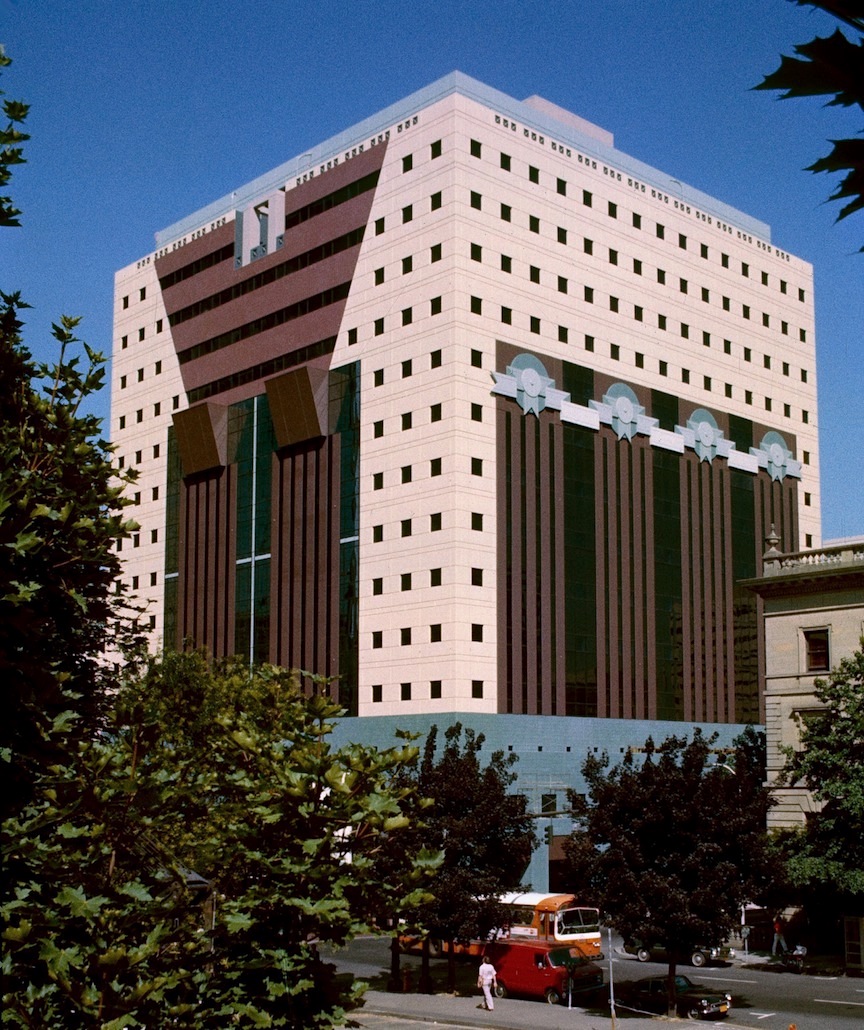
The Portland Building government office tower, designed by Michael Graves in Portland, United States, redefined civic architecture through Postmodern expression and marked a critical shift away from Modernist principles, completed in 1982 and renovated in 2020. The 15-storey building at 1120 SW 5th Avenue was conceived as a municipal services headquarters adjacent to City Hall. Developed through a design competition, the project introduced a symbolic architectural language characterized by color, ornament, and references to classical composition. The building adopts a tripartite organization of base, middle, and top, expressed through oversized decorative elements such as pilasters, keystones, and garlands applied to a compact rectangular mass. Its facade combines painted concrete, tile, and later rainscreen systems, while small punched windows contrast with the glass curtain-wall typology that was dominant at the time. The project became one of the first major built examples of Postmodern architecture, preceding similar works and influencing subsequent civic buildings. Despite its architectural impact, the building faced criticism for functional shortcomings, including limited street-level accessibility, dark interior spaces, and material failures. Structural and envelope issues led to a major reconstruction completed in 2020, which preserved the original design intent while improving performance, durability, and workplace conditions. The Portland Building remains a key reference in late twentieth-century architecture, illustrating the tension between symbolic form, public function, and long-term performance.

The Portland Building stands at 1120 SW 5th Avenue in downtown Portland, Oregon, serving as a municipal office building for the City of Portland. Designed by Michael Graves with Emery Roth & Sons, the building opened in 1982 following a design competition initiated in 1979. Its proximity to City Hall and other civic institutions positioned it as a central component of the city’s administrative core.

The commission emerged during a period of dissatisfaction with prevailing Modernist architecture. City officials and jurors sought an alternative to the uniform glass-and-steel office buildings that had come to define American downtowns. Graves’ proposal introduced a distinct formal language, prioritizing symbolism, color, and historical reference over strict functional expression. The selection of the design marked a deliberate shift toward a more communicative architectural approach.
 The Portland Building / Michael Graves | Classics on Architecture Lab 51
  The Portland Building / Michael Graves | Classics on Architecture Lab 52
  The Portland Building / Michael Graves | Classics on Architecture Lab 53
The building is organized as a compact, symmetrical volume articulated through a classical tripartite scheme. A two-storey base supports the main body and an upper termination, referencing traditional compositional hierarchies. The facades are defined by applied elements such as oversized keystones, pilasters, and decorative garlands, rendered in contrasting colors. Green tones at the base and blue accents above establish a visual relationship with ground and sky, reinforcing the building’s symbolic intent.
 The Portland Building / Michael Graves | Classics on Architecture Lab 54
  The Portland Building / Michael Graves | Classics on Architecture Lab 55
Material expression reinforces this departure from Modernism. The exterior was originally constructed as a painted concrete structure with tile cladding and small punched windows, rejecting the transparency of curtain wall systems. This approach emphasized surface, depth, and graphic composition over structural expression. In 1985, the addition of the Portlandia sculpture by Ray Kaskey above the main entrance further strengthened the building’s civic identity.
 The Portland Building / Michael Graves | Classics on Architecture Lab 56
  The Portland Building / Michael Graves | Classics on Architecture Lab 57
  The Portland Building / Michael Graves | Classics on Architecture Lab 58
Reception to the project was divided from the outset. Many architects and critics viewed the design as a necessary challenge to Modernist orthodoxy, while others considered it overly decorative and lacking the dignity expected of a government building. Criticism extended beyond aesthetics to issues of performance and usability. Entrances were limited and elevated above street level, reducing accessibility, while interior spaces were often described as dark and constrained.

Technical shortcomings became evident soon after completion. Water infiltration, material deterioration, and structural issues required ongoing maintenance and led to early renovations, including work on the lobby and public areas within a decade of opening. These problems were frequently attributed to budget constraints that influenced construction quality and material choices.

A major reconstruction effort began in 2017 and was completed in 2020. Led by DLR Group, the project retained the building’s Postmodern identity while introducing a new rainscreen envelope, upgraded glazing, seismic improvements, and a complete interior reconfiguration. The intervention aimed to address long-standing performance issues while preserving the architectural language that defined the original design.
 The Portland Building / Michael Graves | Classics on Architecture Lab 59
  The Portland Building / Michael Graves | Classics on Architecture Lab 60
  The Portland Building / Michael Graves | Classics on Architecture Lab 61
  The Portland Building / Michael Graves | Classics on Architecture Lab 62
  The Portland Building / Michael Graves | Classics on Architecture Lab 63
  The Portland Building / Michael Graves | Classics on Architecture Lab 64
The Portland Building occupies a central position in architectural discourse. As one of the earliest large-scale Postmodern buildings, it brought theoretical ideas into the public realm and influenced a generation of civic architecture. Its legacy remains complex, defined by the tension between symbolic ambition, functional performance, and evolving standards of building technology.

Project Gallery
© Meredith L. Clausen  © Peter Meijer & Patience Stuart
  © Flickr User: sacred_destinations
  © Steve Morgan © misfitsarchitecture.com © Steve Morgan
  © Michael Graves © Michael Graves
  © Flickr User: camknows © Michael Graves © James Ewing / JBSA
  © Steve Morgan © James Ewing / JBSA © James Ewing / JBSA
  © James Ewing / JBSA © James Ewing / JBSA © James Ewing / JBSA © James Ewing / JBSA
  © James Ewing / JBSA
  © James Ewing / JBSA © James Ewing / JBSA
  © James Ewing / JBSA
  © James Ewing / JBSA © Michael Graves © archhistdaily.wordpress.com © architectural-review.com © Michael Graves & Associates
  © Michael Graves
  © GreatBuildings.com
  © GreatBuildings.com
  © GreatBuildings.com
  © GreatBuildings.com
  © GreatBuildings.com
  © GreatBuildings.com
  © GreatBuildings.com
  © Michael Graves & Associates
Project Location
Address: 1120 SW 5th Avenue, Portland, Oregon 97204, United States
Location is for general reference and may represent a city or country, not necessarily a precise address.