

Architects: Alvar Aalto, Aino Aalto
Year: 1939
Photography: Alvar Aalto, Alvar Aalto Foundation, Maija Holma, Gustaf Welin, Mikko Merckling, Dieter Janssen, Åke E: SON Lindman, Mark Trueman, TRUEMAN DESIGN STUDIO, Jarno Kylmänen, Ninara, Stefamaro, intercontinentalgardener.com, andrewpaulcarr, archphotographr, Leon
Client: Harry and Maire Gullichsen
City: Noormarkku
Country: Finland
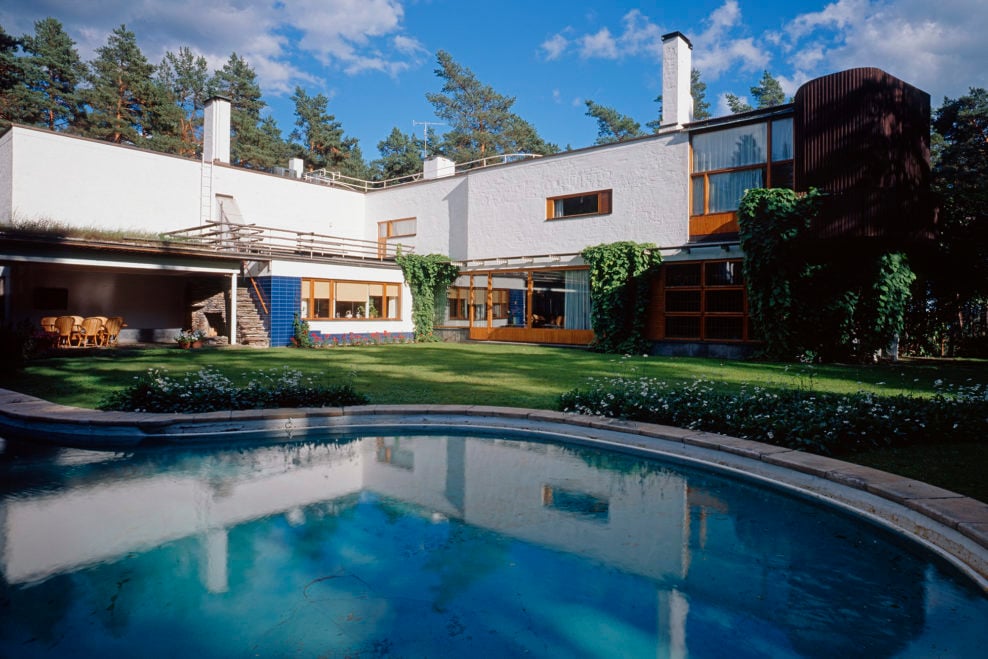
Villa Mairea, a residential villa designed by Alvar Aalto and Aino Aalto in Noormarkku, Finland, redefined the relationship between modern architecture, nature, and domestic life, completed in 1939. Conceived as an experimental house for Harry and Maire Gullichsen, the project brought together Aalto’s evolving ideas on form, material, and spatial composition within a rural retreat setting. The L-shaped plan organizes the house around a semi-private courtyard with a garden and swimming pool, establishing a clear relationship between interior spaces and the surrounding forest. The design combines modernist principles with references to vernacular Finnish architecture, particularly the traditional tupa, while introducing a layered spatial sequence that shifts from public to intimate zones. Villa Mairea uses a wide palette of materials, including wood, stone, brick, and glass, to create gradual transitions in texture and atmosphere. The structural system integrates irregularly placed columns and vertical elements that recall the surrounding birch forest, reducing rigid geometric order. The architectural language balances rectilinear organization with free-form elements, including curved walls, a serpentine pool, and fluid interior boundaries. Aalto revised early schemes during construction, refining spatial coherence and reducing programmatic excess. The project reflects the cultural ambitions of its clients and their collaboration with Aalto, linking architecture with art, furniture, and daily life through the Artek philosophy. Villa Mairea remains one of Aalto’s most significant works, demonstrating a synthesis of modernism, tradition, and landscape.

Villa Mairea stands in Noormarkku, Finland, designed by Alvar Aalto with Aino Aalto for Harry and Maire Gullichsen. Built between 1938 and 1939, the house served as a rural retreat and guest residence. The clients encouraged an experimental approach, allowing the project to develop as a testing ground for ideas that extended beyond Aalto’s earlier built work.

The project occupies a site within the Noormarkku ironworks area, surrounded by forest and shaped by the cultural legacy of the Ahlström family. The commission formed part of a broader lineage of family residences, each reflecting its era. In this context, the villa was intended to express a new vision of domestic life aligned with modern culture and technological progress.

The plan adopts a modified L-shape that organizes the house around a semi-enclosed courtyard. This configuration separates more private family spaces from outward-facing areas while framing views toward the garden and swimming pool. The arrangement establishes a gradient between public and domestic zones, with the ground floor largely dedicated to social and reception spaces and the upper level accommodating bedrooms and Maire Gullichsen’s studio.
 Villa Mairea / Alvar Aalto | Classics on Architecture Lab 90
  Villa Mairea / Alvar Aalto | Classics on Architecture Lab 91
  Villa Mairea / Alvar Aalto | Classics on Architecture Lab 92
  Villa Mairea / Alvar Aalto | Classics on Architecture Lab 93
  Villa Mairea / Alvar Aalto | Classics on Architecture Lab 94
  Villa Mairea / Alvar Aalto | Classics on Architecture Lab 95
Spatial organization evolved significantly during design and construction. Early proposals explored more complex and expansive programs, but revisions led to a more coherent arrangement. The entrance sequence moves from a compressed lobby into a lower main hall, where axial views toward the dining area are offset by angled walls and screens of wooden poles. These elements define zones without enclosing them, creating continuity across living, dining, and library spaces.
 Villa Mairea / Alvar Aalto | Classics on Architecture Lab 96
  Villa Mairea / Alvar Aalto | Classics on Architecture Lab 97
  Villa Mairea / Alvar Aalto | Classics on Architecture Lab 98
  Villa Mairea / Alvar Aalto | Classics on Architecture Lab 99
  Villa Mairea / Alvar Aalto | Classics on Architecture Lab 100
  Villa Mairea / Alvar Aalto | Classics on Architecture Lab 101
  Villa Mairea / Alvar Aalto | Classics on Architecture Lab 102
  Villa Mairea / Alvar Aalto | Classics on Architecture Lab 103
Material expression plays a central role in shaping experience. Wood, stone, brick, and plaster are combined to produce shifts in texture and scale, moving from more robust surfaces at the exterior to softer, domestic finishes inside. Floors transition from stone to tile to timber, reinforcing changes in use and atmosphere. Exterior walls combine timber, stone slabs, and rendered surfaces, while sliding elements allow parts of the house to open toward the garden.
 Villa Mairea / Alvar Aalto | Classics on Architecture Lab 104
  Villa Mairea / Alvar Aalto | Classics on Architecture Lab 105
  Villa Mairea / Alvar Aalto | Classics on Architecture Lab 106
  Villa Mairea / Alvar Aalto | Classics on Architecture Lab 107
Structure and detail are used to disrupt uniformity. Columns vary in material and form, with some wrapped in wood or rattan, and others left as steel or concrete. Vertical elements cluster and disperse in ways that recall the surrounding birch forest, reducing the legibility of a fixed structural grid. This strategy softens the reading of the plan, even as an underlying geometric order remains present.
 Villa Mairea / Alvar Aalto | Classics on Architecture Lab 108
  Villa Mairea / Alvar Aalto | Classics on Architecture Lab 109
The design balances rectilinear organization with free-form gestures. Curved elements appear in the swimming pool, interior walls, and ceiling conditions, introducing a contrasting spatial language associated with movement and variability. These forms reflect Aalto’s interest in natural geometries and his position that the “curving, living, unpredictable line” stands in contrast to rigid mechanical order.

References to tradition are integrated within a modern framework. The open living space echoes the Finnish tupa, where vertical elements define zones for different activities. This interpretation avoids direct imitation, instead translating vernacular principles into a modern spatial system. The result is a hybrid condition where historical memory and contemporary design operate together.

Interior design forms an integral part of the project. Aino Aalto developed furniture, lighting, and material selections specifically for the house, aligning with the broader Artek philosophy of uniting function, comfort, and artistic expression. Custom pieces, textiles, and artworks contribute to a cohesive environment in which architecture and interior operate as a single composition.
 Villa Mairea / Alvar Aalto | Classics on Architecture Lab 110
  Villa Mairea / Alvar Aalto | Classics on Architecture Lab 111
  Villa Mairea / Alvar Aalto | Classics on Architecture Lab 112
Villa Mairea extends beyond its immediate program as a private residence. The project synthesizes architecture, landscape, and cultural ambition within a single work. Its integration of modernist ideas with material richness and spatial variation positions it as one of Alvar Aalto’s most significant contributions to twentieth-century architecture.

Project Gallery
 © Alvar Aalto Foundation
  © Alvar Aalto Foundation
  © Flickr User: Leon
  © Dieter Janssen © Gustaf Welin / Alvar Aalto Fountdation
  © Alvar Aalto
  © Dieter Janssen
  © Dieter Janssen
  © Dieter Janssen
  © Dieter Janssen © Alvar Aalto
  © Dieter Janssen
  © Stefamaro
  © Alvar Aalto
  © intercontinentalgardener.com
  © Alvar Aalto © Maija Holma / Alvar Aalto Fountdation © Jarno Kylmänen
  © Mikko Merckling / Alvar Aalto Fountdation © Ninara
  © Mark Trueman / TRUEMAN DESIGN STUDIO
  © Alvar Aalto
  © Jarno Kylmänen © Alvar Aalto
  © Dieter Janssen
  © Dieter Janssen
  © Dieter Janssen
  © Jarno Kylmänen
  © Jarno Kylmänen © Åke E: SON LINDMAN
  © Åke E: SON LINDMAN © Åke E: SON LINDMAN
  © Maija Holma / Alvar Aalto Fountdation © Åke E: SON LINDMAN © Åke E: SON LINDMAN © Åke E: SON LINDMAN
  © Alvar Aalto
  © Alvar Aalto © Jarno Kylmänen © Maija Holma / Alvar Aalto Fountdation © Jarno Kylmänen
  © Åke E: SON LINDMAN © Åke E: SON LINDMAN © Åke E: SON LINDMAN © Maija Holma / Alvar Aalto Fountdation
  © Åke E: SON LINDMAN © Flickr User: andrewpaulcarr
  © Flickr User: archphotographr
  © Åke E: SON LINDMAN
  © Åke E: SON LINDMAN
  © Åke E: SON LINDMAN © Åke E: SON LINDMAN © Åke E: SON LINDMAN © Åke E: SON LINDMAN © Alvar Aalto Foundation © Alvar Aalto
  © Alvar Aalto
  © Alvar Aalto
  © Alvar Aalto © Alvar Aalto Foundation © Alvar Aalto Foundation
  © GreatBuildings.com © GreatBuildings.com
  © Alvar Aalto
  © Alvar Aalto © Alvar Aalto
Project Location
Address: Pikkukoivukuja 20, 29600 Noormarkku, Finland
Location is for general reference and may represent a city or country, not necessarily a precise address.