

Architects: Adler & Sullivan (Dankmar Adler, Louis Sullivan)
Year: 1891
Photography: Adler & Sullivan, Cole Woodcox, Emil Boehl, William A. Zbaren, University of Missouri, Missouri History Museum, Reading Tom, bluebike, fitzgene, pasa47, w_lemay
Associate Architect: Charles K. Ramsey
Client: Ellis Wainwright
City: St. Louis
Country: United States
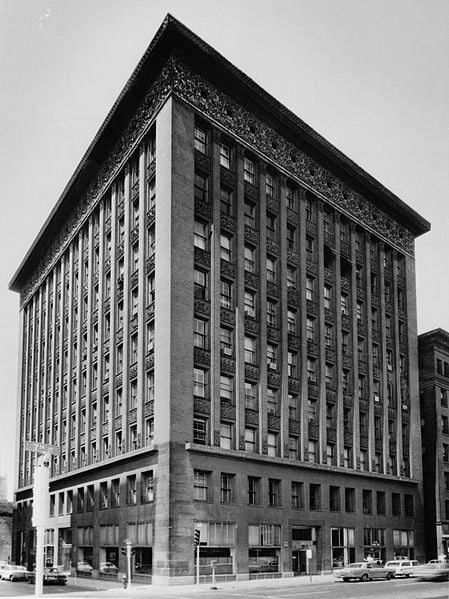
Wainwright Building, an office building designed by Adler & Sullivan in St. Louis, has defined an early model for skyscraper architecture and transformed the expression of the tall office building, completed in 1891. The project stands as one of the first buildings to fully articulate the aesthetic and structural potential of steel-frame construction, establishing a shift from traditional masonry systems toward a vertically expressive architectural language. The building was commissioned by Ellis Wainwright to house offices for the St. Louis Brewers Association. The program organizes retail at street level, public offices on the second floor, repetitive office floors above, and mechanical functions at the top. This functional clarity informs the architectural composition. The structure uses a steel frame clad in masonry, combining a sandstone base, brick piers, and terra cotta ornament. Windows are recessed within the structural grid to reinforce vertical emphasis. The design follows a tripartite composition of base, shaft, and attic, aligning visual hierarchy with internal organization. Ornament is integrated through terra cotta panels with organic motifs, reflecting Louis Sullivan’s approach of combining geometric order with natural form. The building became a key reference for later skyscraper design and remains a National Historic Landmark.

Wainwright Building, an office building designed by Adler & Sullivan in St. Louis, has established a foundational model for early skyscraper design and redefined the architectural language of the tall office building, completed in 1891. The project stands among the first buildings to fully articulate the aesthetic and structural potential of steel-frame construction, marking a shift from traditional masonry massing to a vertically expressive architecture.
 Wainwright Building / Adler & Sullivan | Classics on Architecture Lab 55 Wainwright Building / Adler & Sullivan | Classics on Architecture Lab 56
  Wainwright Building / Adler & Sullivan | Classics on Architecture Lab 57
The commission originated from Ellis Wainwright, a local brewer who required office space for the St. Louis Brewers Association. The program organized retail functions at ground level, accessible public offices on the second floor, and repetitive office floors above, with mechanical equipment and water tanks housed at the top. This clear functional distribution informed the architectural expression.
 Wainwright Building / Adler & Sullivan | Classics on Architecture Lab 58
  Wainwright Building / Adler & Sullivan | Classics on Architecture Lab 59
  Wainwright Building / Adler & Sullivan | Classics on Architecture Lab 60
The design follows a tripartite composition of base, shaft, and attic, derived from the classical column. The lower levels form a pronounced base with large glazed openings for commercial use. The central shaft consists of repetitive vertical bays that emphasize height and continuity. The upper portion terminates in a deep cornice and ornamental frieze, completing the vertical composition.

The structural system relies on a steel frame clad in masonry, enabling increased height and larger window openings. The façade combines a sandstone base with brick piers rising through the upper stories. Terra cotta panels articulate spandrels and ornamental zones, allowing detailed surface treatment while maintaining structural clarity. Window recesses are set behind vertical piers to reinforce the perception of verticality.
 Wainwright Building / Adler & Sullivan | Classics on Architecture Lab 61
  Wainwright Building / Adler & Sullivan | Classics on Architecture Lab 62
  Wainwright Building / Adler & Sullivan | Classics on Architecture Lab 63
Ornament plays a controlled role within the composition. Sullivan applied organic motifs, particularly in the frieze and spandrel panels, using stylized foliage rendered in terra cotta. This approach reflects his broader theory of combining geometric order with natural forms, producing a synthesis between structural logic and decorative expression.
 Wainwright Building / Adler & Sullivan | Classics on Architecture Lab 64
  Wainwright Building / Adler & Sullivan | Classics on Architecture Lab 65
  Wainwright Building / Adler & Sullivan | Classics on Architecture Lab 66
  Wainwright Building / Adler & Sullivan | Classics on Architecture Lab 67
  Wainwright Building / Adler & Sullivan | Classics on Architecture Lab 68
  Wainwright Building / Adler & Sullivan | Classics on Architecture Lab 69
The building’s architectural significance lies in its clear expression of height and function. Sullivan described the intent as a unified vertical form, stating that the building should be “a proud and soaring thing,” emphasizing continuity from base to top. This idea informed later skyscraper design and positioned the project as a reference point in architectural history.

Recognition followed through landmark designations and preservation efforts. The building was designated a National Historic Landmark in 1968 and later restored for continued use as office space. The project remains a key example of early high-rise design and the development of modern architectural principles.
 Wainwright Building / Adler & Sullivan | Classics on Architecture Lab 70
  Wainwright Building / Adler & Sullivan | Classics on Architecture Lab 71
Project Gallery
© Emil Boehl / Missouri History Museum © University of Missouri © University of Missouri  © Flickr User: pasa47 © Flickr User: Reading Tom
  © University of Missouri
  © William A. Zbaren
  © Flickr User: w_lemay
  © University of Missouri
  © Flickr User: w_lemay
  © Adler & Sullivan
  © University of Missouri
  © University of Missouri © University of Missouri © Cole Woodcox
  © Cole Woodcox © William A. Zbaren
  © William A. Zbaren
  © Cole Woodcox
  © William A. Zbaren
  © University of Missouri
  © Cole Woodcox © Cole Woodcox © Flickr User: w_lemay © University of Missouri © University of Missouri © Cole Woodcox
  © Flickr User: fitzgene
  © Flickr User: fitzgene
  © William A. Zbaren
  © William A. Zbaren © William A. Zbaren © Flickr User: bluebike © University of Missouri © University of Missouri © University of Missouri © Adler & Sullivan
Project Location
Address: 111 North 7th Street, St. Louis, Missouri 63101, United States
Location is for general reference and may represent a city or country, not necessarily a precise address.