

Architects: John Hejduk; Thomas Müller / Ivan Raimann Architekten; Otonomo Architecten
Area: Approx. 232 m² (2500 ft²)
Year: 2001 (Design: 1971–1973)
Photography: Liao Yusheng, Gili Merin, Wenkbrauwalbatros, gorlinarchitects.com
Client: A. E. Bye (original); later developed by Groningen municipality and Wilma BV
City: Groningen
Country: Netherlands
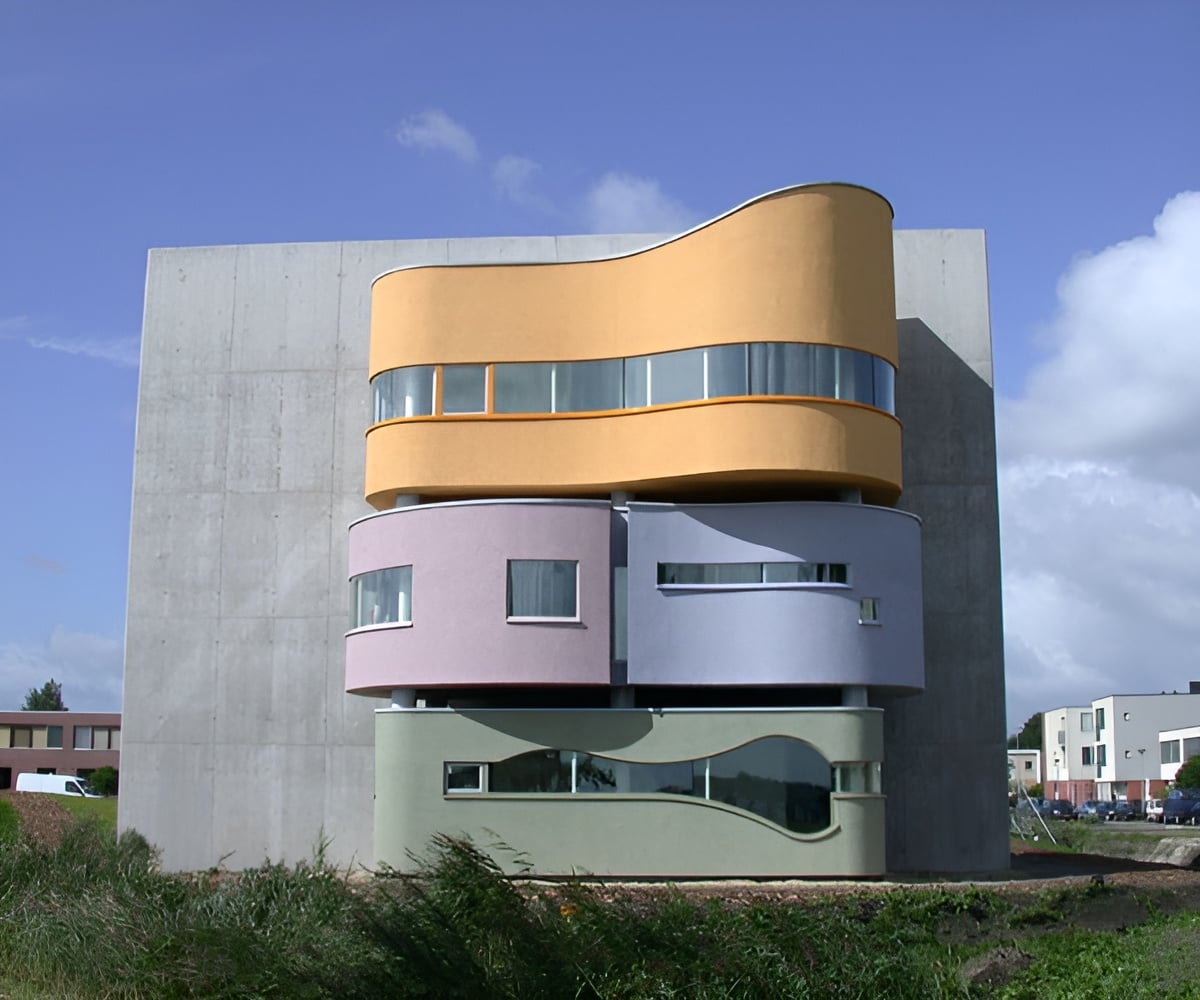
Wall House 2, a residential building designed by John Hejduk and realized by Thomas Müller / Ivan Raimann Architekten and Otonomo Architecten in Groningen, Netherlands, redefined architectural relationships between space, time, and form, completed in 2001. Originally conceived between 1971 and 1973 for a site in Ridgefield, Connecticut, the project remained unbuilt for decades due to cost constraints before being constructed posthumously in a different cultural and geographic context. The design is organized around a dominant freestanding concrete wall that separates and connects living spaces and circulation. Curvilinear volumes containing bedroom, dining, and living functions are stacked vertically and positioned adjacent to the wall, while a long corridor and study extend along a horizontal axis. The wall operates as a symbolic threshold rather than a structural support, with volumes carried by a column grid. Movement through the house requires crossing the wall, reinforcing the concept of transition between conditions. Materials include reinforced concrete, steel framing, wood, and stucco, expressing a contrast between solid and lightweight elements. The project draws from influences including Le Corbusier, Cubism, and Surrealism, translating two-dimensional composition into built form. Wall House 2 remains a critical work in late twentieth-century architecture, demonstrating the persistence of conceptual design across time, authorship, and context.

Wall House 2, also known as the A. E. Bye House stands in Groningen, Netherlands, as one of the few realized works of John Hejduk. Designed between 1971 and 1973 for landscape architect A. E. Bye, the project was originally intended for Ridgefield, Connecticut. High construction costs prevented its realization, and the design remained unbuilt for nearly three decades.

The project was eventually revived in the Netherlands through the efforts of local planners and cultural initiatives. Construction began shortly after Hejduk’s death in 2000 and was completed in 2001. Thomas Müller / Ivan Raimann Architekten and Otonomo Architecten developed the project for execution, adapting the original drawings to contemporary building standards while maintaining the conceptual framework.
 Wall House 2 / John Hejduk, Thomas Muller/van Raimann Architekten & Otonomo Architecten | Classics on Architecture Lab 61
  Wall House 2 / John Hejduk, Thomas Muller/van Raimann Architekten & Otonomo Architecten | Classics on Architecture Lab 62
  Wall House 2 / John Hejduk, Thomas Muller/van Raimann Architekten & Otonomo Architecten | Classics on Architecture Lab 63
  Wall House 2 / John Hejduk, Thomas Muller/van Raimann Architekten & Otonomo Architecten | Classics on Architecture Lab 64
  Wall House 2 / John Hejduk, Thomas Muller/van Raimann Architekten & Otonomo Architecten | Classics on Architecture Lab 65
  Wall House 2 / John Hejduk, Thomas Muller/van Raimann Architekten & Otonomo Architecten | Classics on Architecture Lab 66
  Wall House 2 / John Hejduk, Thomas Muller/van Raimann Architekten & Otonomo Architecten | Classics on Architecture Lab 67
  Wall House 2 / John Hejduk, Thomas Muller/van Raimann Architekten & Otonomo Architecten | Classics on Architecture Lab 68
The house is organized around a large freestanding concrete wall that defines the project. This element, approximately 14 meters high and 18.5 meters long, establishes both a physical and conceptual boundary. Rather than enclosing space, the wall acts as a point of passage, separating living areas from circulation while linking them through movement.

Spatial organization departs from conventional domestic arrangements. Functional volumes are isolated and expressed as distinct forms rather than contained within a single envelope. Curvilinear rooms housing the bedroom, dining space, and living area are stacked vertically on one side of the wall, while a corridor extends horizontally to a separate study. Access between spaces requires crossing the wall, reinforcing the sequence of movement and transition.
 Wall House 2 / John Hejduk, Thomas Muller/van Raimann Architekten & Otonomo Architecten | Classics on Architecture Lab 69
  Wall House 2 / John Hejduk, Thomas Muller/van Raimann Architekten & Otonomo Architecten | Classics on Architecture Lab 70
  Wall House 2 / John Hejduk, Thomas Muller/van Raimann Architekten & Otonomo Architecten | Classics on Architecture Lab 71
  Wall House 2 / John Hejduk, Thomas Muller/van Raimann Architekten & Otonomo Architecten | Classics on Architecture Lab 72
  Wall House 2 / John Hejduk, Thomas Muller/van Raimann Architekten & Otonomo Architecten | Classics on Architecture Lab 73
  Wall House 2 / John Hejduk, Thomas Muller/van Raimann Architekten & Otonomo Architecten | Classics on Architecture Lab 74
The structural system clarifies the distinction between symbol and support. Although the volumes appear to cantilever from the wall, they are supported by a grid of columns. The wall remains a non-structural element, emphasizing its role as a conceptual device rather than a load-bearing component. A glazed connection between the wall and volumes reinforces this separation.
 Wall House 2 / John Hejduk, Thomas Muller/van Raimann Architekten & Otonomo Architecten | Classics on Architecture Lab 75
  Wall House 2 / John Hejduk, Thomas Muller/van Raimann Architekten & Otonomo Architecten | Classics on Architecture Lab 76
Material choices reflect this duality. Reinforced concrete defines the wall and columns, while the corridor is constructed with a steel frame, wood stud walls, and a stucco exterior. Color is used to distinguish volumes, with muted tones that recall references to modernist precedents while maintaining individual identity for each space.
 Wall House 2 / John Hejduk, Thomas Muller/van Raimann Architekten & Otonomo Architecten | Classics on Architecture Lab 77
  Wall House 2 / John Hejduk, Thomas Muller/van Raimann Architekten & Otonomo Architecten | Classics on Architecture Lab 78
The project draws from multiple influences. References to Le Corbusier appear in the treatment of form and color, while the composition reflects principles associated with Cubist painting and Surrealist objects. Hejduk approached the house as an exploration of architectural “first principles,” translating abstract ideas into spatial sequences.

Wall House 2 extends beyond its role as a residence. The building has been used as a cultural venue, incorporating public access and artist-in-residence programs that engage with its conceptual framework. This continued use reinforces the project’s position as both an architectural work and a theoretical statement.
 Wall House 2 / John Hejduk, Thomas Muller/van Raimann Architekten & Otonomo Architecten | Classics on Architecture Lab 79
  Wall House 2 / John Hejduk, Thomas Muller/van Raimann Architekten & Otonomo Architecten | Classics on Architecture Lab 80
  Wall House 2 / John Hejduk, Thomas Muller/van Raimann Architekten & Otonomo Architecten | Classics on Architecture Lab 81
Wall House 2 demonstrates how an architectural idea can persist across time and context. Its realization decades after its conception, and after the architect’s death, positions the building as a rare example of a project that maintains conceptual integrity while adapting to new conditions.

Project Gallery
 © Liao Yusheng © Liao Yusheng © Liao Yusheng Wall House 2 / John Hejduk, Thomas Muller/van Raimann Architekten & Otonomo Architecten | Classics on Architecture Lab 82 © gorlinarchitects.com
  © Liao Yusheng
  © gorlinarchitects.com
  © Wenkbrauwalbatros © gorlinarchitects.com
  © gorlinarchitects.com
  Wall House 2 / John Hejduk, Thomas Muller/van Raimann Architekten & Otonomo Architecten | Classics on Architecture Lab 83 © Liao Yusheng
  © Liao Yusheng Wall House 2 / John Hejduk, Thomas Muller/van Raimann Architekten & Otonomo Architecten | Classics on Architecture Lab 84
  © Liao Yusheng
  © Liao Yusheng
  Wall House 2 / John Hejduk, Thomas Muller/van Raimann Architekten & Otonomo Architecten | Classics on Architecture Lab 85 © Liao Yusheng
  © Liao Yusheng © Liao Yusheng
  © Liao Yusheng
  © Liao Yusheng © Liao Yusheng © Liao Yusheng © Liao Yusheng © Liao Yusheng © Liao Yusheng
  © Liao Yusheng
  © Liao Yusheng © Liao Yusheng
  © Liao Yusheng © John Hejduk, Thomas Muller/van Raimann Architekten & Otonomo Architecten © John Hejduk, Thomas Muller/van Raimann Architekten & Otonomo Architecten © John Hejduk, Thomas Muller/van Raimann Architekten & Otonomo Architecten © John Hejduk, Thomas Muller/van Raimann Architekten & Otonomo Architecten © John Hejduk, Thomas Muller/van Raimann Architekten & Otonomo Architecten © John Hejduk, Thomas Muller/van Raimann Architekten & Otonomo Architecten © John Hejduk, Thomas Muller/van Raimann Architekten & Otonomo Architecten © John Hejduk, Thomas Muller/van Raimann Architekten & Otonomo Architecten
Project Location
Address: A.J. Lutulistraat 17, 9728 WT Groningen, Netherlands
Location is for general reference and may represent a city or country, not necessarily a precise address.