
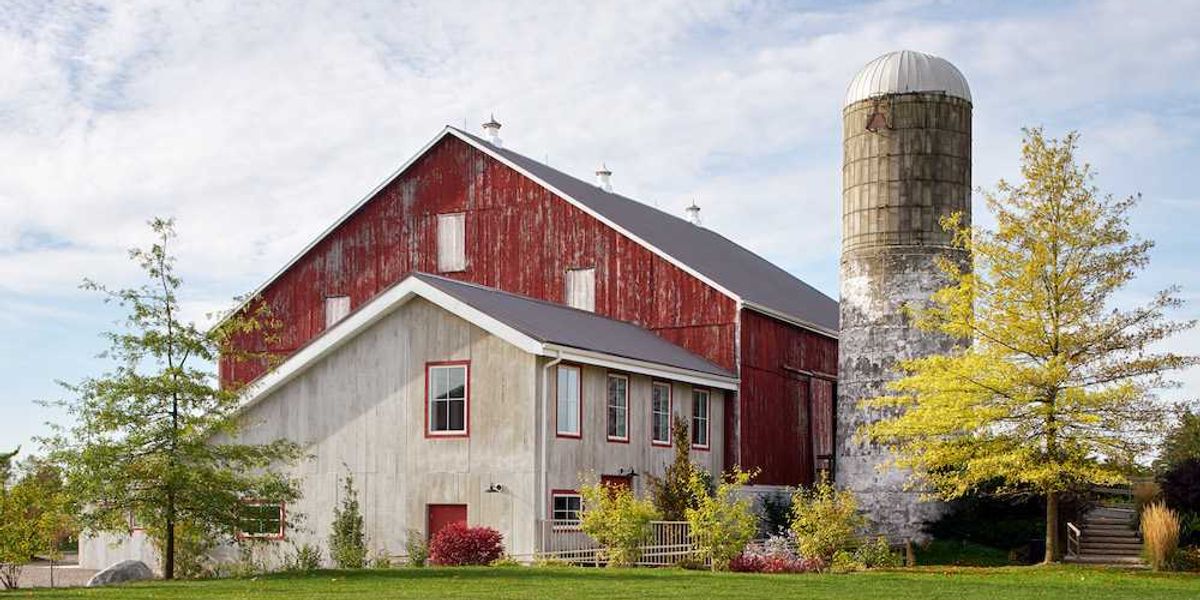
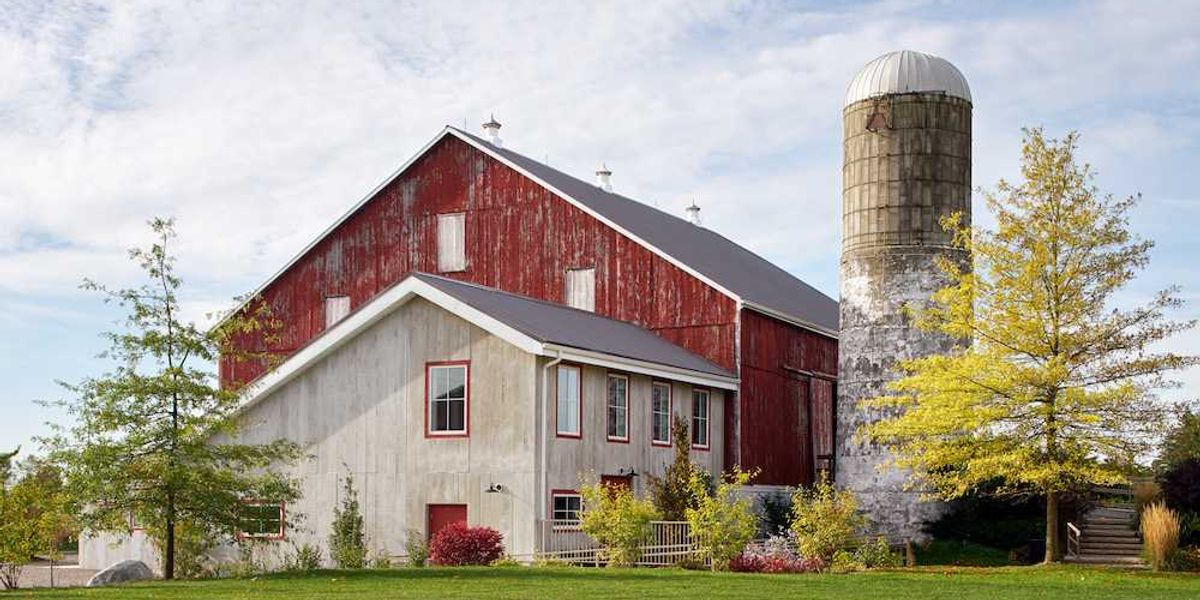
When the Williamses hosted a family wedding at their Cambium Farms property in 2011, they weren’t thinking about adaptive reuse or rural tourism, but the event ended up being pivotal, setting in motion a years-long transformation that would expand the farm’s use well beyond agriculture.
“Facebook had come around, so pictures of the wedding were online, and people were asking to rent the space out. We thought, maybe this is a business opportunity,” says Colin Williams, who has been Cambium Farms’ President since 2013.
Prior to that point, the 50-acre property was cash cropped, and although the bulk of that land is still farmed to this day, Cambium’s foray into event hosting has allowed the family to extend the barn’s story, which dates back to the mid-1800s, in a way that makes sense for this point in time.
“It’s always been a special place for us, and now we’ve been able to preserve this really special building that’s close to 200 years old,” says Williams. “A lot of people have never been to a farm or been inside a barn, and the looks on their face[s] when they walk in and see how beautiful it is, and the architecture — that’s really neat to see.”
In 2013, the Williamses began hosting the odd event at Cambium, and in 2017, they brought on ERA Architects to modernize the property and help establish it as a full-scale venue. ERA coordinated renovations to the historic barn alongside the addition of two new amenity buildings, using salvaged wood siding, floorboards, and beams to mirror the structure’s original material palette. Today, you can book the property’s hallmark, high-ceilinged red barn and its temperature-controlled byre for weddings, while the more intimate Carriage House is available for corporate and private functions.
Cambium Farms in Caledon
Cambium Farms in Caledon
Cambium Farms is one of several rural properties ERA has helped transform in recent years. The firm has also worked on the adaptive reuse of GoodLot Farmstead Brewing Co. in Caledon (now a solar-powered brewery and tasting room), The Brighthouse Farm in Wellington (now a 100-person multi-purpose event space), Wilda Farmhouse in Picton (a revitalized space that now produces natural spritzer), and Two Blokes Cider near Port Perry (more on that later). Shelley Ludman, an associate with ERA, notes that they have more projects like these in the pipeline.
“It’s really the idea of unlocking the potential of these sites to allow for their future,” explains Ludman. “Over the years, we’ve developed a very deep understanding of the farmstead typology, and the makeup of those sites. There’s always a barn, there’s often a silo, there’s surrounding landscape — and I think at the root of a lot of our work is understanding the components, how they relate to each other… and how all of that can be reimagined.”
The demand for this type of adaptive reuse accelerated after the pandemic, as more Canadians began travelling locally, she adds. “Canadians aren’t leaving, they’re exploring their own backyards, and that has fuelled a lot of the projects we’re working on right now.”
Across Ontario, farm owners are increasingly diversifying their properties, transforming historic barns, silos, and outbuildings into wineries, cideries, hospitality businesses, and event venues. While some of these operations fall under the umbrella of agritourism, others are part of a broader shift toward what planners call “on-farm diversified uses” (OFDUs) — commercial activities that generate new revenue streams while preserving existing agricultural buildings and landscapes. OFDUs were introduced in the Provincial Planning Statement for 2024, and are one of three permitted categories of use when it comes to Ontario’s prime agricultural areas.
This is one of the ways the Province is addressing the mounting pressures facing Ontario’s farming sector, including shrinking profits, rising operating costs, labour shortages, weather volatility, and the increasing value of rural land itself. The strain is also generational. Statistics Canada data has consistently shown that the country’s farm workers are aging, while fewer younger people are entering the industry due to high land costs and thin profit margins. Against that backdrop, Ontario has lost roughly 2.8 million acres of farmland over the last 35 years, according to the Ontario Farmland Trust.
Two Blokes Cider near Port Perry
“Farming is in crisis — like, massive, massive crisis — for a whole range of reasons. [OFDUs] are not a panacea, but it’s another arrow in the quiver,” says Matthew Somerville, who is a senior heritage planner with the City of Pickering. He’s also a fifth-generation farmer who saw, first-hand, how unforgiving the sector can be, especially for small and medium-sized operations. When mad cow disease hit Ontario in the early 2000s, it devastated his family’s calf operation on their 120-acre farm just north of Port Perry.
“So we sold the entire herd, and the barn went silent,” he says. “At the same time, I was seeing barns collapsing around Toronto, and understanding that the technology is changing within agriculture and that there was no clear future for the farm. I started thinking, is our family property just going to end up like another one of these properties that’s abandoned with a falling-down barn and a sad house?”
Taking a cue from the UK’s craft cider boom at the time, Somerville and his partner launched Two Blokes Cider on his family farm in 2015. Today, the cidery operates out of a repurposed five-bay pole barn overlooking the property’s century-old apple orchard, and has been used to host art shows, Pride events, and Wassail, an annual winter festival centred around blessing the orchard.
“The whole idea was to build a culture of engagement around agriculture across multiple seasons,” says Somerville. “And to link people. […] We’ve lost churches and we’ve lost community centres, and there’s an inability for us to have these hubs to come together as a community, so for me, one of the biggest things around our business was trying to recreate that.”
Demand for these kinds of direct-to-consumer experiences in Ontario is strong — Williams reveals that Cambium’s event spaces are booked every weekend between May and November, and typically a year and a half out — but it’s not as simple as recognizing the opportunity and running with it. For one, these types of ventures are pricy. Estimates provided to STOREYS by Cambium indicate approximately $500,000-$600,000 spent on consultant fees, $250,000 on development charges, $400,000 on infrastructure, and $3,000,000 on the physical retrofit and expansion of the barn (to date).
They can also be overwhelmingly complicated from a planning standpoint. “A lot of these properties are zoned rural agricultural land, and some of them have an allowable percentage of diversified uses on that land, but some of them do not,” says Ludman. “And so a lot of these projects start with a fairly lengthy, laborious rezoning, official plan amendment process.”
But an even bigger barrier is how unfamiliar municipalities are with this nature of land reuse. Somerville spent years pushing for an official plan and zoning by-law amendment package adopted in the Township of Scugog at the end of last year, which is designed to make the entitlement process more straightforward for farmers to establish on-farm diversified uses. But it’s still awaiting approval in other parts of Durham Region and is one of the first of its kind in Ontario.
Rendering of Thornbury Acres/Castlepoint Numa, NAK Design
Thornbury Acres site plan/Castlepoint Numa, NAK Design
Traditional farming has been a foundational pillar of Ontario’s economy for hundreds of years, and it makes sense for there to be growing pains when rethinking how we treat agricultural land. But there’s a strong case for regions and municipalities to embrace a more progressive approach — the cost of inaction will be the loss of even more farmland, and fundamental changes to who controls it.
“There’s a larger trend happening across rural Ontario where farms are getting larger. The average farm size in Ontario right now is 250 acres, across Canada it’s 500 acres, and we’re seeing [Ontario’s] number trend towards the national median,” explains Harley Valentine, partner at Castlepoint Numa. “What’s happening is private equity is moving into the space in response to the geo-international economy and the demand for Canadian agricultural production. Investment is following that, and that’s consolidating land and really removing the family farm from rural Ontario.”
Castlepoint is behind Thornbury Acres, a farm cooperative coming to The Blue Mountains that will incorporate 31 homesteads with a shared agricultural operation. The project spent several years tied up at the Ontario Land Tribunal before securing approvals earlier this year, with some naysayers arguing that the residential component, which is backed by a draft plan of condominium and will be structured much like a condominium corporation, is an affront to traditional agricultural.
But Valentine claps back, underscoring that the model is ultimately about preserving the “character, culture, and tradition” of agricultural production. “We see it as an opportunity to kind of replace what’s being lost through this cooperative, shared approach, where resources are pooled and land is allocated… which really dials back to the birth of agriculture in a lot of ways,” he says.
More broadly, Valentine says he expects that what we’re seeing today with projects like Thornbury Acres, Two Blokes Cider, and Cambium Farms — those that aim to tie farmland to people in a more intentional, innovative way — is just the beginning of a new and promising age for Ontario agriculture.
“There’s huge potential to expand the character and opportunities within our rural lands across this province. I think the biggest bottleneck, of course, is going to be permissions,” he adds. “Those permissions are in place to protect farmland, and that’s where the debate and the crux of the of the challenge lies.”