
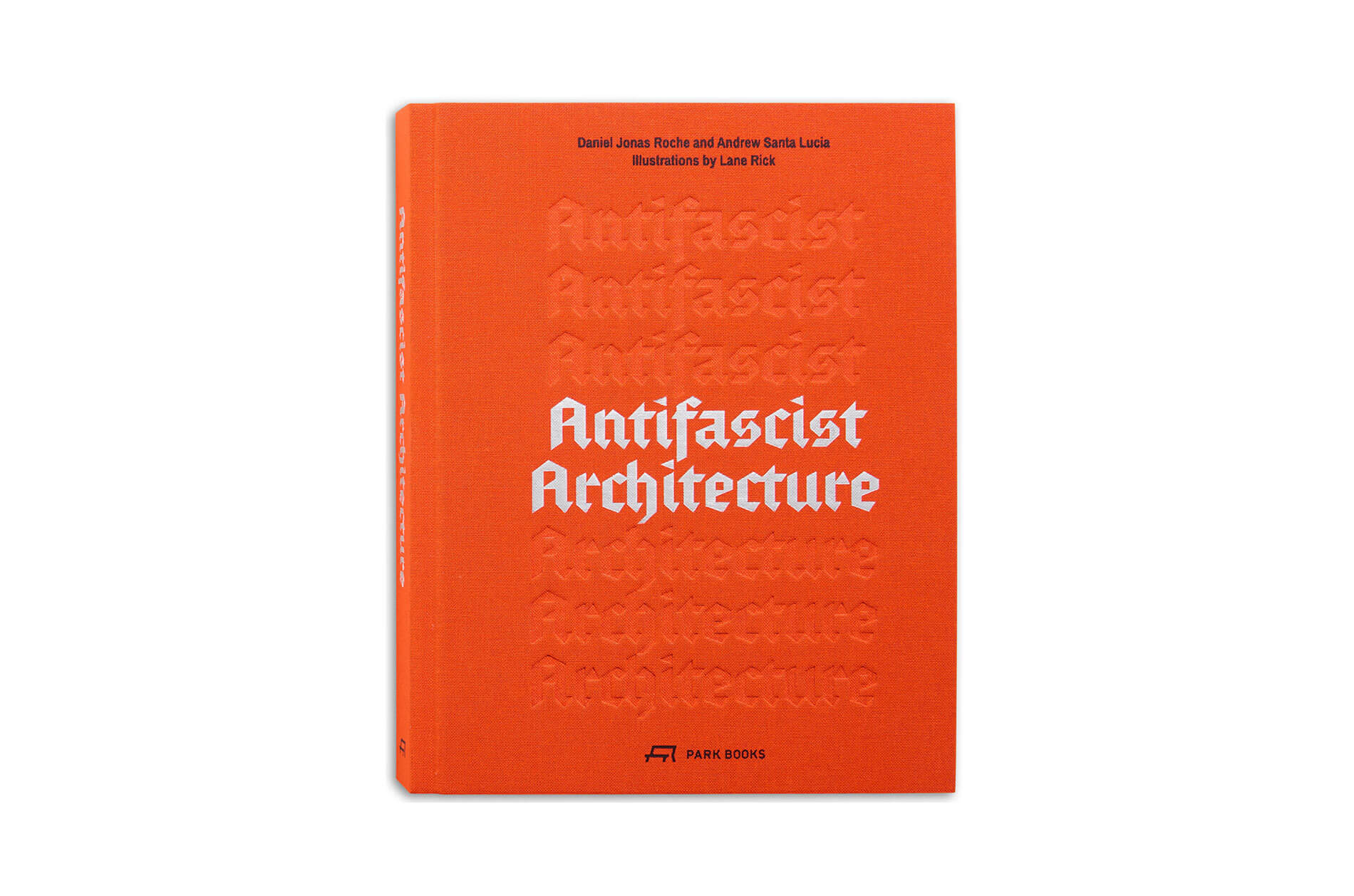

Antifascist Architectureby Andrew Santa Lucia, Daniel Jonas Roche, Lane Rick | Park Books | $40
It’s a popular time to be antifascist. For Antifascist Architecture authors Daniel Jonas Roche, a news editor at The Architect’s Newspaper, and Andrew Santa Lucia, an architecture professor at Portland State University, the point of antifascist architecture is not just to survive the moment of creeping authoritarianism that we’re in but to define architecture’s role as a vehicle for attaining utopian world communism through the historical process of anarchist socialism. It’s a rosy portrait that comes with a reminder: “In late neoliberalism (and late fascism), we must remember that total human liberation is not only a just cause, but also the most rational one.” Clearly, this is not a manual for what architecture should do next week.
At its core, Antifascist Architecture is a sweeping call to reanchor architecture within simple human values. This might seem common enough; however, there’s a growing awareness that the buildings that fill our skylines simply aren’t for us—or for anyone. Manhattan’s largely empty, pencil-thin towers cosplay at human habitation but are actually real-estate ROI generators for the transnational global elite. And elsewhere, AI data centers don’t even bother to pretend to be for human beings. The book offers a searingly critical analysis of how the built environment has been reshaped to augment conditions of scarcity.
 Karl Marx Hof, a social housing complex in Austria, is a site of antifascist armed resistance. (Lane Rick)
Fascism is defined as a violently expansionist and dictatorial ideology that seeks to collapse the division between public and private spheres. The book defuses arguments from centrists and reactionaries that posit that privatized, promarket economics are not linked to fascism, quoting Mussolini in the ideology’s founding documents: “Fascism should more appropriately be called Corporatism, because it is a merger of state and corporate power.” Thus, capitalism and commodity have degraded humanity and architectural expression, and this critique places us firmly in the orbit of Karl Marx and Manfredo Tafuri, where architecture is wholly subservient to the forces of political economy that generate it and is explicitly political.
The book’s three-part structure begins by articulating the theoretical basis for antifascist architecture, followed by case studies of antifascist architecture and architects, and concludes with examinations of how to apply these precedents in the world. Along the way, the analysis digs at critical questions of aesthetic moralism and how a counterhegemonic architecture can function at all. These might read as grand, imperious, and utopian ideas, but the book gains a beautiful measure of humility and intimacy with the illustrations of Lane Rick, who depicts antifascist architects and their buildings in quavering yet dignified red pen strokes.
 Casa del Portuale in Naples, Italy, served as a social building for harbor workers and a hub for union organizing. (Lane Rick)
  The book profiles tactical and reactive architectures of political movements, like the Black Panther Party’s networks of free breakfast hubs and medical clinics. (Lane Rick)
New Pedagogies
The antifascist architecture depicted in these drawings has no common style or materiality. A social mission and grounding in revolutionary struggle are the price of entry. There is an obvious focus on architecture commissioned by leftist governments, as well as on instances of the tactical and reactive architectures of political movements, like the Black Panther Party’s networks of free breakfast hubs and medical clinics, where architects were only tangentially involved at most.
‘); AdButler.ads.push({handler: function(opt){ AdButler.register(175624, 356702, [300,250], ‘placement_356702_’+opt.place, opt); }, opt: { place: plc356702++, keywords: abkw, domain: ‘servedbyadbutler.com’, click:’CLICK_MACRO_PLACEHOLDER’ }}); ]]>
Acts of refusal and negation are to be expected from something called antifascist architecture. For example, OS Cangaceiros, a group of radical anarchist agitators in France, took to curb-stomping architects designing prisons and sabotaging project construction. More conventional examples include Karl Marx Hoff, the social housing complex in Austria, a site of antifascist armed resistance; the work of Yugoslavia’s Svetlana Kana Radevic, who designed antifascist monuments; and the Rashad Al-Shawa Cultural Center in Gaza, since leveled by Israel Defense Forces bombs. Decolonial architects like Abderrahmane Bouchama in Algeria, who designed mass housing developments and a bathhouse used for subversive revolutionary planning also get their due.
 An illustration shows Rashad Al-Shawa Cultural Center in Gaza, Palestine, after it was bombed by the Israel Defense Forces. (Lane Rick)
The fact that the architects profiled are not widely taught is pedagogical malpractice, especially at a moment when the affordability and housing crises are creating public demand for more radical design and policy changes from their architectural successors. What emerges is a clear and inspirational survey, and these lessons are powerful guardrails against the nihilism and hopelessness that comes from not knowing the history and victories of past struggles. But it could go much further. How did the underlying political orientation of these buildings determine granular design choices, in program, material, and detail? To what extent did the clients, designers, and builders see themselves as part of a unified antifascist front? How did architects have to make their design visions subservient to broader goals of communal liberation? Roche and Santa Lucia are probably best prepared to tell the rest of this story.
Blurred Lines
The authors take a hard and sometimes arbitrary line with the explicitly fascist architecture that has supplanted this canon-in-waiting. Their analysis takes issue with academic examinations and appreciation of architecture conceived by fascists and built for them (Giuseppe Terragni first and foremost), equating the formal expression of the building directly with its political alignment at the time of construction, arriving at a leftist species of aesthetic moralism. Here, aesthetic condemnation must arrive with moral condemnation. But within the proper moral framework (fascism is bad and any building that helps fascists do fascism is a plague), the same connections between ideology and form that the authors crave to understand from antifascist architecture persist in fascist architecture and can be instructive.
 Gabriela Mistral Center is celebrated as a paragon of antifascist architecture. (Lane Rick)
Political structures and how they appropriate buildings change over time, and the book’s moralism doesn’t leave enough space for this dialectic. Take the Gabriela Mistral Center—constructed in Chile under Salvador Allende’s democratic socialist government, which is celebrated as a paragon of antifascist architecture. But nine years after its completion, and eight years after Allende was toppled by the CIA in a right-wing coup, dictator Augusto Pinochet converted it into a headquarters for his security apparatus goons. Like Terrangi’s work, here, the origin point seems to be more important than whatever followed. In a liberated, antifascist future, the reverse process would seem to be more common; icons of class- and race-based hierarchy are reappropriated as elements of the people’s city. But would the stigma of fascism still cloud these places, discouraging analysis of their formal qualities? That would seem to be a loss for antifascist architecture at a moment when it would become architecture’s only important project.
So what will the antifascist architecture of the future look like? The authors call for a spirit of non-market-defined maximalism—a condition of postscarcity formal abundance that doesn’t have to prove itself as a commodity. This is in no way prescriptive, which highlights a necessary limitation in defining any new ideological foundation for architecture that we can’t yet experience in full—namely, that any honest appraisal is not going to offer clear guidance on specific formal characteristics.
‘); AdButler.ads.push({handler: function(opt){ AdButler.register(175624, 356702, [300,250], ‘placement_356702_’+opt.place, opt); }, opt: { place: plc356702++, keywords: abkw, domain: ‘servedbyadbutler.com’, click:’CLICK_MACRO_PLACEHOLDER’ }}); ]]>
“Really the only limitation to imagining antifascist architecture will be the limits of our human creativity,” the authors write. “(That is to say, these authors do not worry about what antifascist architecture should look like, which is admittedly ironic for a manifesto.)” They go on to write that an antifascist architecture “would have to look like any act of survival, meaning it must first respond to concrete needs created by some form of state violence or inaction.” In short, antifascist architecture is literally whatever gets people fed and sheltered or brings them moments of joy, rest, care, and solidarity.
The Business of Architecture
Making this happen in the real world, Roche and Santa Lucia argue, means operating outside of state power in a counterhegemonic project that’s certain to be ignored, derided, and starved of funding by the client class. This means adapting the practices of socialist anarchism and mutual aid to architecture, as there is no state apparatus or sizable actor in the market that’s both willing and able to build for this purpose.
The anarchist strain of socialism is often a marginal presence in the factionalist quarrels that can consume the left, but Roche and Santa Lucia deserve credit for its application here. Because architecture is so thoroughly implicated in the political economy that has brought us to this crisis, the cost of wrenching it free will be great and will result in destabilization and dissolution that breaks down the practice of architecture to its most fundamental parts. What’s left might simply be networks of people organizing the resources they have on hand to meet the most urgent needs of their communities: a practice of mutual aid. As such, some of the least overtly “architectural” projects (like the ABC No Rio squatter space given over to mutual aid by Manhattan’s Lower East Side punks) begin to look like the most viable ways to reinvent architecture along antifascist lines.
 Svetlana Kana Radević designed antifascist monuments. (Lane Rick)
For architects, participating in an antifascist architecture might seem like a list of stuff they’re being guilted into giving up: prestige gained from fulfilling the desires of the capitalist client class, traditions of craft that separate designers from their messy publics, and the comfortable resolution of design problems into a beautiful object. But if this seems to impose its own shaming moral austerity, it’s notable that Roche and Santa Lucia make their case on the basis of established architectural theory (Jameson, Tafuri, etc.). This is not a manifesto spray-painted on a wall, though that choice of medium might have been a better way to bring the legion of (fictional) antifa supersoldiers to their book tour. Ultimately, the means and methods here are conciliatory to the discipline.
Roche and Santa Lucia paint a portrait of architecture not as a specialized set of expertise but as a spatial practice integrated with the full spectrum of human activity and creativity. Architecture here becomes akin to baking bread. It is an extremely important thing to do that lots of people can do, and some people can do it exceptionally well. In neither case is this achievement considered particularly exceptional. That may sound liberating to some or lowering to others. Either way, the dissolution and reformation architects experience will be the product of forces far beyond the profession itself. One suspects Roche and Santa Lucia are just fine with that.
Zach Mortice is a Chicago-based design journalist and critic who focuses on the intersection of design and public policy.
This post contains affiliate links. AN may have a commission if you make a purchase through these links.