

Architects: Skidmore, Owings & Merrill (SOM), Gordon Bunshaft, Natalie de Blois
Area: 26,903 m² (289,584 ft²)
Year: 1952
Photography: SOM, Lever House Art Collection, Lucas Blair Simpson, Ezra Stoller | Esto, Florian Holzherr, Columbia University, Elisa.rolle, Beyond My Ken, Irene A. Banks, Seth Tisue, Osvaldo valdes 165443, Epicgenius, H. Grobe
Engineers: Jaros, Baum & Bolles, Weiskopf & Pickworth
Interior Design: Raymond Loewy Associates
Contractor: George A. Fuller Construction Company
Restoration: Skidmore, Owings & Merrill (SOM)
Renovation Collaborators: Marmol Radziner, Reed Hilderbrand, Integrated Conservation Resources (ICR), Higgins Quasebarth & Partners
Client: Lever Brothers Company (Unilever)
City: New York
Country: United States
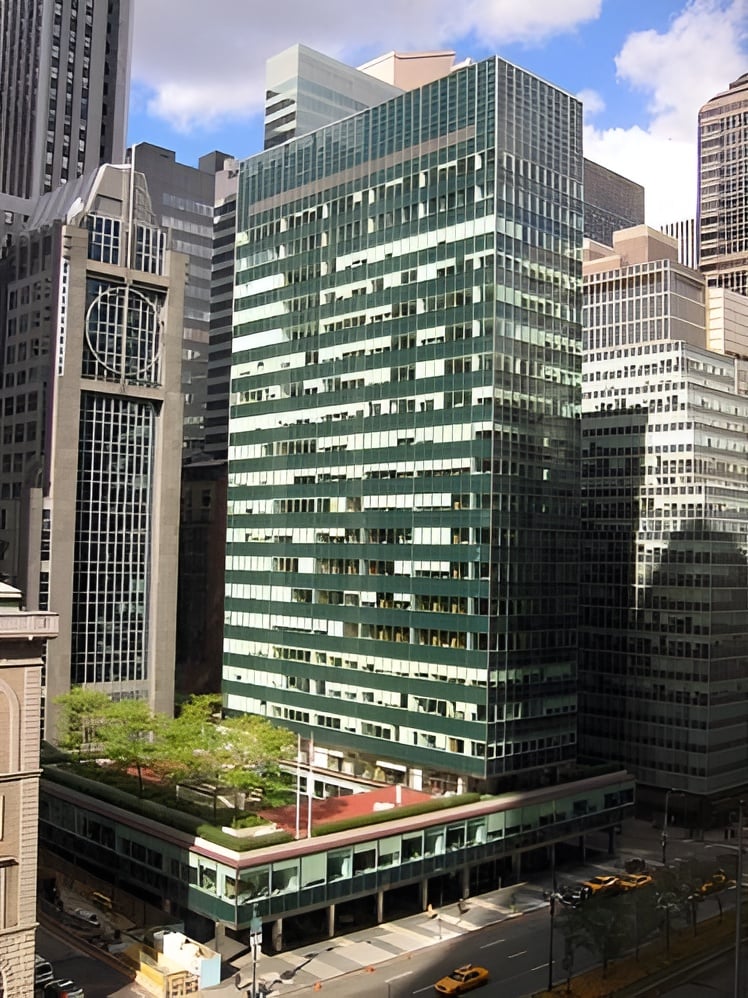
Lever House office building designed by Skidmore, Owings & Merrill in New York has redefined postwar corporate architecture through its glass curtain wall system, slab tower composition, and integration of public plaza space, completed in 1952. Lever House introduced the International Style to the American skyscraper by replacing masonry construction with a steel frame and continuous glass envelope that emphasizes transparency, efficiency, and corporate identity. Lever House organizes a horizontal base elevated on pilotis and a narrow vertical slab occupying approximately one quarter of the site, responding to the 1916 Zoning Resolution while maximizing daylight access and reducing perceived mass. Lever House distributes program across public and private zones, including a ground-level plaza with exhibition spaces, a large second-floor corporate level, terrace and cafeteria at the third floor, and office floors above capped by mechanical levels. Lever House uses a sealed curtain wall composed of heat-absorbing blue-green glass, stainless steel mullions, and opaque spandrel panels that conceal structure and services while maintaining a continuous facade. Lever House integrates centralized air-conditioning, ventilation systems, and a rooftop gondola for facade maintenance, supporting performance and operational efficiency. Lever House influenced the transformation of Park Avenue into a corridor of modernist office towers and established a global prototype for glass skyscrapers, shaping corporate architecture, zoning strategies, and urban development in the second half of the twentieth century.

Lever House, designed by Skidmore, Owings & Merrill under Gordon Bunshaft with Natalie de Blois, established a new model for the American office tower by translating principles of European modernism into a corporate and urban context. Completed in 1952 as the headquarters for Lever Brothers, the project replaced masonry construction with a steel frame and glass curtain wall, redefining both the image and performance of commercial architecture in the United States.
 Lever House / SOM | Classics on Architecture Lab 85
  Lever House / SOM | Classics on Architecture Lab 86
The building organizes two interrelated volumes that respond directly to zoning, light, and urban conditions. A horizontal base spans the site and is elevated on pilotis, releasing the ground plane for a public plaza. Above it, a narrow slab tower rises from the northern portion of the plot, occupying roughly one quarter of the site. This configuration follows the 1916 Zoning Resolution, which allowed unlimited height when limited site coverage was maintained. The slab measures approximately 53 feet (16 meters) in width along Park Avenue, ensuring that all office spaces remain within proximity to natural light while reducing the perceived mass of the building in the city.
 Lever House / SOM | Classics on Architecture Lab 87
  Lever House / SOM | Classics on Architecture Lab 88
The ground level operates as a transitional urban field rather than a conventional lobby condition. A terrazzo-paved plaza incorporates a planted courtyard and reflecting pool, while stainless steel-clad columns support the volume above and reinforce the perception of a suspended structure. Enclosed elements at this level contain display areas, a waiting space, and an auditorium, reflecting the building’s dual role as workplace and corporate exhibition. The plaza functions as a privately owned public space, a model later replicated across Midtown, and remains subject to controlled public access.
 Lever House / SOM | Classics on Architecture Lab 89
  Lever House / SOM | Classics on Architecture Lab 90
  Lever House / SOM | Classics on Architecture Lab 91
  Lever House / SOM | Classics on Architecture Lab 92
  Lever House / SOM | Classics on Architecture Lab 93
  Lever House / SOM | Classics on Architecture Lab 94
Above, the second floor forms the largest continuous plate, accommodating shared corporate functions such as employee lounges, medical facilities, and administrative spaces. The third floor integrates a terrace and cafeteria, extending activity outward and establishing a visual and spatial connection with the city. The slab above contains office floors organized in shallow depths, allowing daylight penetration across workspaces. A penthouse level and a triple-height mechanical zone terminate the tower, expressed externally as an opaque cap contrasting with the transparent curtain wall below.
 Lever House / SOM | Classics on Architecture Lab 95
  Lever House / SOM | Classics on Architecture Lab 96
  Lever House / SOM | Classics on Architecture Lab 97
  Lever House / SOM | Classics on Architecture Lab 98
  Lever House / SOM | Classics on Architecture Lab 99
  Lever House / SOM | Classics on Architecture Lab 100
The curtain wall defines the building’s architectural and technical identity. Heat-absorbing blue-green glass panels are fixed within a system of stainless steel mullions, forming one of the earliest fully glazed facades in a New York high-rise. Vision glass and opaque spandrel panels are organized in a continuous grid, with the latter concealing structural elements and mechanical systems behind dark backing surfaces. The facade is completely sealed, eliminating operable windows to prevent the infiltration of dust and to stabilize interior climate conditions. Ventilation and air-conditioning are integrated through mechanical systems distributed beneath the window line, supporting a controlled indoor environment.

Performance and maintenance were central to the design. The curtain wall reduced solar gain while maintaining visual clarity, and a rooftop gondola system running along embedded tracks enabled systematic cleaning of the facade. This mechanism, among the first of its kind, aligned with the corporate identity of Lever Brothers, reinforcing associations with cleanliness and efficiency. Economic considerations informed these decisions, as reduced maintenance and controlled climate conditions offset higher initial construction costs.

The structural system consists of a steel frame with reinforced concrete floor plates supported by cellular beams and transverse bracing. Cantilevered sections extend beyond column lines, contributing to the slab’s thin profile. A centralized service core consolidates elevators, mechanical systems, and vertical circulation, allowing flexible office layouts along the perimeter. Interior columns divide space into asymmetrical bays, supporting adaptable planning strategies.

Interior organization reflects both functional and social considerations of the period. Office floors were designed with modular layouts, controlled climate, and integrated services, while finishes and color schemes were calibrated to create a consistent working environment. The building originally functioned as a single-tenant headquarters, reinforcing its role as a unified corporate entity rather than a speculative multi-tenant structure.
 Lever House / SOM | Classics on Architecture Lab 101
  Lever House / SOM | Classics on Architecture Lab 102
  Lever House / SOM | Classics on Architecture Lab 103
Material limitations of early curtain wall technology led to long-term performance issues. Water infiltration and corrosion of embedded steel components caused deformation of mullions and failure of glass panels. By the late twentieth century, most original glazing had been replaced. A comprehensive restoration completed in 2001 reconstructed the facade using updated materials and concealed systems while maintaining the original appearance. A subsequent renovation completed in 2023 introduced new mechanical systems, restored interior and exterior spaces, and adapted the building for contemporary office use, including shared amenities and upgraded environmental performance.
 Lever House / SOM | Classics on Architecture Lab 104
  Lever House / SOM | Classics on Architecture Lab 105
  Lever House / SOM | Classics on Architecture Lab 106
  Lever House / SOM | Classics on Architecture Lab 107
  Lever House / SOM | Classics on Architecture Lab 108
Lever House played a decisive role in reshaping Park Avenue. The introduction of a plaza and slab tower replaced continuous masonry street walls with open space and light, establishing a new urban model. The project influenced a generation of office buildings, including nearby developments and international examples that adopted similar curtain wall systems and volumetric strategies. The building’s impact extended beyond form, contributing to changes in zoning practices, corporate identity, and the relationship between architecture and the public realm.

Lever House remains a critical reference for the integration of structure, facade technology, and urban space. The project demonstrates how regulatory constraints, technical innovation, and corporate intent can converge into a coherent architectural system that continues to inform contemporary practice.

Project Gallery
© SOM © SOM  © Ezra Stoller | Esto
  © Ezra Stoller | Esto
  © Ezra Stoller | Esto © Ezra Stoller | Esto © Ezra Stoller | Esto © Ezra Stoller | Esto
  © Ezra Stoller | Esto © Ezra Stoller | Esto
  © Ezra Stoller | Esto © Ezra Stoller | Esto © Ezra Stoller | Esto © SOM © SOM
  © Columbia University
  © Ezra Stoller | Esto
  © Ezra Stoller | Esto
  © Ezra Stoller | Esto
  © H. Grobe © Lucas Blair Simpson © SOM / Lucas Blair Simpson © Elisa.rolle
  © Beyond My Ken
  © Florian Holzherr © SOM © SOM © Lucas Blair Simpson
  © SOM
© SOM  © Seth Tisue
  © Epicgenius
  © Lucas Blair Simpson
  © Florian Holzherr
  © Florian Holzherr © Irene A. Banks © SOM / Lucas Blair Simpson © Epicgenius
  © Florian Holzherr © Epicgenius © Epicgenius
  © SOM / Lucas Blair Simpson
  © Florian Holzherr © Florian Holzherr © SOM © Osvaldo valdes 165443 © SOM / Lucas Blair Simpson © SOM / Lucas Blair Simpson © SOM / Lucas Blair Simpson
  © Lever House Art Collection
  © Columbia University
  © Columbia University
  © SOM
© SOM  © SOM
© SOM  © SOM
© SOM  © SOM
© SOM  © SOM
© SOM  © SOM
© SOM  © SOM © SOM © SOM
Project Location
Address: 390 Park Avenue, Midtown Manhattan, New York, NY 10022, United States
Location is for general reference and may represent a city or country, not necessarily a precise address.