

Architects: John Lautner
Area: 205 m² (2,200 ft²)
Year: 1960
Photography: John Lautner, Julius Shulman, Sara Sackner, Ted VanCleave, Bobak Ha’Eri, CDernbach, Wikimedia Commons, WikiArquitectura, architecture-history.org, trianglemodernisthouses.com, laplaces.blogspot.org
Restoration Architect: Frank Escher
Client: Leonard Malin
City: Los Angeles
Country: United States
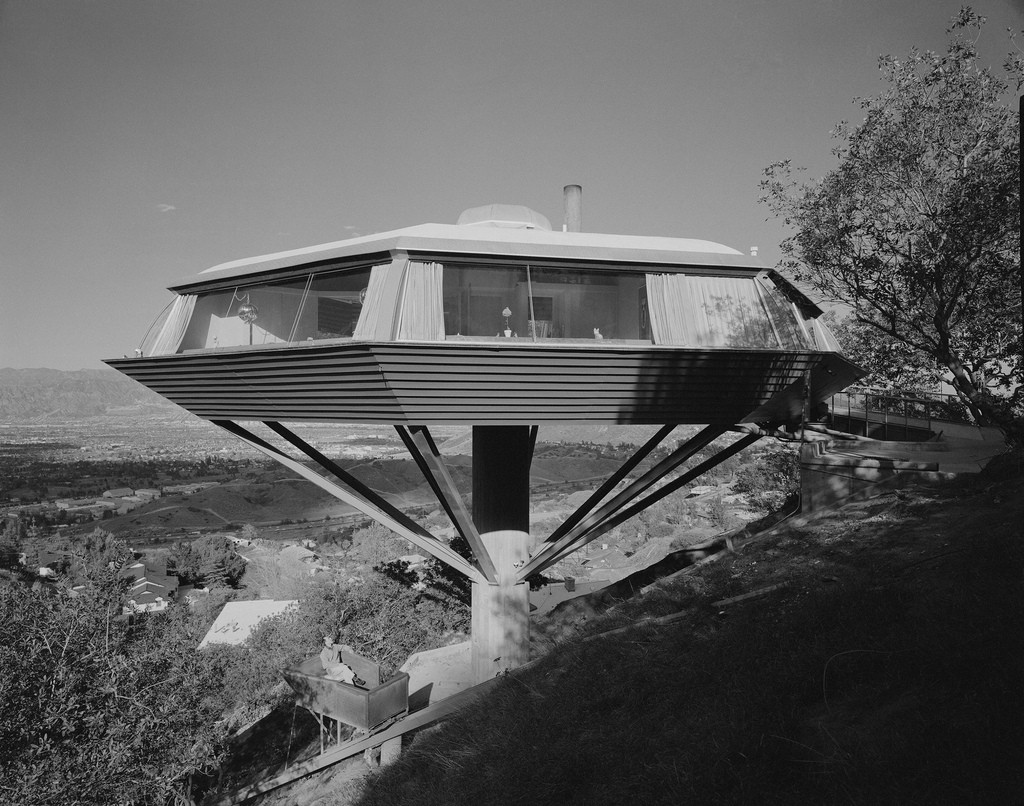
Malin Residence (Chemosphere), a residential building designed by John Lautner in Los Angeles, has redefined hillside housing by integrating structure, form, and site constraints into a single elevated system, completed in 1960. The residence, commissioned by aerospace engineer Leonard Malin, responds to a 45-degree slope by lifting an octagonal living volume on a single concrete column, avoiding conventional excavation and retaining walls. The project advances structural design through a central support and radiating steel elements that stabilize the floor while maintaining a column-free interior. The house organizes a program across a single level, separating public and private zones while maintaining continuous perimeter glazing. Circulation begins at a carport and extends through a funicular and bridge connection, reinforcing the separation between ground and dwelling. Material strategy combines concrete, steel, and laminated timber to address seismic conditions and reduce structural load. The design incorporates a central rooflight that introduces daylight into the core of the plan. The residence expresses structure directly through its elevated form, where engineering and architectural identity converge. Malin Residence has influenced experimental residential design by demonstrating how structural innovation can resolve extreme site conditions while preserving landscape continuity.

Malin Residence occupies a steep hillside site in Los Angeles, where conventional construction methods required either extensive excavation or a distributed structural frame. The project concentrates the load into a single vertical support, preserving the terrain and minimizing ground intervention.
 Malin “Chemosphere” Residence / John Lautner | Classics on Architecture Lab 78
  Malin “Chemosphere” Residence / John Lautner | Classics on Architecture Lab 79 Malin “Chemosphere” Residence / John Lautner | Classics on Architecture Lab 80
  Malin “Chemosphere” Residence / John Lautner | Classics on Architecture Lab 81
  Malin “Chemosphere” Residence / John Lautner | Classics on Architecture Lab 82
  Malin “Chemosphere” Residence / John Lautner | Classics on Architecture Lab 83
The structural system defines the building’s form. A single concrete column supports the house, while steel struts extend outward to carry the floor. The roof is supported independently by curved laminated timber beams organized around a compression ring, allowing the interior to remain free of columns.
 Malin “Chemosphere” Residence / John Lautner | Classics on Architecture Lab 84
  Malin “Chemosphere” Residence / John Lautner | Classics on Architecture Lab 85
  Malin “Chemosphere” Residence / John Lautner | Classics on Architecture Lab 86
  Malin “Chemosphere” Residence / John Lautner | Classics on Architecture Lab 87
  Malin “Chemosphere” Residence / John Lautner | Classics on Architecture Lab 88
  Malin “Chemosphere” Residence / John Lautner | Classics on Architecture Lab 89
The plan is organized within an octagonal geometry. Public functions, including living, dining, and kitchen, occupy one side, while bedrooms and service spaces are arranged on the opposite side, facing the slope. A central fireplace and seating area sit beneath a circular rooflight that introduces daylight into the deepest part of the plan.
 Malin “Chemosphere” Residence / John Lautner | Classics on Architecture Lab 90
  Malin “Chemosphere” Residence / John Lautner | Classics on Architecture Lab 91 Malin “Chemosphere” Residence / John Lautner | Classics on Architecture Lab 92
  Malin “Chemosphere” Residence / John Lautner | Classics on Architecture Lab 93
  Malin “Chemosphere” Residence / John Lautner | Classics on Architecture Lab 94
  Malin “Chemosphere” Residence / John Lautner | Classics on Architecture Lab 95
Access reinforces the elevated condition. Entry begins at a carport below the structure, followed by a funicular ascent and a narrow bridge leading to the main entrance. This sequence separates the dwelling from the ground and emphasizes the suspended character of the building.

Material selection responds to structural and environmental conditions. Concrete forms the central support, while steel and laminated timber define the superstructure. The system has demonstrated durability under seismic activity and severe weather.
 Malin “Chemosphere” Residence / John Lautner | Classics on Architecture Lab 96
  Malin “Chemosphere” Residence / John Lautner | Classics on Architecture Lab 97
  Malin “Chemosphere” Residence / John Lautner | Classics on Architecture Lab 98
The façade is defined by continuous perimeter glazing, establishing visual continuity with the surrounding landscape. Openings extend along the edge of the structure, including views beneath the house toward the carport.
 Malin “Chemosphere” Residence / John Lautner | Classics on Architecture Lab 99
  Malin “Chemosphere” Residence / John Lautner | Classics on Architecture Lab 100
  Malin “Chemosphere” Residence / John Lautner | Classics on Architecture Lab 101
Malin Residence remains a reference in modern residential architecture, where structural clarity, site response, and spatial organization are resolved through a single formal system.

Project Gallery
© architecture-history.org © architecture-history.org © architecture-history.org © Julius Shulman  © WikiArquitectura © architecture-history.org © WikiArquitectura
  © WikiArquitectura
  © architecture-history.org
  © Ted VanCleave
  © architecture-history.org
  © architecture-history.org © laplaces.blogspot.org
  © Sara Sackner
  © architecture-history.org
  © WikiArquitectura © Bobak Ha’Eri / Wikimedia Commons
  © architecture-history.org
  © architecture-history.org © Ted VanCleave © CDernbach / Wikimedia Commons © John Lautner
  © WikiArquitectura © WikiArquitectura © WikiArquitectura
  © architecture-history.org © WikiArquitectura © John Lautner © John Lautner
  © architecture-history.org
  © WikiArquitectura
  © architecture-history.org © architecture-history.org © architecture-history.org © WikiArquitectura
  © trianglemodernisthouses.com
  © architecture-history.org © WikiArquitectura
  © architecture-history.org © architecture-history.org
  © trianglemodernisthouses.com
  © WikiArquitectura
  © architecture-history.org © John Lautner
  © John Lautner
  © John Lautner
  © John Lautner
  © John Lautner © John Lautner
  © John Lautner Foundation
  © John Lautner
  © John Lautner Foundation © John Lautner Foundation
Project Location
Address: 7776 Torreyson Drive, Los Angeles, California 90046, United States
Location is for general reference and may represent a city or country, not necessarily a precise address.